

The Employer of Record (EOR) industry is evolving fast — and technology is driving that evolution. As businesses expand into new markets and demand more flexible workforce solutions, EORs are under pressure to deliver accurate payroll, seamless onboarding, and regulatory compliance — all without slowing down operations.
That’s where technology partnerships come in.
Integrating with payroll and HR tech vendors has become more than just an efficiency upgrade — it’s now a strategic growth driver for EORs. These partnerships enable providers to automate complex back-office tasks, reduce compliance risks, and deliver a smoother experience for clients and workers alike.
💡 EORs leveraging HR and payroll integrations report up to 40% faster onboarding and 25% higher client retention rates.
Why EORs Need Tech-Driven Collaboration
EORs operate in a world of complexity. They manage multiple client and worker contracts, employees, diverse tax rules, and changing local labor regulations. Doing all this manually or with disconnected systems often leads to inefficiencies — and worse, compliance gaps.
Standalone EOR systems, while functional, often struggle with:
- Manual workflows that slow down service delivery
- Fragmented employee and payroll data
- Lack of real-time financial visibility
To overcome these challenges, EORs are increasingly partnering with payroll processors, HRIS platforms, and back-office automation vendors.
These collaborations solve some of the toughest operational problems:
- Cross-border payroll compliance: Automated payroll APIs ensure local tax laws are applied correctly in every region.
- Real-time data sync: Integrated HR and finance systems keep payroll, attendance, and benefits perfectly aligned.
- Reduced administrative overhead: Manual data entry and repetitive approval processes are replaced by intelligent automation.
For example: An EOR without integrated payroll tools often faces delayed salary disbursements, inconsistent tax filings, and missed compliance deadlines — all of which erode client trust and contract renewals.
Key Areas Where Payroll & HR Tech Partnerships Add Value
1. Integrated Payroll Processing
Instead of operating payroll as a standalone function, EORs gain a competitive advantage when payroll is fully integrated with HR, timesheets, attendance, and compliance systems.
Through payroll integrations with HR tech and EOR platforms, employee data flows automatically across systems — eliminating manual uploads, reducing errors, and ensuring every payroll run aligns with local tax laws and contract terms.
This level of integration enables:
- Accurate salary calculations across multiple clients and workers
- Automatic application of deductions, benefits, and statutory filings
- Real-time visibility on payroll funding and client retainer balances
- Easy approval and payment flow for clients.
The result is faster, error-free payroll cycles, improved compliance, and greater trust from clients who expect accuracy.
2. Unified Employee Data
When sales, HR and payroll systems share the same data stream, EORs gain a single source of truth across sales, HR, finance, and compliance.
No more manual uploads or conflicting records — instead, EORs can generate real-time insights, track performance, and improve reporting transparency. This builds stronger trust with clients who expect accurate, on-demand workforce data.
3. Scalable Onboarding and Offboarding
Through HR integrations, EORs can automate onboarding workflows — from collecting KYC documents to assigning payroll IDs. Offboarding processes, such as exit documentation or final settlements, can also be triggered automatically.
This efficiency means faster onboarding for new client projects and quicker revenue recognition.
4. Advanced Analytics & Client Reporting
Integrated payroll back office and HR technology can also unlock data-driven decision-making.
EORs can now provide clients with advanced analytics detailing:
- Cost distribution by region or project
- Worker attendance and compliance trends
These insights not only demonstrate value but also strengthen client retention by showcasing operational transparency.
How Tech Vendors Translate into Client Contract Growth
When operations run smoothly, clients notice. Payroll and HR tech vendors directly impact EOR growth metrics in several ways:
- Improved efficiency → Better client satisfaction → More renewals
- Faster scaling for new client contracts
With connected HR and payroll systems, EORs can onboard new clients and their employees quickly without rebuilding workflows from scratch for each project. - Geographic expansion: Integration with HR and back-office systems that handle local compliance allows EORs to confidently enter new markets.
- Modular service offerings: EORs can tailor offerings (e.g., payroll-only or full HR integration) based on client size and budget.
Example scenario: An EOR using PHRBO can easily configure leave and severance policy rules that automatically govern worker management and invoicing — enabling the EOR to scale services across multiple states without needing manual intervention.
The Role of EOR Software Platforms in Enabling Seamless Integrations
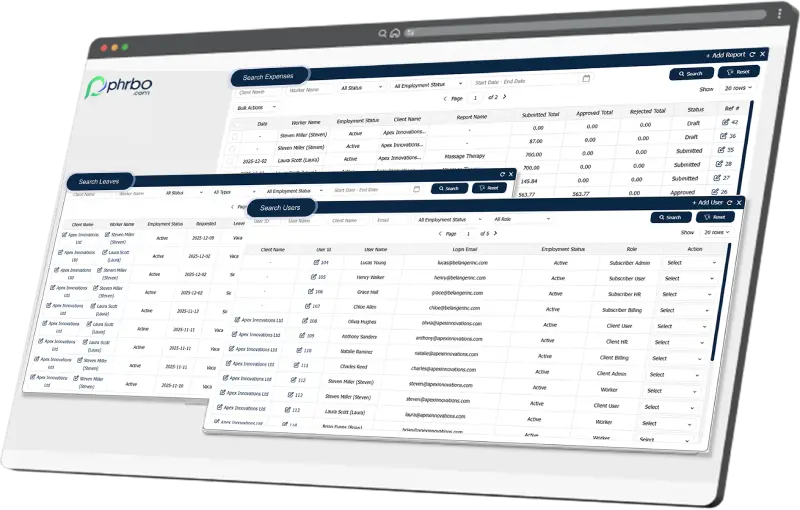
Modern EOR platforms like PHRBO are designed with integration in mind. They provide the backbone for connecting multiple payroll and HR systems through secure APIs and automated data pipelines.
Benefits for EORs include:
- Centralized client management: Manage all client contracts, workers, and billing in one place.
- Automated invoicing and reporting: Eliminate manual reconciliation with end-to-end data automation.
- Open APIs for partner collaboration: Seamlessly connect with HRIS, payroll, and compliance tools.
In essence, choosing the right EOR tech stack isn’t just a technology decision — it’s a strategic investment in scalability, efficiency, and client trust.
How to Build Strategic Payroll & HR Tech Partnerships
If you’re an EOR aiming to scale, technology partnerships must be evaluated not just from an operational perspective — but also from a financial one. Here’s how to structure partnerships the right way:
1. Identify operationally and commercially aligned partners
Look for payroll or HR tech vendors whose capabilities match your service model and whose pricing structure fits your growth plans — whether that’s per-employee-per-month (PEPM), subscription-based, or revenue-sharing.
2. Evaluate integration and cost readiness
Before signing contracts, EORs should assess:
- API and tech compatibility
- Data security and compliance certifications
- Integration costs (setup fees, engineering hours, maintenance)
- Ongoing vendor charges for payroll runs, filings, or employee records
3. Define financial terms clearly
Partnerships often involve commercial agreements like:
- Volume-based pricing (discounts as the number of employees increases)
- Minimum billing commitments for access to payroll or HR services
- Revenue-sharing or referral incentives if both parties exchange clients
- Understanding these upfront prevents margin erosion later.
4. Build a sustainable pricing model for clients
Once vendor costs are clear, EORs can structure their own pricing to protect profitability — for example:
- Passing costs transparently as a line item
- Bundling vendor fees into premium service tiers
- Charging extra for integrated HRIS/payroll modules
5. Use integrations as a competitive differentiator
Once financially and technically aligned, highlight these integrations within proposals and demos to justify pricing and improve win rates — especially for enterprise clients who expect a connected system.
Pro Tip: Before launching the partnership, run financial scenarios like:
- “What is the cost per employee if we onboard 100, 500, or 1,000 employees?”
- “At what point does this partnership become profitable?”
This ensures the collaboration supports growth without damaging margins.
Conclusion: The Future of Partnership-Driven EOR Growth
As the EOR landscape becomes increasingly competitive, success will depend on how well providers connect technology ecosystems. Payroll and HR tech partnerships don’t just streamline internal operations — they directly drive client growth, retention, and expansion.
The next generation of EORs will win by offering connected, automated ecosystems, not isolated services.
