

Most EOR businesses plateau somewhere between 20 and 40 clients. Operators at that inflection point share a common diagnosis: they built their book of business on competitive pricing, and now they’re watching clients leave at the 18-month mark to platforms that bundle more services, integrate deeper into client workflows, and charge more for the privilege.
The churn isn’t a sales problem. It’s a service architecture problem.
The EOR operators who scale past $5M ARR, and hold onto clients at year two, three, and four, have made deliberate decisions about which services to offer, how to sequence them, and how to design their operations so that expansion revenue happens naturally rather than through hard selling. This article maps exactly that: which services retain clients, which create upsell pathways, and which build the structural switching costs that make leaving genuinely costly.
Why EOR Client Churn Happens After Year One (And What It’s Really Telling You)
EOR clients rarely tell you they’re leaving before they’ve already decided to leave. They don’t escalate or complaints. They open a quiet evaluation of your competitors while your account manager is sending monthly check-in emails.
The trigger is almost always operational, not commercial. A payroll exception that went unresolved for three weeks. An invoice dispute that closed without a formal resolution. A compliance question about a new hire country that got answered with a two-line email and no follow-up. These aren’t dramatic failures, they’re micro-erosions of what the client is actually buying, which is compliance confidence.
Compliance confidence is the real product in this industry. When a company hires through an EOR in Germany or Singapore or Brazil, they’re paying to not worry about statutory filings, misclassification risk, and payroll accuracy in jurisdictions they don’t understand. The moment they start to wonder whether the EOR actually has that handled, whether the invoice they received matches what they expected, whether the payroll exception flagged last month was actually fixed, the relationship starts degrading.
Commoditisation pressure from Deel, Remote, and Rippling is real, but it’s rarely the primary cause of churn. Clients leave for price plus friction. When a client is happy with the service, price sensitivity drops sharply. When a client is already frustrated with operational gaps, a competitor’s pricing conversation lands differently.
The operational question for EOR operators isn’t how to win price comparisons, it’s how to build a service layer that keeps compliance confidence high enough that price comparisons never become serious.
The Service Stack That Separates Scalable EOR Operations from Commodity Providers
Not all EOR services have the same strategic value. Some are entry requirements. Few create stickiness. Some generate expansion revenue. Treating them as a flat list,a menu of services you offer, is one of the structural mistakes that keeps operators from scaling.
Table Stakes Services (What Every EOR Must Get Right)
Gross-to-net payroll accuracy, statutory filings, and in-country compliance aren’t differentiators. They’re the floor. Operators who treat these as selling points are competing on the wrong dimension, they’re selling clients on basic competence rather than strategic value.
A single payroll inaccuracy per quarter is enough to open the door to competitive evaluation at a sophisticated client. That’s not an exaggeration, it’s the reality of the trust dynamics in a service where the entire value proposition rests on operational reliability.
Stickiness Services (What Makes Clients Operationally Dependent)
Stickiness services are the ones that embed the EOR into a client’s daily workflows. Real-time payroll visibility dashboards, multi-country payroll summaries, employer-of-record compliance alerts, and end-to-end employee lifecycle management, from onboarding documentation through offboarding checklists, all reduce the client’s administrative surface area in ways they feel every week.
The practical effect: when a client’s HR team is running onboarding checklists through your platform, and their finance team is pulling invoice reconciliation data from your portal, switching to a competitor isn’t just a commercial decision, it’s an operational migration. The switching cost becomes structural, not contractual.
Expansion Services (What Drives Revenue Growth Per Client)
Clients who hire through an EOR in one country expand to two, three, or four countries within 18 months at a rate that consistently surprises operators who haven’t designed for it. Multi-country payroll expansion is the single highest-probability upsell event in EOR, and operators who haven’t built a process around flagging and converting it are leaving meaningful revenue on the table. Other expansion services that belong in a structured service tier: FX billing reconciliation and multi-currency invoicing as premium service offerings, benefits administration for distributed international teams, equity and RSU support for pre-IPO companies, and contractor-to-FTE conversion services for clients managing parallel contractor populations.
Cross-Border Payroll Accuracy as a Retention Lever, Not Just a Compliance Requirement
Payroll accuracy is not a back-office metric. It’s a client relationship metric.
An EOR operation running above a 1–2% payroll error rate is sending a clear signal to clients, even if no one says it out loud: this operation is manual-heavy and unscalable. Clients in the companies-of-record buying persona, typically a CFO or VP Finance on one side and a Head of People on the other, have seen what bad payroll operations look like. They know the difference between a vendor that surfaces exceptions proactively and one that makes them dig.
The strategic move is to make accuracy visible. That means exception reporting distributed before client invoices are issued, not after. It means reconciliation summaries that show PO matching rates, FX rate application transparency, and billing cycle adherence, not just a monthly invoice that the client has to reverse-engineer. Invoice reconciliation discipline ties directly to trust at the finance stakeholder level, and finance stakeholders are often the ones who green-light renewal conversations.
Operators who bring payroll accuracy metrics into quarterly business reviews, proactively, not defensively, retain clients at meaningfully higher rates than those who only surface accuracy data when something goes wrong. The QBR is the mechanism. Payroll accuracy is the content that transforms it from a relationship check-in into an operational review that demonstrates operational maturity.
Compliance Management as a Competitive Moat
Most EOR operators treat compliance as a cost centre, a necessary operational overhead that they absorb in service delivery. The operators who scale treat it as a service differentiator and price accordingly.
Permanent Establishment Risk as a Client Education Opportunity
The majority of EOR clients don’t think about permanent establishment risk until it’s already a problem. A company hiring a remote employee in Germany or a contractor in France rarely has internal legal counsel who tracks PE thresholds, activity triggers, or treaty positions. That’s the opening.
EOR operators who proactively brief clients on PE risk, tied to specific hiring decisions, country expansions, and contractor conversion events, position themselves as strategic partners rather than payroll vendors. A PE risk briefing at the point of a new country hire costs the EOR 30 minutes of structured analysis. The value it signals to the client is disproportionate: this operator understands our exposure, not just our headcount.
That repositioning matters commercially. Clients who see their EOR as legal and compliance infrastructure, not a commodity staffing vendor, are significantly less price-sensitive at renewal.
Worker Classification and the Contractor-to-FTE Pipeline
Clients who maintain contractor populations in parallel to their EOR-managed employees are carrying misclassification risk they often haven’t quantified. For the EOR, this is both a retention opportunity and an expansion funnel.
A formalised contractor audit service, reviewing worker classification against local labour law thresholds, flagging exposure, and providing a conversion roadmap, creates compliance value for the client and a natural conversion pipeline for the EOR. Each contractor converted to an FTE managed under the EOR agreement increases PEPM revenue without a new client acquisition. Operators who track contractor-to-FTE conversion rates as an internal KPI consistently outperform those who treat it as an ad hoc event. The pipeline is there. The question is whether you have a process to work it.
Building Upsell Pathways into Your EOR Service Architecture
Expansion revenue in EOR is not a sales motion. It’s a service design outcome. The operators who generate consistent expansion revenue have structured their service architecture so that upsell moments are natural by-products of client growth, not forced conversations.
PEPM pricing is a common structural obstacle. When clients interpret flat-rate PEPM as “all-inclusive,” every expansion service conversation starts with an expectation reset. The fix is explicit service tier design, scoped clearly in the initial contract, with defined triggers for what’s included and what’s billed at a premium tier.
The more actionable approach is to map expansion triggers in advance. New country hire. Headcount threshold crossing (5, 15, 30, 50 employees). An equity event. A contractor reclassification decision. Each of these is a natural moment to introduce a service that’s genuinely relevant, not a cold upsell, but a service recommendation that arrives at precisely the moment the client needs it.
Operators who document their upsell logic internally, which services get introduced at which triggers, with which communication templates, convert expansion revenue at two to three times the rate of those who rely on account manager instinct. Instinct doesn’t scale. Process does.
Operational Infrastructure That Scales Without Breaking Client Trust
Service architecture decisions are only as good as the operational infrastructure behind them. The operators who scale to 100+ clients under management without degrading service quality have made three infrastructure decisions correctly.
Standardising Onboarding Without Losing White-Glove Quality
Onboarding is the period of highest churn risk. Clients form their long-term perception of service quality in the first 60 days, and the impressions formed during that window are remarkably durable. An onboarding experience that feels chaotic or under-resourced sets a baseline the rest of the relationship has to work against.
Standardised onboarding playbooks, with client-facing status updates, defined milestones, and clear billing expectation-setting, don’t reduce the quality of onboarding. They improve it by eliminating the gaps that happen when onboarding is ad hoc. Invoice disputes in months two through four are almost always traceable to billing scope that wasn’t clearly communicated in the onboarding phase.
The Case for a Dedicated Client Success Function (Even at Sub-$3M ARR)
Most EOR operators at sub-$3M ARR run account management that is reactive and relationship-driven. An account manager who knows their clients, responds quickly, and escalates problems internally. That works until it doesn’t, and it stops working at roughly 25–30 clients, when the reactive model starts producing the slow service degradation that drives year-two churn.
A structured QBR cadence tied to service performance metrics, payroll accuracy rate, open exceptions, invoice cycle time, NRR by account, transforms the client relationship from vendor-managed to operator-partnership. The client stops seeing you as the company that runs their payroll and starts seeing you as the company that manages their workforce revenue operations. That’s a different commercial relationship.
Technology Integration as a Switching Cost
Integration depth is the most durable switching cost available to EOR operators. An EOR that connects into a client’s HRIS, ATS, or finance system, whether that’s BambooHR, Greenhouse, Workday, or NetSuite, becomes part of the client’s operational infrastructure. Replacing it requires not just a commercial decision but a technical migration. API-level billing and payroll data integrations are increasingly appearing as requirements in client RFPs at Series B and later companies. EOR operators who can’t satisfy that requirement are systematically excluded from the deals where retention durability is highest. Investing in integration capability isn’t just a product decision, it’s a client quality decision.
EOR vs PEO – Knowing When to Offer Both (And How to Position the Difference)
EOR and PEO are not interchangeable terms, and buyers at sophisticated companies know the difference. Employer of Record operators who conflate them lose credibility quickly with the CFOs and Head of People buyers who are comparing options seriously.
The relevant distinction for service architecture: EOR takes on employer-of-record liability in the hiring country. PEO is a co-employment model that’s typically US-domestic. A company expanding from a US headquarters frequently needs a PEO for domestic workforce management and an EOR for their international hires. The operator who can serve both sides of that equation, or who can partner credibly on one while owning the other, dramatically increases wallet share per client.
Positioning against Rippling and Deel on this dimension requires a specific framing: compliance depth and relationship quality over platform breadth. The enterprise-grade platforms win on feature coverage and brand recognition. The operators who win against them do so on specificity, they know the labour law edge cases in the countries their clients hire in, they have established relationships with in-country counsel, and they have a service team that treats compliance advisory as core to the relationship, not an add-on.
The Service Architecture Decision Is the Business Decision
Scalable EOR businesses are not built by closing more clients. They’re built by designing a service architecture that keeps existing clients operationally dependent, commercially expanding, and genuinely difficult to replace.
That means payroll accuracy infrastructure that makes compliance confidence visible. Compliance advisory positioning that reframes the EOR as legal and regulatory infrastructure. Structured upsell logic tied to natural client growth triggers. And technology integration depth that transforms the relationship from contractual retention to operational dependency.
None of these are sales decisions. They’re operational and product decisions that create the conditions where retention and expansion revenue become predictable outcomes rather than relationship-dependent variables.
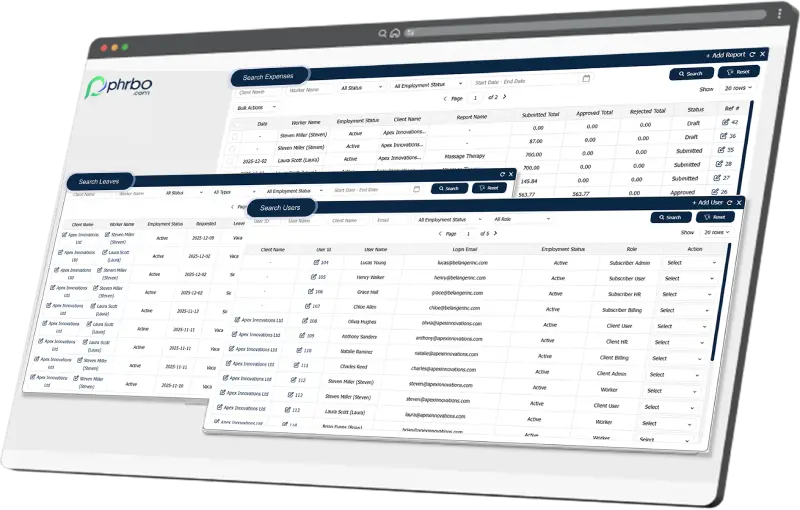
PHRBO is built for EOR operators who are making these decisions and need the operational platform to execute them, invoice reconciliation, payroll exception management, multi-currency billing, and client-facing reporting built into a single workflow layer that scales with the book of business.
Frequently Asked Questions
What is the biggest driver of EOR client churn?
Payroll inaccuracy and unresolved invoice disputes are the most consistent churn drivers, not price. Clients don’t warn you when compliance confidence starts eroding. They open a quiet evaluation of alternatives. By the time they raise a concern, they’ve often already made their decision. The operational priority is surfacing exceptions proactively and resolving them visibly, before they compound into a relationship-level problem.
How do EOR operators create expansion revenue beyond the base PEPM fee?
Multi-country payroll expansion is the primary lever, clients who hire in one country expand to two to four within 18 months at a rate that operators consistently underestimate. Beyond geographic expansion, compliance advisory tiers, FX billing services, benefits administration, and contractor reclassification programs create structured expansion pathways that operate independently of new client acquisition.
What services make an EOR business hard to leave?
Structural integration into client HR and finance workflows creates the most durable switching costs. An EOR connected to a client’s HRIS, embedded in their finance reconciliation process, and running their employee lifecycle management from onboarding through offboarding is not just contractually retained, it’s operationally embedded. The switching cost becomes a migration project, not a vendor comparison.
How should an EOR operator handle compliance management across multiple countries?
Systematic country-level monitoring with client-facing alerts turns compliance into a visible, billable service rather than a hidden cost absorbed in delivery. Operators who build automated monitoring into their compliance workflow, flagging regulatory changes, PE risk thresholds, and misclassification exposure by country, replace manual tracking that doesn’t scale and transforms compliance from a cost centre into a service differentiator.
When does an EOR need to add a dedicated client success function?
Earlier than most operators think. Reactive account management works at low client counts and starts producing the slow service degradation that drives year-two churn at roughly 25 to 30 clients. A structured QBR cadence tied to service performance metrics, payroll accuracy rate, open exceptions, invoice cycle time, shifts the relationship from vendor-managed to operator-partnership, and creates the commercial conditions where retention and expansion revenue become predictable.
Ready to strengthen your EOR business?
Partner with PHRBO to transform your foundational payroll operations and HR services into a retention-driven growth engine.
