

The Invoicing Bottleneck Nobody Warns You About
Picture this. It’s Tuesday, three days before payroll locks. Your finance team should be finalizing client invoices right now. The window to get them approved before payroll runs is closing fast.
But they’re still untangling last month’s loose ends. Two employees whose reimbursements were missed mid-cycle. One correction from a statutory rate applied wrong the previous period. One client who added headcount after the cutoff.
None of it made it into last month’s invoice cleanly. Now it has to be reconciled, manually adjusted, and folded into this month’s numbers, across 12 clients, 3 currencies, and 6 cost components per employee, before the payroll run makes everything even harder to unwind.
This is not an edge case. For most EOR providers, this is the monthly cycle.
The irony isn’t lost: EOR providers sell efficiency, compliance, and operational precision to their clients. Yet their own billing infrastructure often runs like it’s 2009, held together by spreadsheets, email chains, and heroic manual effort from finance staff who can’t take leave during payroll week.
There’s a structural reason for this. And there’s a fix. But closing that gap requires understanding exactly where the process breaks, and why it keeps getting harder as you grow.
Why EOR Invoicing Is Structurally Harder Than Standard B2B Billing
Most B2B service businesses send a relatively straightforward invoice: Team hours worked, ongoing fixed services subscription or a fixed monthly retainer with items charged against it. EOR invoicing is a different animal entirely.
It’s Not One Invoice, It’s a Matrix
A single client invoice in an EOR engagement is typically a composite of multiple cost components: base salary, employer-side statutory contributions, the EOR management fee, reimbursements, and one-off adjustments for that cycle.
One headcount change mid-cycle doesn’t just affect that employee’s line item. It cascades into multiple adjustments across pro-rata calculations, contribution thresholds, and fee structures. Multiply this by your entire client base, and the complexity isn’t additive, it’s exponential.
Multi-country clients amplify this further. Each jurisdiction introduces its own contribution rates, statutory timelines, and employer obligations. A client with employees in Singapore, the UAE, and Canada isn’t three times the work, it’s a different billing universe for each.
Data Sits in Silos, and Someone Has to Bridge Them
In most EOR operations, payroll data lives in one system. Timesheets sit in another. Expense claims are in a third. Invoicing and fee tracking happen in a fourth, or worse, in spreadsheets that someone maintains manually every cycle.
Before a single invoice draft can be produced, finance has to pull data from each of these sources, reconcile any discrepancies, and then, only then, begin building the invoice. Research shows that 57% of invoice data still has to be manually entered from source systems, making every data handoff a potential error point.
Currency, Tax, and Compliance Add Layers of Manual Judgment
Which exchange rate applies, the rate at payroll date, invoice date, or month-end? Which source? Your client’s home currency or the entity’s functional currency? These aren’t trivial decisions; they have downstream implications for both parties’ accounting.
Then there’s jurisdiction-specific tax treatment. GST in Australia, VAT in the UK and EU, withholding tax considerations across Southeast Asia, each has different rules for how it appears on an invoice and how it’s reported. What’s compliant in Canada isn’t in the United States, and getting this wrong isn’t just embarrassing. It can trigger client disputes or create audit exposure.
Approval Chains Create Their Own Drag
Before an invoice reaches a client, it typically needs internal sign-off. Then the client reviews it, and may have questions, request line-item breakdowns, or flag a discrepancy. Without a centralized system, this entire process happens via email threads and occasional WhatsApp messages, with no clear timestamp or paper trail.
Finance teams end up spending significant time on status-chasing alone: “Did you get my email?” “Has the client acknowledged this?” “Is there a payment ETA?” Nearly half of finance teams globally spend more than five full days per month just processing invoices, before follow-up and reconciliation even begin.
The Human Cost Nobody Measures
Take an honest look at your operation. How many hours does your team spend per client per invoice cycle? Five hours? Ten? Now multiply that across your client book.
That number is uncomfortable. And it’s entirely non-billable time.
It doesn’t stop at invoicing either. After the invoice goes out, someone has to track payments against it, reconcile what’s come in against what’s outstanding, and produce profitability reports. The invoice isn’t the final act in the manual drama, it’s the middle of it.
The Real Cost of Running Invoicing Manually
“We manage it manually” sounds like operational pragmatism. In reality, it’s a compounding liability with costs across four distinct dimensions.
Error Cost
Research from 2025 shows that approximately 39% of manually processed invoices contain at least one error. In standard B2B billing, an error on an invoice is an inconvenience. In EOR billing, a misapplied statutory rate or incorrect FX conversion isn’t just embarrassing, it can mean a credit note, a delayed payment, a client dispute, and potentially a compliance exposure if the rate used didn’t meet regulatory requirements.
Each correction costs time, creates friction, and introduces a moment of doubt in the client’s mind: Do these people really have their act together?
Relationship Cost
Clients who have engaged an EOR provider expect precision and reliability above almost anything else. They’re trusting you with employment compliance for their people, one of the most sensitive obligations a business carries.
A late invoice, an unexplained line item, or a month where the numbers just don’t look right sends a signal that cuts against everything your service proposition stands for. Businesses that digitise their billing workflows demonstrate responsiveness and reliability, qualities that build long-term client retention. The inverse is equally true.
The Scaling Ceiling
Manual invoicing doesn’t scale linearly. When you add 10 new clients, you’re not adding 10x the invoice work, you’re adding 10x the coordination effort, the data reconciliation points, the follow-up loops, and the approval dependencies.
Finance teams hit capacity. Timelines slip. Errors increase. The finance headcount grows, but so does the complexity per head. Eventually the ceiling isn’t about capability, it’s about the process itself.
Cash Flow Impact
Only 6% of manually processed invoices in the US are paid within 30 days, compared to 33% under automated systems. For EOR providers who front payroll on behalf of clients, this gap isn’t an accounting abstraction, it’s a real cash flow risk.
Late invoices mean late payments. Late payments mean a widening gap between payroll funded and revenue collected. At scale, that gap becomes a working capital problem.
Staff Burnout That Doesn’t Show Up in Reports
Finance staff who manage EOR billing manually can’t take leave during payroll close weeks. Leave requests get declined. The same two or three people become unavoidable single points of failure every month.
This is the kind of operational pressure that quietly drives good people out. It rarely shows up as a line item, until they’re gone and you’re absorbing the cost of replacement, retraining, and the institutional knowledge that walked out with them.
What the Fix Actually Looks Like
Rethinking EOR invoicing isn’t about working faster. It’s about rebuilding the process so that speed is the natural outcome, not the exception.
The Ideal Workflow, Mapped Out
The cleanest EOR invoice workflow follows a simple sequence: payroll close → payroll processed → automatic data pull → invoice generation → internal review → client delivery → payment tracking.
The operative principle is this: humans should only be involved in exceptions and judgment calls, not in routine execution.
That means automating everything that follows a rule, and reserving human attention for the things that genuinely require it, a dispute, a relationship conversation, a non-standard adjustment. The goal isn’t to remove your finance team. It’s to redeploy them where they’re actually needed.
What to Automate vs. What to Keep Human
This distinction matters, and it’s worth being explicit:
Automate: Data aggregation from payroll and HR systems. Rate application (management fees, statutory contributions, FX). Invoice generation by client configuration. Delivery and acknowledgement. Payment reminders by aging rule. Reconciliation matching.
Keep human: Dispute resolution. Client relationship communication. Non-standard exception approvals. Strategic pricing decisions.
This isn’t about removing judgment from the process. It’s about ensuring judgment is applied where it adds value, and not wasted on data entry.
How PHRBO’s EOR Software Compresses the Invoice Cycle
The difference between a finance team spending three days on invoicing and one spending 30 minutes comes down to whether the underlying infrastructure is built for EOR complexity, or adapted from something else.
One Source of Truth Across Payroll, HR, and Expenses
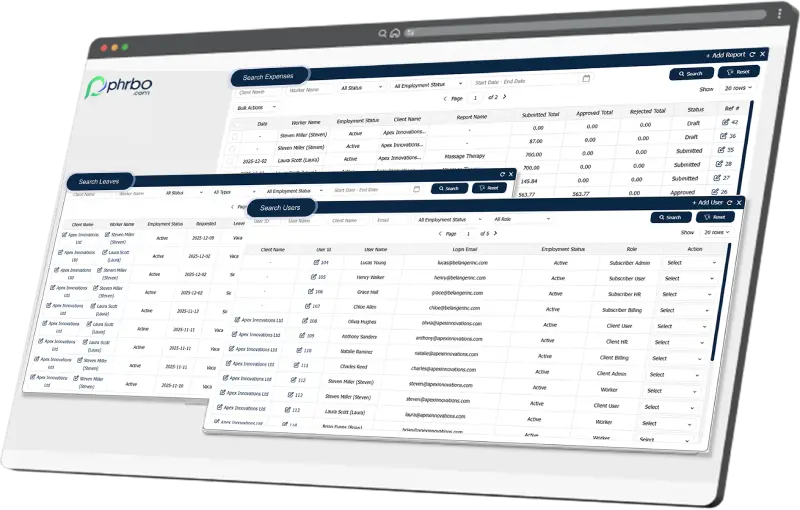
PHRBO operates as a unified Workforce Revenue Data System, connecting payroll, HR data, timesheets, and expense claims into a single pipeline. When payroll is finalized, invoice data is already populated.
There’s no “waiting for payroll to send me the numbers” problem. There’s no manual transfer between systems. The reconciliation that used to take half a day before an invoice could even be drafted simply doesn’t need to happen, because the data never diverged in the first place.
Invoice Generation That Follows Each Client’s Rules and Workers’ Agreement
Every client in PHRBO carries a configurable billing profile: their fee structure, invoice currency, applicable tax treatment, preferred invoice template, and billing cycle cadence.
When payroll closes, invoices are automatically generated according to each client’s specific configuration, not from a generic template that someone then manually adjusts. Clients with multi-entity billing requirements, one client, multiple cost centres, separate invoices, are handled natively.
This matters because EOR billing isn’t uniform. A client with employees in two jurisdictions and three different fee tiers shouldn’t require three separate manual workflows. It should require one configured profile.
Currency and Tax Compliance, Built In
FX rate application in PHRBO is configurable by client, at payroll date, invoice date, month-end close, or payment date. The rate source is defined. The logic is documented. Every calculation is traceable.
Tax logic is applied at the jurisdiction level. GST, VAT, withholding tax obligations, all handled in-system, not as a post-draft manual layer. And every rate, every rule, and every application is preserved in an audit trail that doesn’t require anyone to reconstruct what happened three months later.
Approval Workflows Without the Email Chain
PHRBO replaces the email-based approval loop with structured internal review queues. Finance leads review and approve before anything reaches the client. Role-based access ensures the right people see the right things at the right stage.
Clients access, review, and acknowledge invoices through a dedicated client-facing portal. Every action, opened, reviewed, acknowledged, is timestamped. “I never received that” and “I didn’t see the email” stop being viable explanations, because the system records exactly what happened and when.
Payment Tracking and Automated Follow-Up
Invoice status in PHRBO is visible in real time: sent, opened, acknowledged, overdue. Automated payment reminders trigger according to aging rules you configure, without anyone manually deciding when to follow up or drafting an email to do it.
When payments arrive, reconciliation matches them against outstanding invoices automatically, flagging discrepancies for human review. The payment tracking that used to consume hours of a finance team’s week becomes a daily status check of a few minutes.
The Before and After in Practice
What used to take a finance team three days, data collection from multiple systems, cross-referencing, manual formatting, email dispatch, approval follow-up, payment tracking, now closes in under 30 minutes from payroll lock.
The specific touchpoints eliminated are worth naming: manual data collection across systems, line-item cross-referencing, template formatting, email dispatch to individual clients, approval status chasing, and individual payment follow-up. None of these required judgment. All of them consumed time.
What EOR Providers Actually Get Back
The business case for automating EOR invoicing isn’t just about finance team efficiency. It has implications across your operation.
Faster cash conversion. Invoices go out the same day payroll closes. Payment cycles tighten. The gap between payroll funded and revenue collected narrows. Automated payment solutions improve cash flow visibility and reduce Days Sales Outstanding (DSO), a measurable improvement for any EOR provider fronting payroll.
Fewer client disputes. Consistent, accurate, compliant invoices, generated from the same rules every time, give clients less to question. When a line item needs explanation, the audit trail is already there.
Scalable growth without proportional headcount growth. Doubling your client base doesn’t mean doubling your finance team. The software absorbs the execution load. Your team focuses on exceptions and relationships.
Stronger client confidence. A professional, accurate, timely invoice is a trust signal. It tells your client that the same operational discipline you apply to their employment compliance, you also apply to your own business. That matters.
Audit-readiness without the scramble. Every invoice, every FX rate, every statutory contribution, every approval, logged, timestamped, and retrievable. When a client or regulator asks for documentation, you can respond in minutes, not days.
Making the Transition: What Moving from Manual to Automated Actually Involves
The most common hesitation EOR finance teams have when considering automation is this: “Our billing is too complex and customized to automate.”
This hesitation is understandable. EOR billing is genuinely complex. But complexity and configurability are different things. The right software doesn’t ask you to simplify your billing logic, it maps to your existing logic and executes it consistently.
The migration process is more structured than most expect. Client profiles are configured with existing fee structures and billing rules. A parallel run period allows the system to generate invoices alongside the manual process, so discrepancies can be identified and resolved before go-live. Existing data, employee details, salary information, payroll tax data, imports cleanly.
For most EOR providers, full operational readiness on PHRBO’s invoicing module takes two to three pay periods. Not months of implementation. Not a system overhaul. Two to three cycles to configure, validate, and transition.
Still Managing Invoices Manually?
See how leading EOR providers are cutting invoicing time by 90% using PHRBO’s automation-first workflows.
Your Invoicing Process Reflects Your Business
There’s a simple test worth applying. If a prospective client could see how your invoicing process works today, the spreadsheets, the email chains, the manual reconciliation, the three-day sprint before each payroll lock, would it strengthen or undermine their confidence in you as an EOR partner?
Clients trust EOR providers with their most sensitive obligation: their people. The internal operations that support that service need to match the standard of precision that obligation demands.
The shift from days to minutes isn’t about technology for its own sake. It’s about building a business that doesn’t depend on heroic manual effort to function, one that scales cleanly, invoices accurately, and gives your finance team their Monday mornings back.
