

You find out about the missed PILA filing in Colombia not from your own team, but from a client asking why their employee’s social security record shows a gap.
By the time your operations team has confirmed what happened, ten clients have workers with contribution gaps, penalties are accruing from the missed filing date, and affected employees are already raising discrepancies with their HR contacts. Your team is fielding ten separate client conversations simultaneously. None of them have the same answer yet.
Then Client X, one of the ten, sends a formal request. They have workers in Colombia and six other countries. They want a compliance audit trail across all seven jurisdictions within five business days. Statutory filing confirmations. Contribution records. Payroll ledger. Everything.
Your team starts pulling the records. That is when the second problem surfaces. Filing confirmations are not centralised. Two countries have no standardised confirmation format. One country’s records are six weeks behind, an issue that was never escalated. And buried in the records for one of the other six countries is a tax table that was not updated two cycles ago. The client is about to find out at the same time your team does.
The ops specialist who owns Colombia also owns two other markets. They are now unreachable for anything else.
This is not a Colombia problem. It is what happens when a single compliance failure exposes the gaps in how the entire operation is built.
The difference between single-country and multi-country payroll is not scale. It is structure.
Most EOR providers enter their second and third country the same way they entered their first, by adding capacity and extending existing processes. That approach works until it doesn’t. The failure mode is rarely visible during the expansion. It surfaces during a payroll run, or an audit request, or a client escalation that arrives before your team has the answer.
In multi-country, multi-client payroll, the problems are not bigger versions of single-country problems. They are structurally different. A compliance gap in one jurisdiction does not stay in that jurisdiction. It creates downstream exposure across clients, across countries, and across the operational assumptions your entire delivery model is built on.
This article picks up where Part 1 left off. The single-country foundations, running clean, consistent payroll for multiple clients within one jurisdiction, are assumed here. What follows is what changes when you add countries to that equation, and why the operational playbook that worked domestically is not the one that will hold at global scale.
The Complexity Matrix: How Country Count and Client Count Interact
There’s a mental model that trips up a lot of EOR operators early on. They assume that adding countries creates additive complexity, five clients in five countries means managing ten things. The reality is multiplicative.
Five clients across five countries means 25 distinct compliance contexts to track at once. Scale that to 20 clients across the same five countries and you’re managing 100. Every new jurisdiction you enter doesn’t just add a new row to your operational spreadsheet, it multiplies the existing ones.
Each country you add brings its own regulatory framework, currency and banking infrastructure, statutory calendar, in-country partner relationship, and norms around how employee data can be handled and shared. None of these slot neatly into what you already built.
What changes most dramatically compared to single-country operations is the nature of error propagation. A payroll mistake in a single-country setup is a contained problem. In a multi-country setup, a single failure point, a missed filing, an incorrect tax table, a data routing error, can cascade across clients, jurisdictions, and compliance obligations at once. This is because client relationships are now multi-jurisdictional and as in the scene painted at the beginning of this article, problems spread.
The Six Multi-Country Payroll Failures EOR Providers Rarely Talk About
These six failures don’t appear out of nowhere. Most of them trace back to decisions made under pressure: rushing to match a competitor’s country list, saying yes to a new jurisdiction on a client’s timeline rather than your own, or scaling headcount without scaling the infrastructure underneath it. Each failure is distinct, but they share a common root, the operational model didn’t evolve to match the complexity it was asked to carry.
1. Treating In-Country Partners as Extensions of Your Own Team
No two in-country partners define ‘payroll processed’ the same way. Without standardised SLA contracts, accountability gaps open up, and when something goes wrong, the EOR entity absorbs the client-facing liability regardless of who caused the error.
The fix starts with SLA frameworks that define data submission windows, error correction timelines, statutory filing confirmations, and escalation triggers. Vague partner agreements are operational risk dressed up as relationships.
2. Running Payroll Calendars Reactively Across Time Zones
Jurisdictional pay dates, public holidays, and bank settlement windows don’t align across markets. Managing them reactively means your team is always chasing the next deadline rather than working ahead of it.
Countries like Japan, the Philippines, and Brazil carry strict statutory disbursement deadlines. Missing them isn’t just an operational embarrassment — it triggers direct penalties. Reactive calendar management turns predictable events into recurring crises.
3. No Centralized Payroll Orchestration Layer
Running payroll country-by-country through siloed systems means your team has no single view of payroll status, error exposure, or compliance risk across your client portfolio. Enterprise clients will ask: ‘What’s the current payroll status for our employees across all countries?’
Without a centralised orchestration layer, you cannot answer that question in real time. That gap signals to experienced buyers that your infrastructure isn’t built for their scale.
4. Underestimating FX and Multi-Currency Settlement Risk
When clients are billed in USD or EUR but local payroll is disbursed in Brazilian reais, Philippine pesos, or Japanese yen, you’re carrying FX exposure on every single payroll run. Most EOR providers don’t have treasury or hedging frameworks to manage this.
The risk is absorbed silently, until a currency movement makes it material. By that point, the margin impact is already done. FX risk management isn’t a finance team concern; it’s a payroll operations concern.
5. Inadequate Payroll Data Segregation at the Cross-Border Level
Cross-border payroll data transfers trigger obligations under GDPR in Europe, PDPA in Thailand, PIPL in China, and data residency laws in other markets. Most payroll platforms weren’t built with these distinctions in mind.
A payroll run that routes employee data through a jurisdiction where it legally cannot reside creates regulatory exposure that can dwarf the payroll error itself. Data segregation isn’t a compliance checkbox, it’s core payroll infrastructure.
6. No Real-Time Regulatory Change Monitoring Across Markets
Tax tables, social contribution rates, leave entitlements, and minimum wages change on different schedules across 15-plus countries. Tracking this manually across a multi-country client portfolio is not sustainable at any meaningful scale.
The silent danger is compliance drift, outdated rules producing incorrect payroll month after month until an audit or employee complaint surfaces the gap. By then, the exposure has compounded. Regulatory change monitoring needs to be systematic, not reactive.
Why Multi-Country Payroll Errors Hit EOR Providers Harder Than Anyone Else
Payroll errors are costly for any business, but for EOR providers, the consequences are systematically magnified. The business model itself is the reason. By sitting between the client and the workforce, absorbing employer obligations across multiple jurisdictions, EOR providers face liability exposure in both directions simultaneously. The structure that makes EOR attractive to clients is the same structure that concentrates risk on the provider when something goes wrong.
How that risk materialises depends on how the EOR is structured.
For owned-entity EORs, the liability is statutory and direct. The EOR is the registered employer in each jurisdiction. In the Philippines, late payroll triggers mandatory DOLE penalties. Japan, wage payment must land on the contracted date, delays invite administrative guidance and, in serious cases, litigation. In Colombia, salary delays carry interest penalties and can form the basis for constructive dismissal claims. In Germany, incorrect Lohnsteuer filings generate back-tax assessments that sit with the EOR entity as legal employer. The regulator knows the EOR. The EOR wears it.
For ICP-model EORs, the exposure is contractual and operational — and in some ways harder to manage. The in-country partner holds the statutory relationship with local regulators, but the lead EOR has promised the client compliant payroll delivery. When an ICP fails, the lead EOR typically discovers it late, often after the client already has. The only remedy is contractual recovery from the ICP, which takes time, may be contested, and rarely makes the client whole fast enough to protect the relationship.
In both models, there is a downstream risk that receives less attention. Loose payroll controls can inadvertently generate evidence that the client, not the EOR, is functioning as the real employer. That co-employment risk undermines the core value proposition the EOR is selling. And most indemnification clauses will not cover statutory penalties triggered by operational failures, or the reputational damage that follows when a partner fails and there was no visibility until it was too late.
What Scalable Multi-Country, Multi-Client Payroll Infrastructure Actually Looks Like
Describing payroll infrastructure as a competitive differentiator is common. Actually building it is less so. For EOR providers operating across multiple countries and clients simultaneously, the gap between adequate and scalable is where margin erosion and reputational damage tend to originate. Scalable infrastructure is not a single investment, it is the disciplined alignment of three interdependent layers: technology, governance, and people. Each is necessary. None is sufficient on its own.
The Technology Layer
There is a common refrain in global payroll circles: consolidate onto a single platform. In principle, the logic holds, fewer integration points means fewer failure modes. In practice, truly global payroll platforms that handle the depth of local statutory compliance are still rare, and the ones that exist vary significantly in their coverage of less common jurisdictions.
Real-time payroll ledger visibility, by country, by client, by employee, replaces monthly PDF reporting packets. And AI-assisted anomaly detection, which flags statistical outliers in payroll runs before disbursement, is no longer a premium feature. It’s a baseline expectation for providers operating at scale.
The Governance Layer
Standardized SLA contracts with in-country partners need to specify error correction windows, reporting obligations, and escalation triggers, not just service descriptions. Alongside that, a formal regulatory change management system monitors tax law, contribution rate, and leave law updates across all operating markets and feeds them into your configuration libraries before the next payroll cycle.
Payroll post-mortems matter too. Every material payroll error should generate a documented root-cause analysis. The findings should improve configuration libraries and operating procedures, not sit in an email thread and disappear.
The People Layer
Global payroll operations teams structured by region, not by client, build the jurisdictional depth that multi-country compliance demands. A payroll specialist who owns Colombia, Peru, and Chile develops a different quality of knowledge than one rotating through clients across five continents.
Defined client-load ratios matter here too. There’s a real number of active country-client combinations one payroll specialist can manage without quality degradation. Operating beyond it without adding capacity is how payroll errors become a structural feature of your delivery, not an occasional exception.
How to Evaluate a Global EOR Provider’s Multi-Client Payroll Maturity
If you’re an enterprise HR or finance leader evaluating EOR providers for global deployment, the standard vendor checklist won’t get you far enough. These questions are specific to multi-country payroll operations:
- How do you monitor regulatory changes across all countries where you operate, and what is your implementation timeline when something changes?
- Can you give us real-time visibility into payroll status for all our employees across all countries?
- What are your contractual SLAs with in-country partners, and how do you enforce them when they aren’t met?
- How do you handle employee payroll data routing across jurisdictions with data residency laws?
- What is your documented process when an in-country partner misses a statutory filing deadline?
- Can you share payroll error rates by country for the past 12 months?
The red flags are equally specific: no dedicated global payroll operations team, no clear answer on how regulatory changes are tracked and implemented, and payroll reporting delivered only as static monthly exports. These aren’t minor gaps. They are signals about how the provider will perform when something goes wrong at 11pm in a country where you have 200 employees.
Stop reconciling payroll across 5 countries in spreadsheets
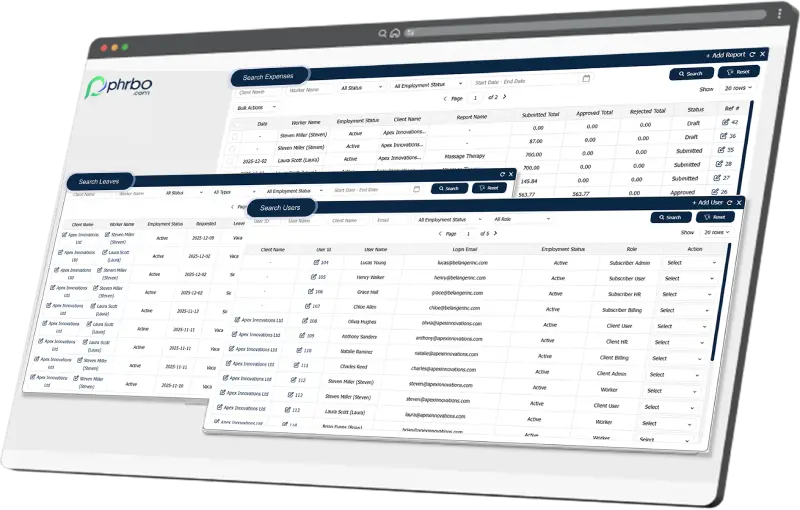
PHRBO automates multi-currency invoicing, statutory filing confirmations, and cross-border payroll reconciliation, so your ops team has answers before clients ask.
What the Best Global EOR Providers Are Doing Differently
The providers doing this well are reducing the number of systems their payroll data passes through. Every handoff between systems is a potential failure point. Fewer handoffs means fewer errors that trace back to an integration rather than a genuine compliance gap.
Client-facing payroll portals with real-time dashboards, showing payroll status per employee, per country, are replacing the monthly PDF reporting cycle that forces clients to ask reactive questions. Clients who can see status themselves stop calling with anxiety. That’s a meaningful operational difference.
AI-assisted compliance monitoring is being used to generate automatic alerts when a tax rate, contribution threshold, or statutory leave entitlement changes in an operating market. The alternative, a compliance team manually tracking legislative updates across 20-plus countries, doesn’t scale and introduces the compliance drift risk described earlier.
Providers with strong client retention consistently cite payroll accuracy and transparency as top-three factors. Not pricing. Not country coverage breadth. Clients renew because they trust that employees get paid correctly and on time, and because they can verify it themselves.
The more operationally mature providers are also building internal quality scorecards for their in-country partners, tracking error rates, SLA adherence, and response times, and using that data to make real decisions about who they continue working with.
Global Scale Demands a Different Category of Operational Maturity
Single-country payroll operations are fundamentally about consistency, doing the same things correctly, every cycle, for every client. Multi-country payroll is about coordination, across partners, time zones, regulatory frameworks, currencies, and data obligations that don’t naturally want to work together.
EOR providers that treat multi-country expansion as a bigger version of their domestic model discover the difference the hard way. The infrastructure problems surface during payroll runs, not during sales calls.
The global EOR providers getting this right aren’t the ones with the most country flags on their website. They’re the ones who built the operational infrastructure before they planted the flags.
If you’re still laying the domestic groundwork, managing clean, consistent payroll for multiple clients within a single jurisdiction, start with Part 1 of this series. For those evaluating country-specific compliance requirements, our country payroll guides cover the statutory details needed before going live in any new market.
