
SERIES 1 OF 5 – Highlight from PHRBO’s 2026 Industry Report on Workforce Revenue Leakage in EOR Operations
The Problem EOR Leaders Are Not Seeing
The Employer of Record industry has reached a critical inflection point. The global EOR market was valued at approximately $6.82 billion in 2025 and is projected to reach $7.45 billion by the end of 2026. Behind that growth lies a systemic, largely invisible problem that is quietly eroding the profitability of EOR providers at every scale: workforce revenue leakage.
This is the first in a five-part series examining the findings of PHRBO’s 2026 Industry Report on Workforce Revenue Leakage in EOR Operations. This edition introduces the problem, explains why EOR providers are uniquely exposed, and establishes the definitional framework that underpins the rest of the series.
Five Headline Statistics
Why EOR Operations Are Uniquely Exposed
The EOR business model is structurally different from staffing agencies or PEOs in one critical way: the EOR provider does not simply process payroll for its own employees. It manages the employment and billing relationship for workers who belong — operationally — to another company’s workforce.
This creates a fundamental asymmetry: the EOR provider carries the legal and financial obligations of the employer, but the commercial reality and risk of accurate billing sits directly on the provider’s revenue line.
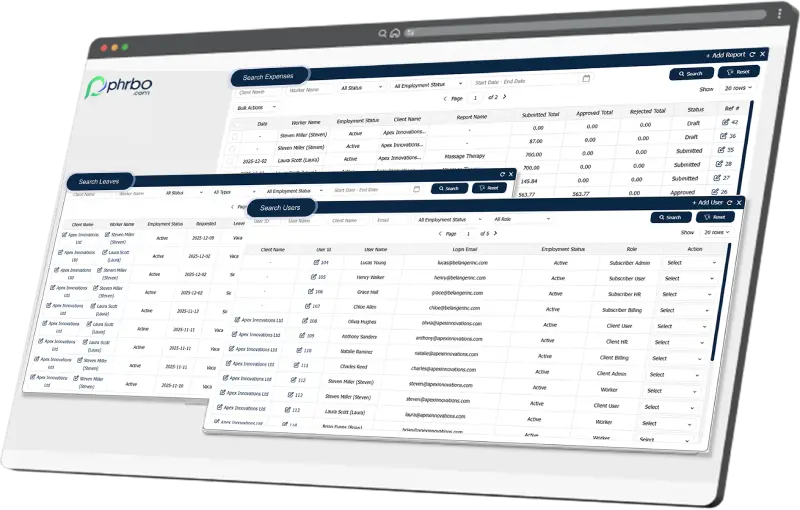
Every worker record in an EOR platform is, in effect, a revenue-generating unit. The worker’s start date, compensation rate, allowances, benefits, entitlements, leave status, contract type, and eventual offboarding terms are not just HR data — they are the input variables for every invoice the EOR sends to its client. When a worker record is incomplete, outdated, or incorrectly loaded into a billing system, the invoice that follows is wrong.
EOR providers also face compounding timing complexity that other workforce models do not. Revenue recognition is not linear — it varies with the timing of services delivered. Probation period clearances, severance calculations, offboarding settlements, success fees, and benefits billing adjustments all create billing events that fall outside the standard payroll cycle. Without a system that connects workforce events directly to billing triggers, these events are routinely missed or processed late.
The Link Between Data Quality and Billing Accuracy
The relationship between workforce data quality and billing accuracy is direct and multiplicative. A single error in a worker record does not create a one-time billing mistake. It creates a recurring billing mistake that compounds across every payroll cycle until it is detected and corrected.
Consider: an EOR provider onboards a worker with a contracted monthly salary of $8,500, but the billing system is loaded with $8,050 due to a data entry error. Over a six-month engagement, this single error creates an unbilled gap of $2,700 — which, if undetected, may never be recovered once the engagement closes.
Multiply this scenario across hundreds of workers and multiple jurisdictions, and the aggregate revenue impact becomes material very quickly. Research consistently confirms the scale of this risk: nearly 70% of organizations report issues in their payroll and workforce data, and Gartner estimates poor data quality costs organizations an average of $12.9 million per year across all functions.
Defining Workforce Revenue Leakage
For the purposes of this series, workforce revenue leakage is defined as:
Revenue that is lost, unrecognized, or unbilled by an EOR provider as a direct result of workforce data gaps, errors, or mismanagement across the worker lifecycle — from pre-onboarding setup through final offboarding settlement.
This definition deliberately excludes three adjacent but distinct categories of financial loss:
- Fraud — intentional misrepresentation to extract financial benefit.
- Bad debt — correctly billed revenue that remains uncollected due to client non-payment.
- General revenue leakage — broader commercial losses from pricing strategy or missed upsell opportunities.
Workforce revenue leakage is operational in origin, structural in nature, and largely preventable with the right data infrastructure. This distinction matters because it determines both the detection mechanism required and the remediation strategy that will be effective.
The Three Types of Workforce Leakage
How Leakage Compounds Over Time
What makes workforce revenue leakage particularly damaging in EOR environments is the compounding dynamic. Small data errors, left undetected, do not stay small. They repeat across every billing cycle until they are identified.
Consider an EOR provider managing 2,000 active workers, each billed at an average of $3,500 per month. A 2% workforce data error rate — affecting 40 workers at any given time — creates approximately $140,000 per month in billing exposure. Over a 12-month period, this compounds to $1.68 million in potential leakage from a data error rate that, on its face, sounds negligible.
The challenge is compounded by the detection lag. Industry data suggests that financial errors of this type take an average of 18 months to be detected — and a significant proportion of the leakage that accumulates during that window is never recovered once the client relationship or worker engagement has concluded.
Coming Up in This Series
Sources:
- Custom Market Insights (2026)
- Electroiq.com Payroll Statistics (2024)
- Gartner HR Research
- AIHR HR Data Management (2026)
- HireLevel Payroll Fraud Risks (2025)
Be the First to Access the 2026 EOR Revenue Report
To access the 32 page report of hidden revenue leaks impacting EOR businesses, join the email distribution list and receive it in your inbox on March 30, 2026.
