

The Changing Landscape of EOR Growth
Ten years ago, winning an EOR client came down to two things: your country coverage and how fast your legal team could turn around a contract. Those were the primary differentiators.
That is no longer true.
Client expectations have shifted significantly. Companies hiring across borders now come to the table having already used at least one HR or payroll platform internally. They know what good data management looks like. They expect their EOR to match that standard — or exceed it.
This shift has changed how EOR businesses grow and retain business. The ability to process payroll on time in twelve countries matters. But so does how cleanly that payroll data connects to the client’s finance system, how quickly new hires are set up in the system, and how clearly costs are reported at month-end.
Industry context: EORs that operate with integrated HR and payroll systems report up to 40% faster client onboarding and 25% stronger contract retention compared to those running disconnected manual workflows. The numbers reflect a simple truth — better operations produce better client relationships.
Strategic partnerships with payroll and HR technology vendors sit at the center of this shift. This article covers what those partnerships look like in practice, where they add the most value, and how to build them in a way that drives measurable contract growth.
Why EORs Need Tech-Driven Collaboration
The Day-to-Day Reality of Running an EOR
EORs operate in a world of complexity. They manage multiple client and worker contracts, employees, diverse tax rules, and changing local labor regulations. Doing all this manually or with disconnected systems often leads to inefficiencies — and worse, compliance gaps.
Standalone EOR systems, while functional, often struggle with:
- Manual workflows that slow down service delivery
- Fragmented employee and payroll data
- Lack of real-time financial visibility
To overcome these challenges, EORs are increasingly partnering with payroll processors, HRIS platforms, and back-office automation vendors.
These collaborations solve some of the toughest operational problems:
- Cross-border payroll compliance: Automated payroll APIs ensure local tax laws are applied correctly in every region.
- Real-time data sync: Integrated HR and finance systems keep payroll, attendance, and benefits perfectly aligned.
- Reduced administrative overhead: Manual data entry and repetitive approval processes are replaced by intelligent automation.
For example: An EOR without integrated payroll tools often faces delayed salary disbursements, inconsistent tax filings, and missed compliance deadlines — all of which erode client trust and contract renewals.
Key Areas Where Payroll & HR Tech Partnerships Add Value
1. Payroll Processing Automation
Processing global payroll without automation is like manually filing tax returns for hundreds of individuals across a dozen countries simultaneously. Currency conversion rates shift daily. Tax brackets update annually or mid-year. Social contribution rates differ not just by country but by employment category and sometimes by region within a country.
When an EOR connects its operations to a payroll technology platform via API, these variables are handled by the system. Tax tables update automatically. Gross-to-net calculations account for jurisdiction-specific deductions. Pay runs generate automatically based on configured pay schedules.
The practical outcome for clients is payroll that arrives on time, calculated correctly, with clear documentation. That consistency is worth more to a client than almost any other service quality metric.
2. Unified Workforce Data
In EOR operations, the same employee record often needs to exist in multiple systems: the HR system for employment details and benefits, the payroll system for compensation and deductions, the finance system for cost allocation, and the EOR platform for invoicing and contract management.
When those systems do not share data, each record becomes a version that may or may not match the others. Over time, these inconsistencies accumulate. A salary change processed in payroll does not reflect in the HR system. A termination date entered in the EOR platform does not trigger the correct final payment calculation.
Integrated systems maintain a single, consistent employee record that flows through every connected function. When compensation changes, it changes everywhere. When an employee is offboarded, every relevant workflow fires from that one event. This matters directly to clients because their reporting — headcount, cost per hire, benefit spend — is only as accurate as the underlying data.
3. Scalable Onboarding and Offboarding
Client onboarding speed is one of the few EOR metrics clients can observe in real time. When a new hire is placed with an EOR, the client is watching the clock.
- How long until the contract is ready?
- How long until the employee is in the system?
- How long until the first payroll is confirmed?
When HR systems connect directly with EOR software, onboarding workflows become document-driven rather than email-driven. The required paperwork is triggered automatically based on the employee’s country, employment type, and start date. Approval workflows are built into the system and tracked without chasing.
Offboarding carries equal operational weight. Final payment calculations, statutory notice obligations, compliance documentation, and benefit terminations all need to happen in the right sequence and on time. Integrated systems manage that sequence without requiring a team member to coordinate each step manually.
Faster, more consistent onboarding and offboarding means fewer error corrections, fewer compliance exposures, and a noticeably better experience for both the client and the employee.
4. Advanced Analytics & Client Reporting
Reporting has quietly become one of the biggest differentiators in the EOR market. Clients no longer want just a monthly invoice. They want visibility into their workforce costs, broken down by country, employment category, and cost center. Both HR and Tech partners want to see compliance status across all active workers. They want reports that match their internal finance formats.
When payroll and HR data flow through integrated systems, generating those reports becomes a configuration task rather than a manual effort. Cost-per-employee breakdowns, benefits utilization, invoice reconciliation, and compliance status summaries can be produced on demand.
This level of reporting changes the working relationship. Instead of responding to client questions, the EOR is proactively providing insight. That shift — from reactive to informative — is one of the clearest signs a client is receiving genuine value from the relationship.
How Tech Vendors Translate into Client Contract Growth
When operations run smoothly, clients notice. Payroll and HR tech vendors directly impact EOR growth metrics in several ways:
- Improved efficiency → Better client satisfaction → More renewals
- Faster scaling for new client contracts
With connected HR and payroll systems, EORs can onboard new clients and their employees quickly without rebuilding workflows from scratch for each project. - Geographic expansion: Integration with HR and back-office systems that handle local compliance allows EORs to confidently enter new markets.
- Modular service offerings: EORs can tailor offerings (e.g., payroll-only or full HR integration) based on client size and budget.
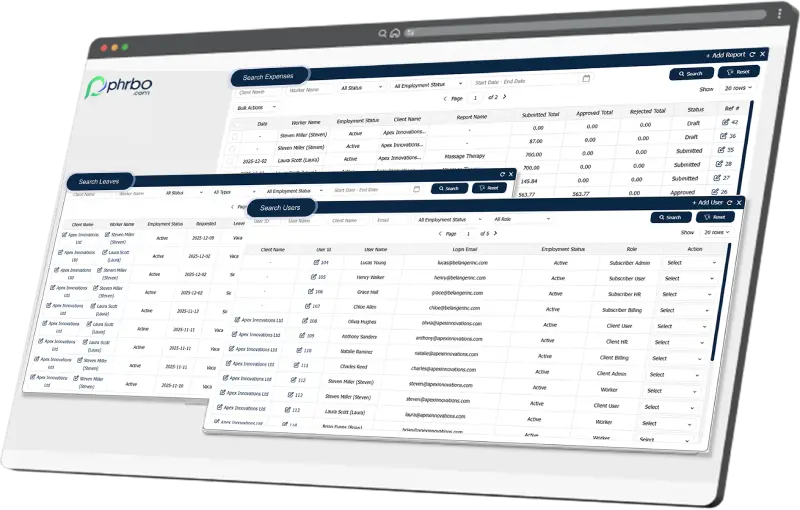
Example scenario: An EOR using PHRBO can easily configure leave and severance policy rules that automatically govern worker management and invoicing — enabling the EOR to scale services across multiple states without needing manual intervention.
The Role of EOR Software Platforms in Enabling Seamless Integrations
Modern EOR platforms like PHRBO are designed with integration in mind. They provide the backbone for connecting multiple payroll and HR systems through secure APIs and automated data pipelines.
Benefits for EORs include:
- Centralized client management: Manage all client contracts, workers, and billing in one place.
- Automated invoicing and reporting: Eliminate manual reconciliation with end-to-end data automation.
- Open APIs for partner collaboration: Seamlessly connect with HRIS, payroll, and compliance tools.
In essence, choosing the right EOR tech stack isn’t just a technology decision — it’s a strategic investment in scalability, efficiency, and client trust.
How to Build Strategic Payroll & HR Tech Partnerships
If you’re an EOR aiming to scale, technology partnerships must be evaluated not just from an operational perspective — but also from a financial one. Here’s how to structure partnerships the right way:
1. Identify operationally and commercially aligned partners
Look for payroll or HR tech vendors whose capabilities match your service model and whose pricing structure fits your growth plans — whether that’s per-employee-per-month (PEPM), subscription-based, or revenue-sharing.
2. Evaluate integration and cost readiness
Before signing contracts, EORs should assess:
- API and tech compatibility
- Data security and compliance certifications
- Integration costs (setup fees, engineering hours, maintenance)
- Ongoing vendor charges for payroll runs, filings, or employee records
3. Define financial terms clearly
Partnerships often involve commercial agreements like:
- Volume-based pricing (discounts as the number of employees increases)
- Minimum billing commitments for access to payroll or HR services
- Revenue-sharing or referral incentives if both parties exchange clients
- Understanding these upfront prevents margin erosion later.
4. Build a sustainable pricing model for clients
Once vendor costs are clear, EORs can structure their own pricing to protect profitability, for example:
- Passing costs transparently as a line item
- Bundling vendor fees into premium service tiers
- Charging extra for integrated HRIS/payroll modules
5. Use integrations as a competitive differentiator
When pitching a new client, naming the payroll and HR platforms your EOR connects with, and explaining what that means for their onboarding speed, reporting accuracy, and compliance confidence, changes the conversation. It signals operational maturity. For clients who have dealt with fragmented EOR operations before, that signal carries real weight.
6. Develop a joint go-to-market plan before launch
Define what the commercial arrangement looks like. Are referrals tracked? Is there a co-marketing budget? Will both parties contribute to joint case studies or webinars? Technology partnerships with a clear commercial structure produce more business value than those that exist only as an integration.
7. Assess API readiness before agreeing to anything
Request full technical documentation early. Understand what data the integration can sync, how frequently updates happen, how conflicts are handled, and what the failure behavior looks like. A poorly built API connection becomes an operational problem the moment live client data flows through it.
Conclusion: The Future of Partnership-Driven EOR Growth
The EOR businesses that grow their client base most effectively in the years ahead will be those that have built connected, well-integrated operational systems — ones where payroll, compliance, HR data, invoicing, and reporting work together without manual intervention between each step.
Technology partnerships with payroll and HR vendors are how that kind of infrastructure gets built. They reduce the operational overhead of running a multi-client, multi-jurisdiction EOR business. It improve what the client actually experiences. They create new service packages and new revenue opportunities. And they open commercial channels that solo EOR marketing rarely reaches.
The competitive difference in EOR is no longer just about where you can hire. It is about how reliably you operate once the contract is signed — and whether your technology infrastructure can support growth without requiring proportional operational expansion.
