

Platform-based EORs have mastered SEO at scale. They publish country-level “Hire in X” pages across dozens of geographies, often produced in bulk, lightly localized, and structured to satisfy search engines and AI crawlers. Because these platforms are funded to operate at scale, search engines reward their breadth—even when the provider behind the content has limited or no real operational presence on the ground.
This is why many local EORs are invisible online despite doing the actual work of being an employer of record.
The irony is that platforms win rankings precisely because local EORs are not leveraging their strongest asset: hyper-local operational experience. Search engines and AI agents may reward volume today, but buyers still reward trust, accuracy, and risk reduction—especially when employment compliance is involved.
This creates a powerful opportunity for local EORs.
A hyper-local SEO strategy allows true EOR providers to outperform platforms by publishing content that demonstrates real, granular compliance knowledge at the state/, province, city, and industry level. These are insights global platforms cannot safely publish without exposing themselves to legal risk or operational contradictions.
When executed correctly, hyper-local SEO turns your lived experience—local audits, payroll nuances, enforcement patterns—into both a ranking advantage and a conversion engine.
What Is a “Hyper-Local Guide” SEO Strategy for EOR Providers?
A hyper-local guide SEO strategy is not simply a rebranded “Hire in Country” page. It is a location-specific, compliance-focused resource that reflects how employment actually works within a defined jurisdiction.
It is a location-specific, compliance-driven content asset that speaks directly to how employment works in a specific jurisdiction—state, province, city, or even metro area.
Where country-level content answers “Can I hire here?”, hyper-local SEO content answers:
- “How do I hire compliantly here, right now?”
- “What risks apply in this province or city?”
- “Who actually understands local enforcement and audits?”
- “What do workers expect and need from their employer in this city or province?
This maps perfectly to EOR buyer psychology. Employers searching at this level are no longer browsing—they’re risk-aware and decision-ready.
Examples of High-Intent Hyper-Local SEO Searches
Here are some examples of web searches that signal buyer intension:
- “Employer of Record in Ontario”
- “EOR services in Alberta”
- “Hire employees in Montreal compliantly”
- “Is Waterloo a good place to hire developers?”
These searches signal urgency, legal concern, and budget approval. They don’t want education—they want certainty.
Why Platform EOR Country Guides Fall Short
Platform EORs rely heavily on standardized country guides. These typically follow a predictable structure that includes a high-level employment overview, basic payroll mechanics, a general benefits summary, and surface-level compliance notes.
This structure works for awareness, but it breaks down during evaluation.
In real sales conversations, employers frequently discover that country-level content avoids specifics. Key phrases like “requirements may vary by region” or “consult a local expert” are common, because platform marketing teams cannot commit to jurisdiction-level accuracy without owning the operational risk.
Local EORs, on the other hand, operate inside these regions every day. You already know which rules are enforced strictly, which ones are negotiable in practice, and where employers most often get into trouble. That difference is exactly what hyper-local SEO content is designed to surface.
The goal is not to discard the country guide model entirely, but to evolve it. Structural clarity can remain, but generic explanations must be replaced with jurisdiction-specific insight grounded in real execution.
Adapting the Country Guide into a Hyper-Local Guide Playbook
The HLG Playbook starts with a single country guide acting as the top of a structured content hierarchy, not the final destination. For local EORs, the real authority is built further down the funnel.
Organize your hyper-local content into a clear hierarchy:
- Country overview (light, contextual)
- State / province employment guides
- Regional employment hubs
- City-specific hiring pages
- Industry-specific local pages
Content Hierarchy Example
- Canada
- Ontario
- Southern Ontario
- Waterloo
- Hiring Software Engineers in Waterloo via EOR
- Software Engineering Talent Hotbeds in South Ontario
- Ontario
This structure does two things:
- Signals topical authority to search engines
- Mirrors how buyers actually think and search
Internal Linking Strategy
Internal linking plays a critical role here. City-level pages should reinforce province-level authority, while province pages provide context back to the national framework. This creates topical depth without duplication, strengthening your overall SEO footprint.
- City pages link to province pages
- Province pages link to country context
- Industry pages link back to city + province
Building State & Province-Level EOR Pages (The Compliance Advantage)
State and province-level EOR pages often outperform national pages in conversion rate, even if they generate less traffic overall. The reason is intent.
At this stage, employers are no longer browsing. They are validating vendors.
What to Include
- Local labor laws and enforcement nuances
- Statutory benefits and employer contributions
- Talent quality and infrastructure details that apply to hiring
- Payroll taxes and reporting requirements
- Termination and notice rules as enforced, not just written
- Historical and expected trends for this area
Creating City-Level EOR Pages for High-Intent Searches
City-level EOR pages capture some of the highest-intent searches in the entire funnel. When someone searches for an Employer of Record in a specific city, they are almost always evaluating providers, not learning concepts.
When someone searches “EOR services in Toronto,” they’re not researching anymore. They likely have a candidate or multiple candidates lined up and are vendor-shopping.
What Employers Expect on City Pages
These pages work best when they reflect the local employment ecosystem. That includes wage benchmarks, dominant industries, common compliance pitfalls, and hiring timelines specific to that city. Employers want reassurance that you understand the market they are entering, not just the law on paper.
Real Scenario from the Field
A SaaS company expanding into Vancouver once asked a platform EOR about local overtime enforcement. The answer was vague. When they spoke to a local EOR, the conversation shifted immediately to:
- BC-specific overtime calculations
- Recent enforcement trends
- How audits typically start
That prospect never went back to the platform supplier.
Regional & Industry-Specific Hyper-Local Pages
Hyper-local SEO becomes especially powerful when geography is combined with industry context.
Combining Geography + Industry
Regional and industry-specific pages allow local EORs to demonstrate specialization rather than general capability. This not only improves search relevance but also shortens the sales cycle by pre-qualifying prospects who see themselves reflected in the content.
For example;
- EOR for Manufacturing in Edmonton
- EOR for SaaS Companies in Ontario
Why Regional Pages Matter
Employers rarely hire in just one city. Regional pages allow you to speak to important facets of employment like:
- Multi-city compliance strategy
- Consistent payroll handling
- Regional labour mobility issues
From an SEO perspective, these pages also reduce dependency on a small number of high-competition keywords, creating a broader and more defensible content moat.
Hyper-Local Trust Signals That Platform EORs Can’t Replicate
Trust and confidence are a crucial factor in EOR selection, and hyper-local content is the most efficient and compelling vehicle for communicating it.
Trust Signals That Matter
- Local registrations and licenses
- Named compliance partners
- Physical office presence
- Local HR and payroll teams
On-Page SEO Best Practices for Hyper-Local EOR Pages
Hyper-local pages should be optimized not just for rankings, but for credibility.
Optimize for Local Intent
- Clear location-based title tags
- Descriptive meta descriptions with compliance language
Structural Trust Enhancers
- Table of contents within blog pages
- Clear CTAs tied to location
- Last updated dates
- Related local content
These same signals also improve visibility in AI-driven overviews, which increasingly favour precise, experience-backed explanations over generic summaries.
Location-Based FAQs
Answer the questions sales teams hear every week:
- “Do rules differ by city?”
- “Who handles local audits?”
- “What happens if we get it wrong?”
Optimizing for AI Overviews
In addition to the above, the hyper-local specificity is in itself optimizing for AI agent search. AI models favour precise, grounded, and even contrarian explanations over generic summaries. Local details which are clearly important or flagged as “must know” information, will be highlighted by AI agent responses.
Bonus SEO: Internal Linking & Content Clusters for EOR Authority
To get the most “Google Juice” from your Hyper-Local Guide pages, they should not exist in isolation. They should connect naturally to broader EOR content clusters; Your site likely already includes content describing Compliance, Payroll, Benefits and Worker classification. Hyper-local pages should connect into these clusters, strengthening your overall authority.
How to Connect These Content Clusters for Internal Linking
Each hyper-local page should internally link to its relevant compliance, payroll, benefits, and worker classification articles using contextual, problem-driven anchor text. In turn, those core cluster pages should link back to location-specific guides, creating a two-way authority loop that reinforces topical depth and search relevance.
Avoiding Keyword Cannibalization
Carefully considering the Keyword structure for your pages ensures search engines clearly understand page intent and prevents internal competition between closely related content. This can be tricky when considering closely related location-based EOR content. Here are some tips to get started.
- One clear page per location + intent
- Avoid duplicating content between city and province pages
- Use internal links instead of repetition
When done correctly, hyper-local pages elevate the entire domain, not just individual rankings.
Measuring Success: KPIs for Hyper-Local EOR SEO
Hyper-local guide pages are designed to drive organic visibility and inbound traffic, but their true impact extends beyond rankings and sessions. When implementing this strategy, EOR providers should also measure how leads from hyper-local pages influence downstream sales performance.
To do this effectively, isolate and tag leads originating from state, province, and city-level pages within your CRM or marketing automation system. Tracking these leads separately allows you to evaluate not only traffic growth, but also changes in sales cycle length, conversion rates by geography, and close rates compared to broader country-level traffic.
In practice, hyper-local pages often produce fewer leads than a broadly tarted sales page, however HLP leads tend to move faster through the funnel, require less education, and convert at higher rates—making them more valuable than high-volume, low-intent traffic. Further, building a battery of pages covering your EOR’s geographic and industrial reach will stack the traffic each page creates.
Conclusion: Hyper-Local SEO as a Long-Term Growth Engine for True EORs
Hyper-local SEO aligns naturally with how true EORs operate.
As a true/local EOR, you already:
- Possess the local knowledge.
- Manage compliance at ground level.
- Carry the operational risk that platforms avoid.
This strategy doesn’t just help you rank—it helps you own the hiring narrative in your market.
As platforms continue to scale content, local EORs who invest in hyper-local authority will compound trust, visibility, and deal velocity over time.
In a market where compliance mistakes are expensive, local expertise isn’t a feature—it’s the competitive advantage.
Ready to Replace Spreadsheets and Manual EOR Operations?
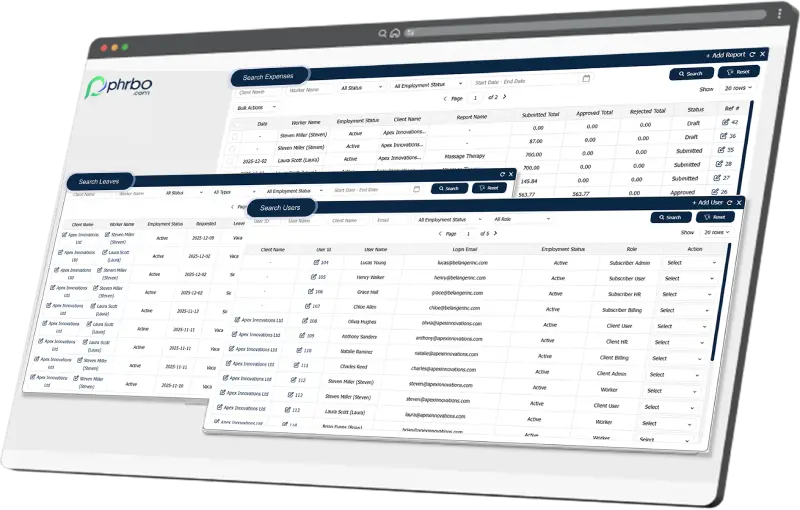
Get a live walkthrough of payroll operations, worker and client management, and invoicing automation in PHRBO.
Request a Live Demo