

Building the Operational Foundations That Let EOR Providers Scale with Confidence
Picture an EOR provider operating exclusively in the UK. One jurisdiction. One compliance framework. One set of statutory rules. On paper, this looks straightforward, and in the early stages, it often is.
Then client 10, 20, or 30 comes on board with some specific needs and dozens of workers. It’s a great problem to have, right? Suddenly, the payroll team is balancing commission-heavy pay structures alongside fixed-salary schemes, multiple pension contribution rates, and separate pay cycles, all under the same HMRC umbrella. It’s not that anything has gone wrong. It’s that the operation has outgrown the model it started with.
This is a transition point that most domestic EOR providers reach at some stage. The legal framework stays constant. The compliance rules don’t change. What grows is the operational load generated by client variation, and the systems built for early-stage delivery eventually need to evolve.
This article walks through the operational realities of running multi-client payroll within a single country, why the complexity is greater than it first appears, where the common pressure points tend to emerge as client numbers grow, and what the infrastructure and process foundations of a scalable operation look like in practice. Whether you are building out your payroll function for the first time or reviewing a model that has grown organically, the goal here is to give you a clear picture of what good looks like and a practical framework for getting there.
Why “Same Country” Doesn’t Mean “Simple Payroll”
Compliance complexity and operational complexity are different things. In a single-country EOR operation, the legal framework is consistent, but what varies enormously is the client side of the equation.
Here’s where the real operational load lives:
- Pay structure variation. Commission tiers, overtime calculations, shift differentials, equity vesting schedules, each client brings a different configuration, all sitting inside the same statutory wrapper.
- Multiple pay period frequencies. Running weekly, fortnightly, and monthly payrolls for different clients means payroll is a continuous cycle with overlapping deadlines, not a monthly event.
- Benefits variation. Different pension contribution rates, private healthcare schemes, and leave entitlement policies need to be tracked, managed, and reported per client, per employee.
- Data input inconsistency. Client A sends a CSV export. Client B emails a spreadsheet. Client C submits changes verbally. Every format needs to be normalised before a single payslip can be processed.
- Worker classification nuance. Remote and hybrid workers can straddle classification boundaries. Employment insurance premiums and legal employer liability depend on getting this right across every engagement.
None of this is a compliance problem. It’s an operational challenge, and one that compounds with every client you add.
The Client Count Inflection Point
Most EOR providers start small. At five to ten clients, payroll is very manageable. The team knows each account personally, errors are caught quickly, and close client relationships make communication easy.
At twenty to fifty clients, the same approach typically starts to feel stretched. Not through any single failure, growth often looks healthy from the outside. But quietly, things shift: a correction run here, a missed cut-off there, a query that takes two days to resolve instead of two hours.
This is the stage that catches many providers off guard, not because they’ve done something wrong, but because a model built for one phase of growth needs to be re-engineered for the next.
The challenge isn’t a blowout, it’s the slow accumulation of small payroll corrections that signal a system under strain.
Five Common Payroll Challenges in Single-Country EOR Operations
These are patterns that appear across domestic EOR operations as they scale. Recognising them early makes them far easier to address.
1. No Structured Client Payroll Configuration Library
In early-stage operations, client-specific payroll rules often live in email threads, spreadsheet tabs, and the knowledge of experienced staff. This is natural and workable, up to a point.
As the client book grows, a centralised, versioned, auditable record of each client’s payroll configuration becomes important. Without it, staff transitions carry more risk than they should, and errors that were previously caught informally can start to surface in client-facing outcomes.
The solution isn’t complicated. It’s documentation discipline and a system that supports it consistently.
2. Treating Payroll Cut-Offs as the Client’s Responsibility
When data submission relies on clients remembering to send information on time, operational control shifts away from the payroll team. Late data isn’t a client problem once it arrives, it becomes an internal one.
Running forty clients with different submission timelines means that late data from just a few of them can compress into a difficult month-end crunch. Automated reminders, structured submission windows, and clear escalation processes are tools that help EOR providers manage this proactively rather than reactively.
3. Conflating Payroll Accuracy with Payroll Completeness
A payroll run can be technically accurate and still be incomplete. Correct numbers processed for the wrong employees, missing new starters, leavers still on the system, or mid-cycle changes not captured, all of these produce outputs that pass a calculation check but fail a completeness one.
In jurisdictions with real-time reporting requirements, RTI in the UK, STP Phase 2 in Australia, completeness errors carry downstream costs that go beyond the payslip. They require corrections to statutory filings, which is a different category of remediation entirely.
4. No Payroll Error Escalation Protocol
When a payroll error is discovered after disbursement, having a clear, documented response process matters a great deal. Who owns resolution? How are clients notified? What’s the SLA for correction? How are regulatory filings amended?
Without this, responses tend to be improvised rather than repeatable. Clients don’t just remember that an error occurred, they remember how it was handled. A well-managed response to a payroll error can preserve trust in a way that an inconsistent one cannot.
5. Under-Investing in Payroll Technology Relative to Client Volume
Many domestic EOR providers grow to twenty or forty clients while running on off-the-shelf payroll software built for single-employer use. In the early stages, this often works well enough. Over time, the gap between what the software was designed for and what a multi-client operation needs begins to widen.
Multi-client operations eventually benefit from platforms that offer genuine client-level data segregation, parallel processing capability, and audit trail granularity that matches EOR-specific requirements. Recognising when to make this investment, ideally before the need becomes acute, is a meaningful operational decision.
The Compliance Layer: Statutory Liability in a Multi-Client Context
As the legal employer on record, an EOR entity carries full statutory liability for payroll outcomes, even when errors originate on the client side. A client submits incorrect data. The EOR processes it. The downstream compliance implications fall to the EOR entity.
In the UK, RTI reporting errors can trigger HMRC penalties and affect employee tax codes in ways that are slow to unwind. About Australia, STP Phase 2 non-compliance feeds directly into ATO reconciliation issues. In the US, state-level payroll tax deadlines and wage provisions vary enough that even a single-country operation carries layered compliance exposure.
There’s also a scale dimension worth noting. With fifty or more clients in one jurisdiction, a systemic process gap doesn’t affect one client, it affects the entire book simultaneously. This is different from multi-country operations, where errors tend to be geographically isolated.
Understanding this liability context is part of what motivates investment in robust processes. The stronger the operational foundations, the less exposure the EOR entity carries as it grows.
What a Scalable Single-Country Multi-Client Payroll Operation Looks Like
There is no single template, but there are consistent foundations that tend to differentiate providers who scale smoothly from those who find growth amplifies their operational friction.
The Infrastructure Layer
- A multi-client payroll platform with genuine client-level data isolation, not just separate accounts in a single-employer tool, but database-level segregation that grows with the business.
- Structured client onboarding that captures payroll configuration in versioned, auditable records from day one. Email chains and shared drives can be replaced by documented, retrievable, transferable records.
- Automated submission portals that build cut-off discipline into the process and flag missing data inputs before a payroll run begins.
- In-system document transmission, with all requests, approvals, and data exchanges timestamped and permissioned, so email is removed as a primary payroll data channel.
The Process Layer
- Staggered payroll calendars. Not every client needs to share the same run date. Building natural breathing room into the monthly cycle is a practical way to avoid compressible crunch points.
- Documented escalation paths. Every error type has a named owner and a defined response SLA, so resolution is repeatable rather than improvised.
- Post-run reconciliation as a standard practice, not an exception. Every payroll cycle gets a clean sign-off before it closes.
The People Layer
- A dedicated payroll operations function, structurally separate from HR advisory services. These are distinct disciplines with different skills, and separation tends to strengthen both.
- Cross-training across client accounts to reduce single points of failure. When one specialist is unavailable, someone else can step in without disruption to the client.
A Self-Assessment: How Is Your Operation Positioned?
These five questions are intended as a practical reflection tool for payroll operations leaders, not a benchmark or a vendor pitch. Honest answers are the useful ones.
- Can you produce a complete, auditable payroll configuration record for every active client within 24 hours?
- Do you have a documented process for handling a payroll error discovered after disbursement, covering who owns it, how clients are notified, and how filings are corrected?
- What is your payroll error rate per 1,000 payslips? Do you track it consistently, and do you track it by client?
- Could your payroll operation run normally if your two most experienced payroll specialists were absent simultaneously?
- Does your payroll platform enforce client data segregation at the database level, or only at the user interface level?
- If any of these surfaces a gap, that’s useful information. It points to where attention is worth directing before the next phase of growth begins.
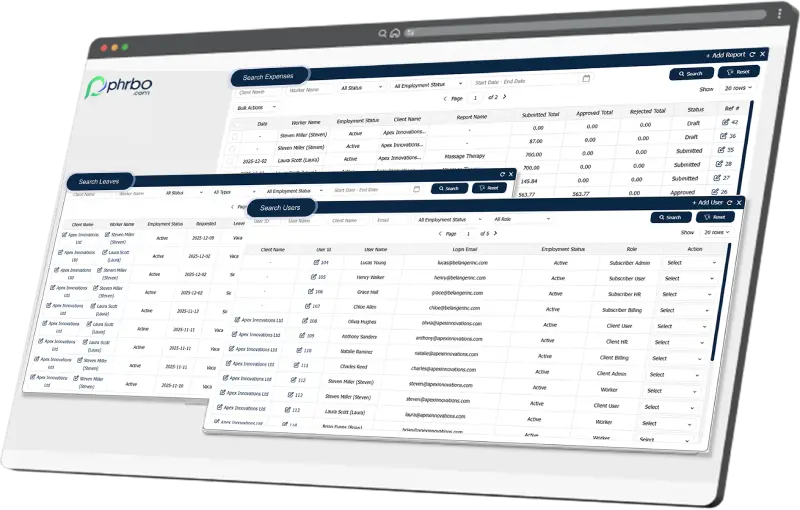
Still managing HR, invoicing, and payroll data in separate tools?
PHRBO brings it all together for EOR providers — so your back-office runs as cleanly as your compliance does.
Single-Country Is Not a Ceiling, It’s a Foundation
Single-country EOR is sometimes described as the simpler version of the business, a stepping stone toward multi-jurisdictional operations. That framing undersells it.
EOR providers who build strong multi-client payroll operations within a single jurisdiction develop the operational discipline that makes everything else possible: clean data architecture, tested escalation protocols, a payroll team capable of holding a growing client book without accumulating invisible strain.
The providers who invest in this foundation early don’t avoid complexity. They arrive at the next phase of growth with the infrastructure to handle it.
The providers getting this right aren’t necessarily the ones with the most clients. They’re the ones who built the infrastructure before they needed it.
