

Introduction – The Payroll Puzzle No One Warns You About
Does this sound familiar…
When I first started managing payroll and invoicing for multiple client employers, I predicted billing would be a straightforward and easy administrative operation. After all, the logic seemed simple: workers log hours, agencies pay them, and clients receive invoices for those worksheet hours plus the agreed margin.
Reality proved more complicated.
As staffing agency expanded beyond a few clients, invoicing began to resemble a complex logistics operation rather than a regular accounting process. Each employer had its own billing cycle, rate structure, own payment conditions, and contractual requirements. Meanwhile, workers were clocking hours from more than one location, sometimes even within the same pay period.
At the heart of this complexity lies what the staffing industry calls multi-employer payroll.
Unlike traditional payroll systems designed for a single employer, staffing agencies operate within a three-party structure:
- The staffing agency
- The client employer
- The placed worker
This triangular relationship creates layers of operational complexity that most accounting, HRIS, and payroll systems were never built to handle effectively.
As agencies grow, the complexity increases rapidly. Each new worker placement adds another variable, another pay rate, billing rule, or client requirement that must be tracked accurately.
What begins as manageable manual work eventually turns into operational chaos.
This is why invoicing software is not merely a convenient administrative upgrade. For staffing firms managing multi-employer payroll, it becomes a critical component of operational infrastructure.
More significantly, invoicing should be viewed within a larger strategic framework. More and more, staffing agencies becoming increasingly aware that they need to consider a broader Workforce Revenue Data Systemization perspective. This approach considers that workforce revenue data points, like worker hours, payroll, deposits/retainers, invoices and client payments are all connected through reliable data workflows.
What Makes Multi-Employer Payroll Uniquely Complicated
Multi-employer payroll comes with layers of complexity that regular payroll systems rarely encounter. Staffing agencies must keep data from multiple employers, dozens or hundreds of employees, and several operational systems simultaneously.
Tracking Worker Placement Data Across Clients
The first problem is keeping track of worker placement data accurately. Each worker must be associated in the system with the correct client employer, contract terms, pay rate, and pay rate. When agencies handle dozens or hundreds of active employees or workers, maintaining this level of detail manually becomes extremely challenging.
Managing Client-Specific Billing Structures
Another difficulty arises from client-specific billing structures. Every client contract may involve unique billing arrangements. Some clients require regular hourly billing, while others include overtime multipliers, weekend premiums, or shift differentials. Agencies must ensure that the wages of worker and client billing rates stay aligned while maintaining profitability.
Handling Multiple Billing Cycles
Billing cycles add an additional layer of complexity, make things even harder. Staffing agencies regularly tackle a mixture of weekly, bi-weekly, and monthly invoicing schedules. These cycles don’t always line up perfectly with payroll timetables, so finance teams must work with more than one calendar at a time.
Managing Workers Across Multiple Client Locations
Operational challenges increase further when workers are assigned across multiple client sites during the same pay period. Payroll calculations must allocate hours correctly, while invoices need to show the accurate billing distribution across employers.
Meeting Compliance and Regulatory Requirements
Compliance requirements also vary based on the domain, industry, jurisdiction, and geo-location of each client employer. Accurate recordkeeping becomes critical to meet regulatory obligations and maintain audit readiness.
Preventing Cascading Billing Errors
Perhaps the most challenging aspect of multi-employer payroll is the cascading impact of tiny monetary errors. One wrong billing rate can mess up payroll, client invoices, revenue reporting, and financial reconciliation. When staffing operations are busy, these mistakes can easily add up across accounts.
The True Cost of Outdated Invoicing Processes
Many staffing agencies underestimate the operational and financial costs associated with outdated invoicing workflows. Manual processes often appear inexpensive at first glance because the expenses are hidden within daily administrative activities.
Administrative Labour Consumes Valuable Staff Time
One of the largest hidden costs is administrative labour. Manual invoicing requires staff to gather timesheets, verify placement records, confirm billing rates, generate invoices, and perform multiple rounds of quality checks. As the number of client employers increases, these repetitive tasks consume significant staff time.
Delayed Invoices Create Cash Flow Pressure
Delayed invoicing is another common consequence of manual billing processes. When invoices are generated late, payment cycles are pushed back accordingly. Because staffing agencies must typically pay workers before receiving payment from clients, delayed invoicing can place serious pressure on agency cash flow.
Billing Errors Damage Revenue and Client Trust
Billing inaccuracies present an additional financial danger. Manual calculations sometime lead to overbilling or underbilling in a system. Overbilling hurts business reputation with client relationships and can lead to disputes, while underbilling directly reduces agency revenue.
Staff Burnout from Repetitive Administrative Work
Agencies operational activities stress on staff is another overlooked costly mistake. Billing teams often spend a lot of time managing and fixing spreadsheets, reconciling discrepancies, and correcting mistakes. Over time, this tedious workload contributes to employee tired and turnover within finance departments.
The Real Monthly Cost of Manual Billing
For example, think of a mid-sized staffing service that has twenty client employers and about one hundred active workers. If the organization has to do twenty-five hours of administrative work each week to send out bills by hand, it may spend more than one hundred hours a month only on billing.
Small Inefficiencies Add Up to Significant Financial Impact
When administrative costs, billing errors, delayed payments, and missing deposits are considered together, the financial impact of inefficient invoicing processes becomes substantial.
What Invoicing Software Actually Does for Staffing Agencies
Modern invoicing software systemizes staffing agency billing by automating many of the repetitive workflows traditionally handled through spreadsheets and manual data entry.
Automated Invoice Generation from Timesheets
One of the most valuable capabilities is automated invoice generation connected to timesheets and placement data. When worker hours are approved, the system can automatically calculate billable amounts based on predefined rate structures and contract terms. This significantly reduces manual calculation errors.
Client-Specific Billing Profiles and Rules
Advanced invoicing systems also allow agencies to create separate billing profiles for each client employer. These profiles can include unique billing rates, payment terms, overtime rules, and invoicing schedules. The system will automatically follow these rules every time it makes an invoice after they are set up.
Real-Time Visibility into Invoice Status
Finance teams have better control over receivables when they can see the status of invoices in real time. Billing dashboards usually show unpaid bills, payment statuses, and accounts that are past due. This helps organizations keep an eye on their cash flow and decide which bills to collect first.
Payroll and Billing System Integration
Integration with payroll systems is another main advantage. When invoicing and payroll technology communicate directly, worker compensation calculations and client billing amounts remain synchronized. This alignment cut down reconciliation work and prevents discrepancies between payroll and finance teams.
Built-in Audit Trails and Compliance Reporting
Invoicing software may also manage detailed audit trails and transaction records as reporting module, allowing agencies to trace how each pay item was generated. This tracking is extremely essential for compliance reviews, financial audits, and resolving client billing disputes quickly.
Key Benefits of Invoice Software for Staffing Agencies
After implementing invoicing software in your staffing agency operations, the difference in efficiency and accuracy became noticeable almost immediately. Repeated workflows that previously consumed hours of administrative effort will reduce to streamlined workflows completed in few clicks.
Faster Invoice Generation and Billing Cycles
The most immediate reflection is speed. Preparing invoices needed manually scanning of timesheets, calculating billing totals, and fixing of invoice document formats. With automation, approved hours flow directly into invoice templates, allows finance teams to generate invoices quickly and consistently.
Higher Billing Accuracy Through Automated Rate Application
Accuracy will improve significantly as well. Automated rate matching eliminates many of the errors that used to be occurred during manual calculations. Because the software sync contract-specific billing rules, the likelihood of incorrect rates or miscalculated totals will drop dramatically.
Real-Time Cash Flow Visibility and Receivables Tracking
Another major benefit is cash flow visibility. Instead of relying on scattered spreadsheets, the finance team will gain a centralized dashboard showing which invoices had been sent, which were paid, and which (payroll funds) remain outstanding. This transparency will improve forecasting and collections.
More Professional Client Billing Experience
Client communication will also improve. Professionally formatted invoices with clear breakdowns of hours, rates, and billing terms will develop a more polished client experience. Structured invoices reduce confusion and minimize billing disputes.
Operational Scalability Without Increasing Admin Headcount
Perhaps the most important operational advantage is scalability. As the agency needed new clients and placements, the billing workload would not increase proportionally. Automated systems allow the finance team to support business growth without continuously expanding administrative headcount.
Stronger Compliance and Audit Readiness
Finally, improved recordkeeping strengthened compliance confidence. Detailed digital records make it easier to respond to client questions, resolve discrepancies, and maintain documentation for audits.
Stop Managing HR, Billing & Collections in Silos
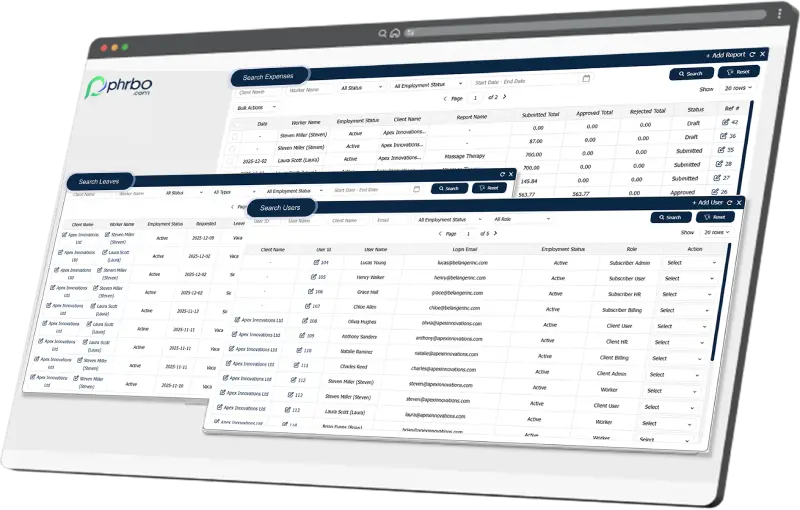
With PHRBO, unify employee data, automate billing cycles, and secure your receivables, so your finance and HR teams work from the same system.
Conclusion: Empowering Multi-Employer Payroll Management
For staffing agencies operating in multi-employer payroll environments, invoicing is far more than a routine administrative function. It represents a critical connection point between worker compensation, client billing, and overall agency revenue. While manual invoicing may work during the early stages of an agency’s growth, these processes rarely scale efficiently as the number of clients, workers, and placements increases.
Invoicing software introduces automation, consistency, and transparency into billing operations by connecting timesheets, payroll calculations, and client invoices within a single workflow. Many agency owners recognize the value of these systems only after experiencing the operational improvements firsthand. If your agency still relies heavily on spreadsheets or manual billing workflows, exploring modern invoicing platforms through a demo or free trial can reveal how automation strengthens financial operations and supports long-term growth.
