

If you’ve spent any time inside an EOR’s pricing sheet, you already know the tension: charge a flat fee and you’re betting that every worker on your book costs roughly the same to service — and that your operational discipline keeps your average cost under that number. Charge a percentage of payroll, and on the surface it can look like you’re charging more for identical work just because someone earns more, which is why the model gets a bad reputation among buyers.
Look at what actually drives cost-to-serve, though, and the picture flips: the employees who earn more are usually the ones who genuinely cost more to service — more complex compliance, more hands-on support, more risk exposure if something goes wrong. The model that looks “fairer” on paper isn’t necessarily the one protecting your margin.
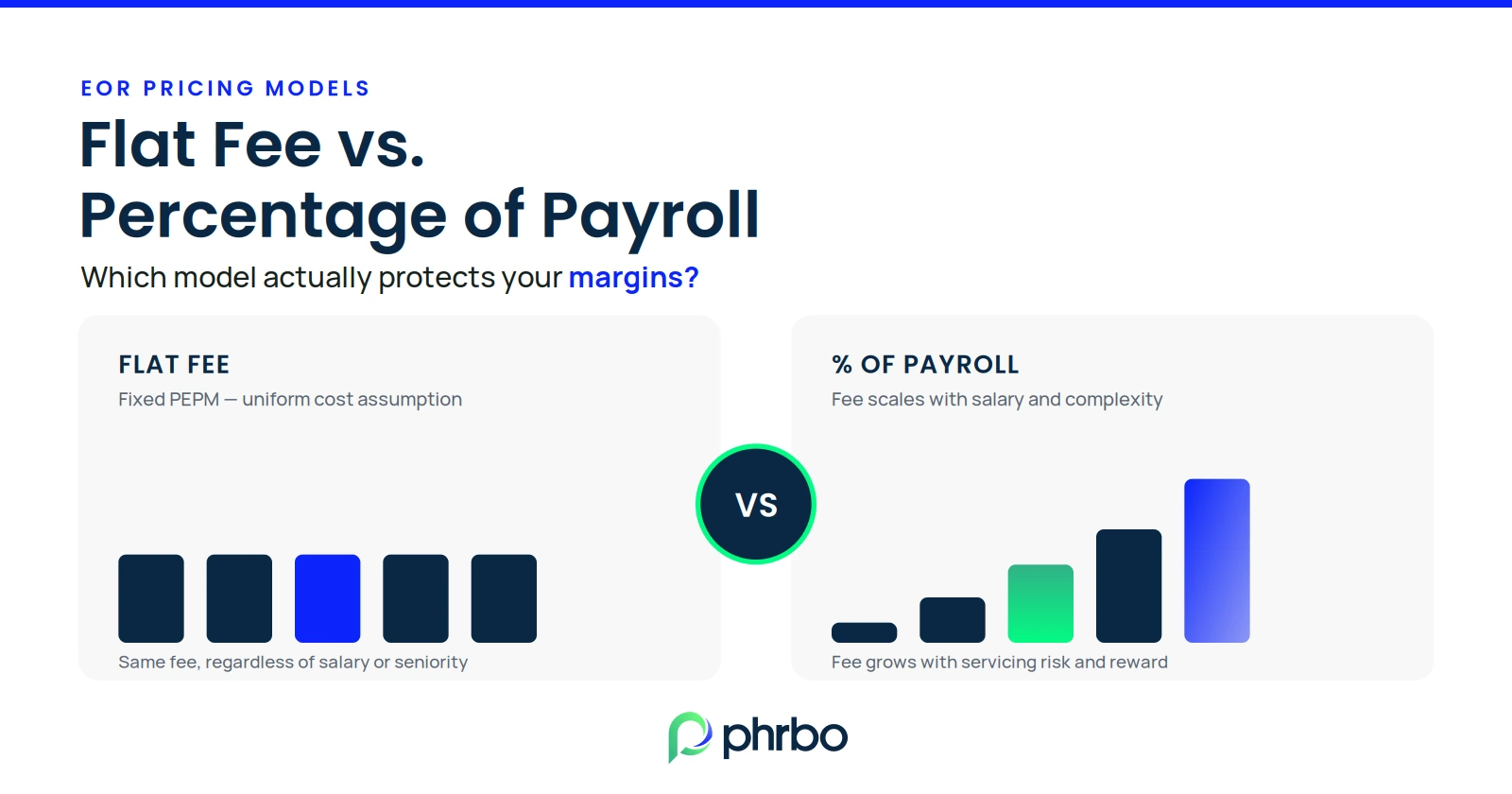
Here’s the short version: flat fee pricing bets that servicing cost is roughly uniform across your workforce — an assumption that breaks down the moment your book includes senior, high-touch, or higher-risk employees, and that’s exactly where margin erodes quietly. Percentage-of-payroll pricing ties your fee to salary, and salary is a reasonable — if imperfect — proxy for the cost and risk that actually varies most: senior and highly compensated employees tend to need more support and carry more downside risk if something goes wrong.
That correlation is why percentage pricing often tracks your real cost-to-serve more closely than a flat fee does. The tradeoff is on the sales side, not the margin side: percentage pricing is a harder sell to a price-sensitive buyer, who sees a fee that grows alongside their own growth and pushes back on it.
We’ve talked pricing strategy with well over 100 EOR operators across different markets and growth stages, and one pattern shows up again and again: most of them are more attached to their current pricing model than they realize. Not because they’ve run the math and concluded it’s optimal — usually because it’s how they started, it’s what their first few clients agreed to, and nobody’s gone back to stress-test it against where the business is now. That attachment quietly costs money. So before you skim to the verdict, it’s worth reading this with some distance from whatever model you’re currently running. You might find the case for switching — or for a hybrid — stronger than you expected.
What Is Flat Fee EOR Pricing?
Flat fee pricing charges a fixed amount per employee per month — a PEPM fee — no matter what that employee earns. A software engineer on $220,000 and a customer support rep on $45,000 cost the client the same management fee, assuming they’re in the same country and under the same service tier.
The bet underneath a flat fee isn’t really about your own cost discipline — it’s about assuming the cost to service any given employee is roughly comparable: the same payroll run, the same statutory filing cadence, a similar volume of HR support. That assumption holds up fine when a client’s workforce is fairly homogeneous — junior-to-mid-level roles, straightforward comp, a single jurisdiction.
Where it breaks is the moment that stops being true. A senior hire with equity comp, a multi-entity tax situation, or simply a higher likelihood of a complex, costly separation down the line doesn’t cost the same to service as a standard mid-level employee — but a flat fee treats them identically. None of that added complexity or risk shows up in the rate, so the fee quietly stops reflecting the real cost, and your margin absorbs the difference. This isn’t a matter of underpricing a specific market; it’s a structural blind spot: flat fee pricing can’t flex to an individual worker’s actual complexity or risk profile.
What Is Percentage-of-Payroll EOR Pricing?
Percentage-of-payroll pricing charges a fee calculated as a percentage of the gross payroll the EOR processes for a client — commonly somewhere between 3% and 15%, depending on the market, the scope of services, and how much negotiating leverage the client has.
It’s a harder sell than a flat fee, not an easier one. A percentage fee grows every time a client hires or gives a raise, and a sophisticated buyer notices when their EOR bill scales alongside their own success — it invites renegotiation and can read as being taxed on growth. That sales friction is real, and it’s a big part of why so many EORs default to flat-rate quoting in early conversations.
But the fee structure isn’t the liability it’s often assumed to be. Salary is a reasonable proxy for the complexity and risk you’re actually taking on with a given employee. Senior and highly compensated hires are, on average, more likely to need dedicated support, more likely to carry equity or multi-jurisdiction tax complexity, and more likely to be the ones involved if something goes legally or operationally wrong — larger severance exposure, higher-profile disputes, more scrutiny. A percentage fee moves with that risk automatically. In most cases, it isn’t capturing extra margin for identical work — it’s charging more because the work, and the risk you’re carrying, genuinely is more.
The Margin Math: Side-by-Side Breakdown
Take two employees in the same country, under the same service tier — the real-world difference between them isn’t the paperwork, it’s that one is a standard mid-level hire and the other is a senior, higher-touch hire, and their salaries roughly reflect that gap.
Employee A earns $60,000, in a straightforward role with standard onboarding, no equity, and low compliance complexity. Realistic cost-to-serve: around $150/month. Employee B earns $180,000, in a senior or executive-track role with an equity component, more frequent HR touchpoints, and meaningfully higher severance and dispute risk if the relationship ends badly. Realistic cost-to-serve, once you price in the added support and a reasonable risk reserve: closer to $420/month.
Under a flat $349/month PEPM fee, Employee A generates roughly $199 in margin. Employee B generates roughly –$71 — a loss, once the real servicing cost is accounted for. The flat fee looks identical for both on the invoice, but the underlying economics are opposite: comfortably profitable on the simple hire, underwater on the complex one. Enough employees like B in your book, and your “protected” flat-fee margin is quietly being subsidized by your simpler accounts.
Under a 6% percentage-of-payroll fee, Employee A generates $300 in fees — margin of roughly $150. Employee B generates $900 in fees — margin of roughly $480. That gap isn’t arbitrary extraction from a higher earner; it’s the fee tracking the real cost and risk difference between the two roles reasonably well.
Percentage pricing isn’t a perfect proxy for cost-to-serve — salary and complexity don’t correlate exactly. But it moves in the right direction as workforce complexity changes. Flat fee doesn’t move at all, which is exactly what makes it risky the moment your book stops being homogeneous.
How Payroll Volume Changes the Calculus
At low headcount and low volume, either model is a reasonable choice — the dollar amounts are small enough that a mismatch between fee and real cost hasn’t compounded yet, and a flat fee is genuinely easier to quote and close in an early sales conversation.
As headcount grows and a client’s workforce diversifies — a mix of junior and senior hires, multiple jurisdictions, some equity comp — the flat fee’s uniform-cost assumption gets tested far more often. Every senior or high-touch hire a client adds is a small margin leak if you’re on flat fee, and those leaks compound across a growing book. Percentage pricing doesn’t eliminate that variance, but it tracks it, because the fee itself moves in roughly the same direction as the added complexity.
Where percentage pricing gets harder isn’t the margin side — it’s the sales and retention side. As a client’s payroll, and therefore your invoice, grows, procurement and finance teams start scrutinizing the percentage more closely, and “why does our EOR bill keep growing faster than our headcount” becomes a conversation you need to be ready for at renewal. That’s a real cost of the model. It just isn’t a margin cost — it’s a negotiation and retention cost.
Pros and Cons of Percentage-Based Billing
Pros:
- Tracks real cost-to-serve more closely than a flat fee, because salary correlates with the complexity and risk that actually drive servicing cost
- Naturally captures more margin on senior or high-touch hires without a separate pricing tier or manual repricing
- Scales with client growth, so you’re not stuck renegotiating every time a client’s payroll grows
Cons:
- Harder to sell to price-sensitive buyers, who see a fee that grows alongside their own success and push back on it in negotiation and at renewal
- Revenue is exposed to client-side volatility you don’t control — layoffs, hiring freezes, seasonal headcount dips — even though your fixed operating costs don’t move with it
- Forecasting is harder because your realized fee depends on each client’s specific salary distribution, which shifts over time
One infrastructure note that doesn’t get discussed enough: running a percentage-of-payroll model well requires a genuinely capable billing and payroll infrastructure layer underneath it. You’re not invoicing a static number every month — you’re recalculating a variable fee against fluctuating payroll data, across multiple currencies and jurisdictions, with statutory changes constantly shifting the base you’re calculating against.
Operators running percentage pricing on spreadsheets or a patchwork of disconnected tools tend to discover the leakage problem the hard way, usually during an audit. A platform built to systemize that recalculation — the way PHRBO’s infrastructure handles payroll-linked billing — isn’t optional overhead for percentage pricing; it’s close to a prerequisite for doing it accurately at any real scale.
Frame this as an operator decision, not a pitch to a prospect. The pros and cons above are about what protects your business, not what’s easiest to explain on a sales call — those two things aren’t always the same, and conflating them is how EORs end up locked into a model that served their sales motion but not their margin.
Pros and Cons of Flat Fee Billing
Pros:
- Easy to quote, close, and invoice — one number, no negotiation over percentages
- Revenue and forecasting are simple and predictable at the top line
- Reads as straightforward and easy to compare for a buyer evaluating you against a payroll software subscription
Cons:
- Bets that cost-to-serve is roughly uniform across your workforce — an assumption that breaks down the moment a client’s book includes senior, high-touch, or higher-risk hires
- Margin erosion is invisible at the top line; the aggregate fee can look healthy even while specific accounts are running at a loss once real servicing cost is accounted for
- Doesn’t automatically adjust as a client’s workforce gets more senior or complex over time, so margin can degrade quietly across a maturing book without a single number in your dashboard flagging it
Is Percentage Pricing Actually Riskier?
Not for margin. For margin, flat fee is arguably the riskier model, because it can’t flex to the real cost and risk differences between workers, and that mismatch stays invisible until you dig into per-account unit economics. Percentage pricing carries a different kind of risk: revenue volatility tied to client headcount changes, and heavier sales resistance from price-sensitive buyers. Both are real risks. They’re just not the same risk, and conflating “harder to sell” with “riskier for margin” is where a lot of pricing debates go wrong.
Play out a few scenarios. A client reduces headcount mid-contract: under percentage pricing, your revenue drops immediately while your fixed operating costs for supporting that account don’t drop at the same rate — a genuine volatility risk. A client hires several senior or executive-level employees: under percentage pricing, revenue rises roughly in step with the added complexity and risk you’re now carrying — that’s the model working as intended. Under flat fee, this is where the real risk sits: the fee stays flat while your actual cost to service those hires goes up, and margin compresses with no trigger anywhere in your invoicing to flag it. A client operating across multiple jurisdictions with wildly different compliance complexity is a harder case for both models, but flat fee absorbs the full range of that variance inside a single number, while percentage pricing at least partially reflects it if higher-value roles cluster in the more complex jurisdictions.
Flat fee pricing’s risk, in other words, isn’t primarily about sales resistance or market mispricing — it’s a structural margin risk baked into the pricing model itself: a fixed number that can’t respond to real variation in what different employees actually cost to service. Percentage pricing’s risk is easier to see coming, because it shows up as revenue swings and renewal pushback rather than a silent gap between fee and cost.
How EOR/PEO Operators Actually Decide Between Models
In practice, the decision usually comes down to four variables: the client’s profile (SMB versus enterprise), the client’s average salary band, the jurisdictional complexity involved, and — just as important — the EOR provider’s own growth stage.
Plenty of operators land on hybrid structures rather than picking one model outright: a flat fee with tiered pricing by salary band, a flat fee plus statutory cost pass-through so jurisdictional complexity doesn’t get absorbed silently, or a minimum fee with a percentage kicking in above a certain payroll threshold. Each of these is really an attempt to keep the sales-friendly logic of percentage pricing while capping the margin exposure that comes with it.
There’s also a clear pattern in how operators evolve over time, and it’s worth naming explicitly because it’s rarely discussed openly: a meaningful number of EORs start on flat fee pricing because it’s simpler to sell and administer against a small, early client base — then shift toward percentage pricing or a hybrid structure as their book scales and diversifies, once cost variance across workers starts actually showing up in their margins. If that describes where you are, you’re not behind the curve. You’re on the normal path. The mistake isn’t starting on flat fee — it’s staying there past the point where your workforce mix stops being homogeneous enough for the model’s core assumption to hold.
Which Model Prevents Revenue Leakage at Scale?
Percentage-of-payroll pricing reduces revenue leakage risk more reliably at scale, because the fee moves with salary — a reasonable proxy for the servicing complexity and risk that actually drives cost. Flat fee pricing is the more leakage-prone model as a book matures, because nothing in the fee structure adjusts when a client’s workforce gets more senior, more equity-heavy, or more legally complex. The leakage is baked into the pricing model itself, not just an execution gap you can fix with better process.
Percentage pricing has its own specific leakage triggers worth naming: statutory changes in a jurisdiction that go unbilled because nobody updated the fee calculation, comp creep that isn’t reflected in a repriced percentage rate, and employee tiers that get misclassified and billed at the wrong rate entirely.
Flat fee pricing’s primary leakage trigger is the structural cost-variance blind spot described above. Underpriced markets that never get corrected once the initial rate is set, and scope creep — a client asking for additional services delivered without a corresponding fee adjustment — are secondary, execution-level leakage sources on top of that.
The fix for both models includes a repricing cadence built into your operating rhythm rather than treating pricing as a one-time decision made at contract signing, and contract language that explicitly ties fee reviews to material changes — headcount shifts, new jurisdictions, comp band changes. For flat-fee books specifically, the more direct fix is tiering the flat rate by role complexity or seniority instead of treating every employee identically, which addresses the structural blind spot rather than just patching around it.
Stop guessing where your pricing model is leaking margin.
Whether you’re on flat fee, percentage-of-payroll, or a hybrid, the real risk isn’t the model — it’s not knowing where your cost-to-serve and your pricing have drifted apart. PHRBO maps that gap client-by-client, so you can see margin erosion before it shows up in your books.
Decision Framework: Which Model Should You Use?
There’s no universal answer, but there is a reasonably reliable way to think through it for your own business. Weigh four factors: client size, average client salary, the number of jurisdictions you’re managing for that client, and how homogeneous or diverse that client’s workforce actually is. The more those factors skew toward senior compensation, multi-jurisdiction complexity, and a wide range of roles, the more percentage-of-payroll pricing protects your margin. The more they skew toward SMB, junior-to-mid-level compensation, and a genuinely uniform workforce, the more flat fee’s core assumption holds and its simplicity wins without much margin risk.
If you’re optimizing for margin accuracy — making sure your fee actually tracks what each employee costs you to service — percentage-of-payroll pricing wins, because it moves with the same signal, salary, that correlates with real servicing complexity and risk. If you’re optimizing for sales simplicity and predictable top-line revenue, flat fee wins — but go in aware that its simplicity is also its blind spot: it can’t flex to the real cost differences across your workforce, and that’s exactly where margin quietly leaks on a maturing book. Don’t commit to either without running your own cost-to-serve numbers by role and seniority first.
