
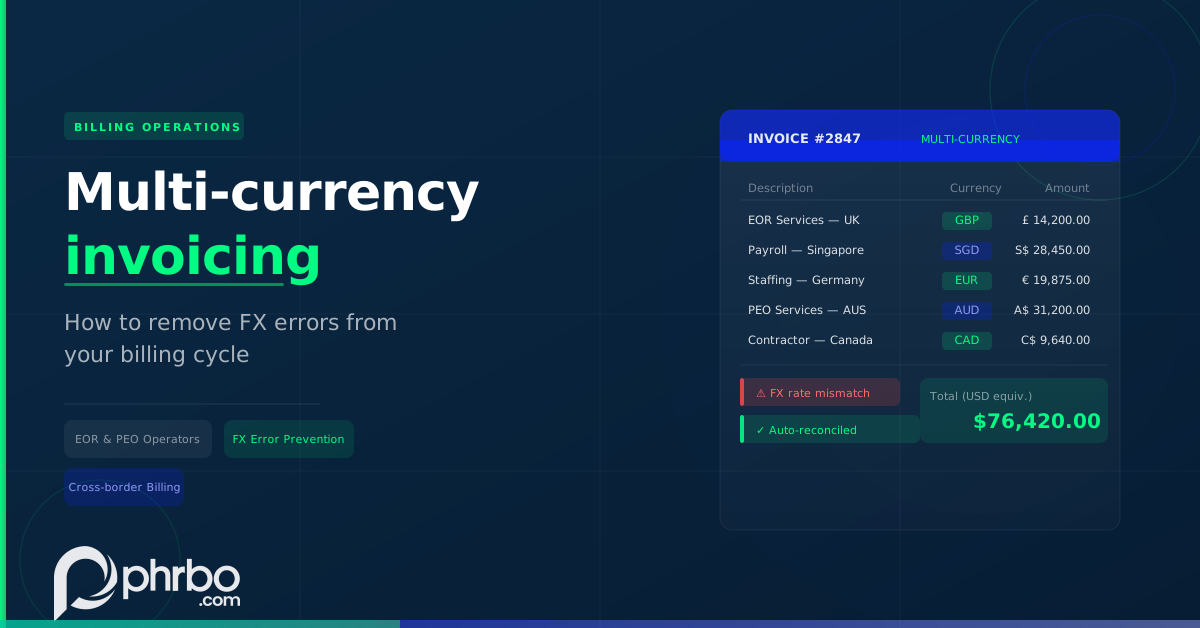
Introduction: FX errors as a revenue leakage vector for EOR operators
Quarter-close. Your accounts receivable team is reconciling invoices sent to a North American client over the past 90 days. The client’s contract specifies billing in USD. Your workers in Mexico and the Philippines were paid in MXN and PHP respectively. On the surface, everything looks clean.
Then the numbers don’t balance. A $14,200 gap, not a rounding issue, not a missing invoice. A rate problem. The exchange rate applied at invoice generation was pulled manually two weeks before payroll actually closed, before the final worker hours were confirmed, before the applicable tax withholdings settled. By the time money moved, the rate was stale by 1.8%.
For a single billing cycle, $14,200 is manageable. Across 12 billing cycles, across eight clients in six currencies, it becomes a structural revenue leak, one of the clearest and most quantifiable vectors in what researchers estimate as $149M–$373M in annual leakage across EOR operations industry-wide.
That is the problem this article addresses directly. Not the concept of multi-currency invoicing as a feature list, but the specific failure points where foreign exchange errors enter the billing cycle for EOR providers, PEOs, and staffing agencies, and the operational steps that close those gaps permanently.
Multi-currency invoicing, in the EOR context, means billing a client in their preferred settlement currency while simultaneously carrying payroll costs in one or more worker currencies, and doing so with rates that stay consistent, auditable, and reconciled from payroll close through to bank receipt.
If your invoicing workflow handles the currency conversion at any step other than payroll close, you are carrying FX exposure you likely aren’t measuring. This article shows you where to look and what to change.
Why multi-currency invoicing fails: a root cause map
Most FX billing errors don’t originate from exotic currencies or volatile markets. They originate from process gaps that are easy to normalise and difficult to see until the damage compounds. These are the five root causes that appear most consistently in EOR and staffing billing operations.
1. Manual rate entry with no source record
Someone on the billing team opens a browser, checks the day’s USD/PHP rate on a bank website or currency converter, types it into the invoice template, and moves on. No timestamp and source logged. No comparison to what payroll used.
This is the single most common origin point for FX billing discrepancies. The rate is often directionally correct but not precisely aligned to the rate the payroll system applied, or the rate the client’s finance team will use to validate the invoice on receipt. Small deviations per transaction accumulate into meaningful variance across a quarter.
2. Rate lock versus rate float, a contractual ambiguity left unresolved
An EOR contract might specify billing in USD without specifying which rate applies or when it is fixed. Is the rate set at the date the client’s purchase order is issued? The first day of the billing period? The date the invoice is raised? The date payment is received?
Each of those trigger points can produce a materially different invoice amount, and the difference is nobody’s error, it’s an unresolved contractual ambiguity that the billing process is left to resolve ad hoc, inconsistently, every month.
3. Disconnected systems holding different rates for the same period
A typical EOR back-office runs at least three systems that all handle currency: a payroll platform that calculates worker compensation in local currency, an ERP or accounting system that converts those costs to the functional reporting currency, and a billing or invoicing tool that generates the client-facing document.
In most cases, these systems do not share a single rate source. Each pulls its own rate, at its own time, from its own reference. The payroll platform might use a mid-month rate. The ERP might use a month-end close rate. The invoice tool might use whatever was manually entered. The result: three documents, three rates, one reconciliation nightmare.
4. Rounding and decimal precision errors that compound over time
Currency pairs involving emerging market currencies, MXN, PHP, BDT, NGN, often carry four to six decimal places of precision in interbank rates. Billing systems that round to two decimal places at each calculation step introduce small errors that are invisible on any single invoice but measurable across a client relationship of three or more years.
Mid-period rate changes, when a payroll run spans a month boundary, or when a worker’s hours are approved and billed in different periods, compound this further. The rate that applied when hours were worked is not the rate that applied when hours were approved, which is not the rate applied when the invoice was generated.
5. Multi-entity billing complexity
EOR providers operating across multiple jurisdictions frequently bill through subsidiary entities, a Canadian entity bills the North American client, a Singapore entity bills the APAC client, a UK entity bills the European client. Each subsidiary has its own functional currency, its own banking relationships, and often its own billing process.
Without a centralised rate management layer sitting above all entities, each subsidiary manages its own FX exposure independently. The parent company’s consolidated P&L then carries unexplained variances that originated in billing, not operations.
The anatomy of a multi-currency invoice: what must be accurate
Before addressing process fixes, it’s worth establishing what accuracy actually means on a cross-border invoice. Many billing teams conflate three distinct currency roles that serve different functions and can diverge significantly on any given invoice.
Functional currency, transaction currency, and settlement currency
The functional currency is the currency in which the EOR entity keeps its books, typically the currency of the country where it is incorporated. The transaction currency is the currency in which the invoice is denominated, typically the client’s preferred billing currency. The settlement currency is the currency in which payment actually arrives in your bank account, which may be neither of the above, depending on your banking infrastructure.
A Canadian EOR entity billing a US client in USD, receiving payment through a USD-denominated account, and reporting its results in CAD is operating across all three at once. Each conversion step carries FX exposure, and each step needs a rate that is both accurate at the time it applies and traceable back to a source.
The six fields every cross-border invoice must carry
Regulatory standards vary by jurisdiction, but for an EOR invoice to be auditable and disputable, it needs to carry at minimum: the base amount in the worker’s local currency, the applicable exchange rate, the rate source and the date that rate was captured, the converted amount in the billing currency, any FX variance from the prior period’s rate if applicable, and the settlement currency if it differs from the billing currency.
Invoices that show only the converted billing-currency amount, the most common format, leave the client unable to validate the conversion and leave the EOR unable to defend the rate in a dispute.
Tax currency obligations that diverge from billing currency
In Mexico, digital invoices issued under the CFDI framework must reflect the exchange rate published by Banco de México on the date of the transaction, not the bank rate, not the interbank mid-rate, not the rate your treasury desk prefers. An EOR billing a Mexican payroll through a Mexican entity and failing to use the official Banxico rate on its CFDI invoice is not just exposing itself to reconciliation errors; it is creating a compliance gap with SAT, Mexico’s tax authority.
In the Philippines, the Bureau of Internal Revenue (BIR) requires that invoices involving foreign currency transactions reference the Bangko Sentral ng Pilipinas (BSP) exchange rate. In Canada, the Canada Revenue Agency (CRA) specifies which rate sources are acceptable for GST/HST reporting on cross-border transactions.
These are not edge cases. For any EOR operating payroll in these jurisdictions, the tax-authority-mandated rate and the rate your billing system applies may not be the same number, and the gap between them creates a compliance exposure that sits quietly until an audit surfaces it.
The manual process vs. what a unified platform eliminates
Most EOR billing workflows were built before cross-border payroll reached its current scale. The manual process that worked for one or two client currencies becomes structurally inadequate at five, twelve, or fifty, not because the people running it are careless, but because the failure surface grows with every currency pair added.
What the manual workflow looks like, and where it breaks
The typical sequence runs like this: payroll closes in the local currency system. A billing analyst is notified. The analyst checks an external rate source, a bank portal, a financial data terminal, sometimes a public currency site, captures the rate, and enters it manually into the invoice template. The invoice is generated and sent. Payment arrives, often at a different rate. The difference is logged as an FX variance and written off at quarter-end.
The breakdown point is the manual rate capture step. It introduces three compounding risks: the rate is captured at a different time than payroll closed, the rate may be from a different source than the client’s finance team uses to validate the invoice, and the rate is entered by a person who may use a different source next month. None of this is detectable in real time. The error only surfaces at reconciliation, after the invoice has been accepted, payment terms have started, and correcting the rate requires a credit note.
What centralised rate management eliminates
A unified billing and payroll platform eliminates the manual rate capture step by design. When payroll closes, the exchange rate applied to convert worker costs into the billing currency is captured automatically, from a single authoritative source, at the exact moment the payroll run finalises. That rate is then locked to the invoice, it travels with the transaction record, not entered separately into a billing tool.
The invoice that reaches the client carries the same rate the payroll system applied. The rate that posts to the ERP is the same rate on the invoice. There is no longer a manual handoff between systems where a human can introduce a different number.
Three-way reconciliation: what it looks like when it works
The gold standard for cross-currency billing reconciliation is a three-way match: the payroll cost in the worker’s local currency matches the converted cost in the invoice, and the converted cost on the invoice matches the settlement amount received in the bank account (adjusted for the settlement rate, which is a separate and known variable).
When this three-way match closes automatically, because the rate travels with the transaction from payroll through invoice through bank receipt, the reconciliation that currently takes a billing analyst two to three days per quarter takes minutes. The variance that used to require manual investigation either doesn’t exist, or is explained entirely by the known settlement rate difference, which is not an error but a treasury variable.
FX gain/loss, from manual journal entries to automated posting
Every cross-currency invoice produces an FX gain or loss at the point of settlement: the rate at which payment was received differs from the rate at which the invoice was raised. Under both IFRS and local GAAP variants, this variance must be recognised in the period it occurs.
In a manual workflow, this means a finance team member calculates the variance per invoice, per client, per currency, and posts a manual journal entry. At scale, this is a significant source of month-end workload and an equally significant source of posting errors. A unified platform that knows both the invoice rate and the settlement rate can calculate and post the FX gain/loss automatically, eliminating the manual journal entry entirely.
Audit trail: from reconstructed to native
When a client disputes an invoice rate, or when an auditor asks for documentation of the exchange rate applied to a specific transaction, the response in a manual workflow is: search email archives, check the spreadsheet the billing analyst used that month, try to reconstruct what rate source was checked and when.
A platform-native audit trail means every rate applied to every transaction is logged with a timestamp, a source reference, and a link to the payroll run it corresponds to. The documentation exists by default, not assembled after the fact.
Multi-currency invoicing in EOR, PEO, and staffing: sector-specific considerations
The failure modes described above are common across workforce services, but the specific exposure varies by operating model. Each sector carries a different configuration of currency risk, and the remediation approach needs to account for that.
EOR providers: the primary exposure point
For an Employer of Record, the core billing structure is inherently multi-currency: the EOR employs the worker, pays them in their local currency, and invoices the client in a separate billing currency, often USD, EUR, GBP, or CAD. The spread between what the EOR pays in local currency and what it recovers in billing currency is the margin. Any FX slippage in the rate applied at billing directly compresses that margin.
At the scale PHRBO’s platform supports, 120+ currencies across EOR client deployments, the markup compliance requirement adds a further dimension. The EOR must apply its contracted markup percentage to the base cost converted at the agreed rate. If the rate applied at billing differs from the rate applied at payroll, the markup is calculated on the wrong base. The EOR may be over-recovering (creating a client dispute) or under-recovering (compressing its own margin) without either party immediately detecting it.
EOR providers with operations in multiple jurisdictions face this risk across every active currency pair. A provider billing clients in USD, EUR, and SGD while running payroll in PHP, MXN, INR, and BDT carries twelve active currency conversion exposures per billing cycle, each one a potential source of revenue leakage if not managed through a centralised rate mechanism.
PEOs: scoped exposure within a co-employment structure
Professional Employer Organizations operating in North America, where PHRBO’s target market is concentrated, typically co-employ workers alongside their client companies. The PEO administers payroll, benefits, and compliance; the client retains operational direction of the workforce.
In a domestic PEO structure, FX exposure is limited. The relevant cross-currency risk arises when a Canadian PEO is administering payroll for a US-based client with Canadian workers, or when a PEO client is invoiced in a currency that differs from the currency in which the PEO holds its payroll accounts.
The FX exposure in the PEO model sits primarily at the worker currency/client billing currency boundary, not at the payroll tax level, which is assessed and remitted in the jurisdiction currency and does not create a billing currency discrepancy. Contract structures for PEOs operating across the Canada-US border should specify the applicable exchange rate source and fixing date to avoid ambiguity at billing.
Staffing agencies: leakage that aggregates across placements
For staffing agencies operating across multiple countries, the FX billing challenge is one of volume and fragmentation. A single agency may have workers placed across eight countries, billed to clients in four currencies, on billing cycles that don’t align with each other or with payroll runs.
Each individual FX discrepancy may be small, a few dollars or euros per placement. But the aggregate leakage across 200 active placements, over four quarterly billing cycles, compounds into a meaningful figure. Staffing agencies that have not built currency-specific rate controls into their billing workflow are typically carrying this leakage invisibly, it shows up as unexplained variance in the margin report, attributed to “currency movements” rather than identified as a billing process failure.
Contract structures that allocate FX risk explicitly
Regardless of operating model, the most effective risk allocation tool is the client contract. Three mechanisms are commonly used: a fixed exchange rate clause that locks the billing rate for the contract term (eliminating variability at the cost of any rate improvement); an FX buffer, typically 1–3% added to the billing rate to absorb minor fluctuations without triggering invoice adjustments; and a monthly rate adjustment window, where the rate is reset on the first business day of each billing period using an agreed reference source.
Each mechanism trades off certainty against flexibility. Fixed-rate clauses give both parties budget predictability but leave the EOR carrying market risk if the currency moves sharply against it. Monthly adjustment windows pass more of the rate movement through to the client but require a transparent, agreed source that both finance teams can independently verify.
Still losing margin to FX errors on every invoice?
Most EOR and staffing operators don’t catch currency discrepancies until they’ve already hit their bottom line. PHRBO shows you exactly where the leakage is, and closes it.
Conclusion: closing the FX gap starts with the billing workflow
FX billing errors are not an accounting nuisance. They are a measurable, recurring revenue leak that compounds across clients, currencies, billing cycles, and quarters. For an EOR operator running payroll across eight countries and billing four currencies, the gap between the rate payroll applied and the rate the invoice carried is not a rounding difference, it is a structural margin erosion that has a dollar figure attached to it.
The root cause, in almost every case, is the same: the exchange rate is handled at the wrong step in the workflow, by the wrong system, using the wrong source, and the gap between those three “wrongs” is where the leakage lives.
The fix is not more rigorous manual checking. At the billing volume and currency complexity that characterises modern EOR operations, manual rate management does not scale to accuracy. The fix is synchronisation, between payroll close and invoice generation, between rate source and rate application, between what the platform records and what the client receives.
When payroll closes and the invoice is already populated with the correct rate, the entire category of FX billing error ceases to exist. That is not an efficiency improvement. It is a structural elimination of a leakage vector.
FX errors in billing are one of the five named revenue leakage vectors in PHRBO’s Workforce Revenue Leakage in EOR Operations series. If this article has surfaced a process gap worth investigating further, the full series provides the framework to assess your total leakage exposure across billing, time and attendance, contractor classification, rate card management, and payroll reconciliation.
