

The Spreadsheet Trap in Staffing Agencies
Across the staffing industry, a critical operational risk persists largely unaddressed: the continued dependence on spreadsheets to manage one or more of the continued dependence on spreadsheets to manage the inputs and outputs of their core recruitment operations, the data flowing into their pipelines and the reports, billing, and payroll summaries flowing out.. At 11:47 PM, ahead of a client’s payroll deadline, a recruiter or back-office admin is manually copying candidate names, pay rates, and start dates across multiple tabs. One misplaced row, one stale version of the file, and the agency faces a payroll error, a difficult client conversation, and damaged trust that took months to build.
Spreadsheets persist because they offer the perception of control. They require no implementation cost, no vendor relationship, and no learning curve. For agencies operating at low placement volumes, this perception holds. The operational cracks remain hidden.
The fundamental problem is the back office team regularly interrupts, postpones or schedules vacations around payroll cycles. one of scale. What functions adequately at ten placements per month becomes a structural liability at one hundred. The tool that provided early operational order becomes the primary constraint on growth. The evidence is clear, consistent, and consequential.
The Hidden Costs You’re Not Tracking in Your Staffing or Recruitment Firms
The operational cost of spreadsheet dependency does not appear on a profit and loss statement. It accumulates in four distinct and compounding ways.
Time leakage is the most measurable. Every hour a recruiter invests in manual data entry — updating candidate statuses, logging call notes, reformatting reports for client delivery — is an hour diverted from revenue-generating activity. At scale, this loss is not marginal; it represents a significant and permanent reduction in team capacity.
Version chaos is the inevitable consequence of distributing files across a team. When multiple recruiters work from emailed copies of a shared spreadsheet, data integrity cannot be guaranteed. Conflicting records, missed updates, and duplicated entries are not occasional errors — they are structural outcomes of the process itself.
Error compounding transforms individual mistakes into systemic failures. A single incorrect formula or misplaced row cascades into inaccurate billing, flawed performance reporting, and client disputes. The downstream consequences of a data entry error in a spreadsheet environment are difficult to contain and frequently expensive to resolve.
The absence of an audit trail compounds every other risk. When data is altered in a spreadsheet, there is no record of who made the change, when it was made, or what the prior value was. Accountability is structurally impossible, and root cause analysis after an error is largely guesswork.
How Spreadsheets Stall Your Sales Pipeline
A staffing agency’s revenue is determined by the efficiency of its sales pipeline. Spreadsheets are passive repositories. They do not trigger follow-up actions, alert teams to stalled opportunities, or surface pipeline gaps that require intervention.
Client leads and business development activities managed through rows and columns lack the structure required for consistent pipeline progression. Without automated reminders and stage-based tracking, opportunities do not advance — they stagnate. Deals are lost not through competitive failure, but through internal process failure.
The strategic implications are equally significant. Without structured data on client performance and job type profitability, leadership cannot identify the relationships and verticals that generate the highest return. Revenue strategy defaults to intuition rather than evidence. Investment in the wrong client segments persists unchallenged.
A purpose-built staffing agency software platform is the necessary first step in converting pipeline management from a passive tracking exercise into an active, accountable process, with full visibility across every team member and every stage.
However, it is precisely that: a first step. If the output of that sales process still terminates in a spreadsheet, placement confirmations manually logged, billing summaries extracted into a file, client reports assembled by hand, the structural risk is reduced, but it is not eliminated. The goal is not simply to improve how the sales team operates within the system. It is to ensure that what flows out of that system is as automated, accurate, and integrated as what flows through it.
The Candidate Experience Takes the Hit
Candidate experience is a direct function of operational infrastructure. When two recruiters independently contact the same candidate for separate roles with no awareness of each other’s outreach, the damage is immediate and lasting. The candidate perceives disorganization. The agency’s professional credibility is undermined before a placement conversation begins.
Without a centralized communication history, every recruiter-candidate interaction begins without context. Prior conversations go unacknowledged. Commitments are missed. Information must be gathered repeatedly, which signals to candidates that their time and history with the agency are not valued. This visibility deficit, however, does not stop at the recruiter level.
Every internal stakeholder managing the client’s interests, from account managers tracking placement commitments, to back-office teams processing onboarding and payroll, to leadership monitoring client health, requires access to the same communication record. When that record exists only in a recruiter’s inbox or a disconnected spreadsheet, the rest of the organization operates without the context needed to serve the client accurately and consistently. A failure at any one of those touchpoints is, from the client’s perspective, a failure of the agency as a whole.
In a competitive talent market, the agencies securing the highest-quality candidates are those that deliver faster, more informed, and more professional engagement at every touchpoint. Operational inefficiency does not remain internal — it surfaces in the candidate experience, and candidates respond by disengaging.
Compliance and Data Security: A Ticking Clock
Spreadsheets provide no access control architecture. Any individual with access to the file has access to its entire contents — candidate personal information, compensation data, client contractual terms, and sensitive employment records. There is no mechanism for role-based permissions, no capability for data segmentation, and no system for logging access events.
For agencies operating under GDPR, equal employment opportunity regulations, or sector-specific compliance frameworks, manual tracking of data governance obligations is both unreliable and unsustainable. The probability of a compliance violation increases proportionally with volume and team size.
A single spreadsheet transmitted to an unintended recipient constitutes a data breach. The regulatory and reputational consequences of such an event are significant. As agency operations scale, the exposure compounds. This is not a theoretical risk — it is a predictable outcome of inadequate data infrastructure.
The Scaling Wall — Where Spreadsheets Break Down
There is a definable inflection point in every staffing agency’s growth trajectory at which spreadsheet-based operations transition from manageable to obstructive. Below that threshold, the inefficiencies are tolerable. Above it, they become a structural ceiling that constrains revenue, team performance, and client capacity.
Onboarding new recruiters into a spreadsheet-dependent environment requires weeks of institutional knowledge transfer before productivity begins. The system’s logic is undocumented, its structure informal, and its continuity dependent on individuals rather than processes. Each new hire represents a period of operational vulnerability.
Performance reporting consumes disproportionate resources. Producing accurate client-facing reports or internal leadership dashboards requires manual aggregation from multiple sources, with no guarantee of data currency. Decisions are routinely made on lagging, incomplete, or inaccurate information.
Sustainable growth demands delegation. Delegation demands documented, repeatable systems. Growth that depends on individuals rather than infrastructure is not scalable — and spreadsheets, by design, are not systems.
What Staffing Agencies Are Doing Instead
Agencies that have moved beyond spreadsheet dependency have adopted integrated operational platforms — combining applicant tracking systems (ATS) built for recruitment, client management CRMs, and Workforce Revenue Data Systems (WRDS) that provide financial oversight across the full staffing lifecycle.
At the operational level, recruitment workflow automation eliminates the manual effort that currently consumes recruiter capacity. Interview scheduling, candidate follow-up sequences, onboarding documentation, invoice generation, payroll funding analysis, and profitability reviews are systematized and executed without reliance on individual discretion or availability.
Real-time dashboards provide leadership with immediate visibility into the metrics that govern operational and financial performance — fill rates, time-to-place, gross margin by client, payroll funding status, and team productivity. Strategic decisions are grounded in current, accurate data rather than periodic manual compilations.
Signs Your Staffing Agency Has Already Outgrown Spreadsheets
The following indicators signal that operational infrastructure has become a constraint on agency performance. Each represents a systemic failure mode, not an isolated incident:
- A placement has been lost as a direct result of a data error or file version conflict.
- Team is often spending Wednesday evenings reconciling and correcting spreadsheet data rather than advancing client or candidate activity.
- Leadership cannot answer fundamental operational questions — current payroll funding status, fill rate by client, or average time-to-place — without conducting a manual audit across multiple files.
- New recruiter onboarding requires weeks of process orientation before productive activity begins, with no documented process to support it.
These are not isolated operational difficulties. They are predictable, recurring outcomes of an infrastructure that has reached its functional limit.
Growth Requires Infrastructure in Your Staffing Firm or Recruitment Agency
The decision to move beyond spreadsheets is not a question of technology preference. It is a question of strategic capacity. Agencies that scale effectively do so because their operational systems support growth — not because individual contributors compensate for the absence of those systems through additional effort.
The agencies achieving consistent, compounding growth are those that have built infrastructure capable of expanding with them. Infrastructure that enforces data integrity, automates repetitive processes, protects sensitive information, and provides leadership with the visibility required for sound decision-making.
Transitioning away from spreadsheets is not an operational disruption — it is an operational foundation. It is how agencies build organizations that function independently of any single individual, deliver consistent client and candidate experiences at volume, and maintain the financial clarity required to grow with confidence.
Your Agency Has Outgrown Spreadsheets. Your Software Should Reflect That.
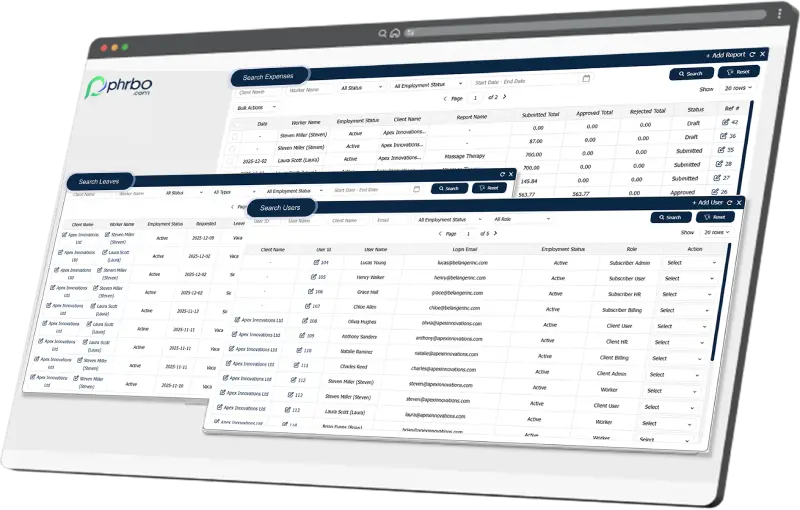
PHRBO is purpose-built for staffing agencies that are ready to replace manual processes with integrated, end-to-end operations, from pipeline management and recruiter activity all the way through to payroll outputs, billing, and profitability reporting. No more spreadsheet intermediaries. No more data falling through the gaps between systems.
Where to Start to be modern staffing agency in the industry
The instinct for most agencies is to begin where the pain is most visible, with the sales team and recruiters. Improving how opportunities are tracked, how candidates are managed, and how pipeline activity is reported delivers measurable gains, and it is a legitimate place to start. However, there is a growing body of evidence to suggest that the higher-value intervention lies elsewhere.
Workforce Revenue Data Systems (WRDS) theory proposes that the greater source of revenue leakage is not within individual functions, but in the connective layer between them, the points where data moves between sales, recruitment, onboarding, payroll, and billing. These handoffs, almost universally managed through spreadsheets and manual processes, are where errors compound, delays accumulate, and margin quietly erodes.
Addressing the connective tissue first, understanding what moves between workforce operations, where it breaks down, and how it can be systematically controlled, identifies and engineers out revenue leakage at its source, rather than optimizing individual functions while the gaps between them remain.
The audit, therefore, should not begin with the question of which team is least efficient. It should begin with the question of where data leaves one system and enters another manually. That is where the structural risk is highest, and where the return on infrastructure investment is greatest.
