

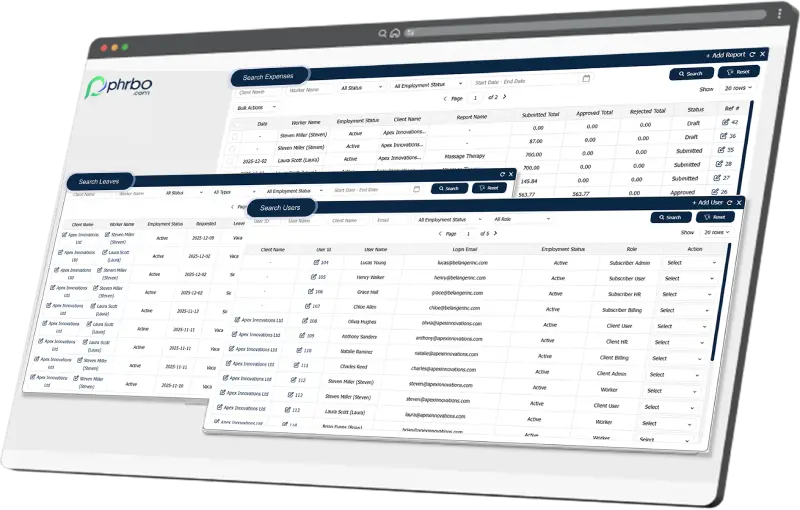
Integrated HR and payroll software matters because it closes the gap between the moment an employee’s status changes and the moment that change reaches payroll. In most EOR operations, that gap is where the damage happens, a comp change logged in one system, a termination date recorded in another, a benefits election sitting in a spreadsheet somewhere between the two. At ten employees, someone catches it. At a thousand, across a dozen entities, nobody does until finance asks why the accrual doesn’t match headcount.
For an operator running EOR at any real scale, this isn’t a nice-to-have systems question. It’s the difference between a platform that can absorb growth and one that requires a headcount of internal ops staff just to keep two systems talking to each other.
What Integrated HR and Payroll Software Actually Means for an EOR
The term gets used loosely enough that it’s worth being precise. Integrated HR and payroll software means employee data and pay data live in a connected system where a change in one place is reflected in the other without a person moving it manually. That’s the bar. Anything short of that — a nightly export, a manual upload, a support rep re-keying a field — is not integration. It’s a workaround wearing an integration’s name.
This distinction matters more for an EOR platform than it does for a typical mid-market company running its own payroll, because an EOR is managing employment relationships on behalf of clients across multiple legal entities, multiple pay cadences, and often multiple countries at once. The HR record for a worker in one entity has to stay synchronized with the payroll run for that same worker without anyone on either side of the client relationship having to double-check it.
| Read-only sync | Bidirectional integration | |
|---|---|---|
| Direction of data flow | HR system pushes to payroll, one way | HR and payroll systems update each other |
| Who catches an error | A person, usually after the fact | The system, at the point of entry |
| Typical mechanism | CSV export, nightly batch file | API, webhook, real-time field mapping |
| What breaks first at scale | Month-end reconciliation | Rarely breaks the same way — errors surface immediately, not in arrears |
The difference between those two columns is the entire reason this topic deserves more attention than it gets during a vendor evaluation.
The Read vs. Write Problem — Why “Integration” Doesn’t Mean What Vendors Say It Means
Every vendor in this space will tell you their HR and payroll software is integrated. Ask a second question before you believe it: does the integration read data, or does it write data?
A read-only connection means the payroll system can see what’s in the HR system, but nothing flows back the other direction. An employee’s address changes in the HR platform, and payroll picks it up on the next scheduled sync — assuming the sync runs, assuming the field maps correctly, assuming nobody’s mid-cycle. A bidirectional integration means either system can update the other, in something close to real time, and the correction happens once instead of twice.
The gap between those two setups rarely shows up in a sales demo. It shows up three months into a live client relationship, when a mid-cycle salary adjustment doesn’t reach payroll in time, or when a termination processed in HR still shows an active pay run because payroll never got the update. Neither system was wrong. They just weren’t actually talking to each other, no matter what the pitch deck called it.
The fields that should sync in both directions, at minimum:
- Employee name, title, and employment status
- Compensation and any mid-cycle adjustments
- Hours worked, overtime, and time-off balances
- Tax status and jurisdiction
- Benefits elections and deduction changes
If any of those fields only move in one direction, you don’t have integrated HR and payroll software. You have two systems with a courier service between them.
How Payroll and HRIS Synchronization Reduces Operational Risk
The operational risk in an EOR relationship isn’t abstract. It shows up in specific, recurring places, and payroll and HRIS synchronization addresses each one directly rather than as a general efficiency gain.
Duplicate records are the most common failure. When HR and payroll maintain separate employee databases, even a well-run team ends up with two versions of the same worker — one updated last week, one updated last month. Synchronization removes the second copy entirely, because there’s only one record to update.
Stale headcount data is the second. A client adds five contractors mid-quarter, HR logs them, and payroll doesn’t know they exist until someone manually flags it. In a synchronized system, that’s not a manual flag — it’s the same entry appearing in both places the moment it’s created.
Month-end accrual mismatches are where finance teams usually notice the problem, even though it started weeks earlier. If payroll data and headcount data don’t reconcile automatically, someone spends the last week of every month manually walking the numbers back to figure out where they diverged. That’s not a payroll problem. It’s a systems architecture problem that happens to surface in the payroll close.
None of this is theoretical for an EOR operator specifically, because the exposure compounds with every additional client entity. A single mismatch inside one company’s internal HR team is an inconvenience. The same mismatch inside an EOR platform means it’s happening across every client relying on that platform, simultaneously, without any of them necessarily knowing it yet.
Compliance at Scale — Why a Single Platform for HR and Payroll Management Matters More as You Grow
A single platform for HR and payroll management earns its value slowly and then all at once. At low headcount, the compliance burden is manageable even with disconnected systems — one jurisdiction, one set of rules, enough institutional memory that people catch what the software doesn’t. That stops being true the moment an EOR operator adds a second country, a third pay frequency, or a client with workers spread across several regions.
Payroll automation and HR compliance software earns its place here because compliance isn’t a single rule — it’s a stack of jurisdiction-specific requirements that change on their own schedule, independent of each other. Tax withholding thresholds shift. Statutory leave entitlements get revised. A benefits deduction that was compliant last quarter isn’t this quarter because a local regulation changed underneath it.
A single, integrated platform can apply those changes once, at the system level, and have them reflected everywhere that data lives. Disconnected systems require someone to apply the same change twice, in two places, and hope both updates land the same way.
This is also where the “worth it at scale” question actually gets answered. Integrated HR and payroll software is not obviously worth the switching cost for a company running payroll in one country with a stable headcount. It becomes clearly worth it the moment an operator is managing multiple entities, multiple compliance regimes, and a growth rate that outpaces the internal team’s ability to manually catch every discrepancy.
The math changes with scale, not with company size on its own — a fast-growing 50-person operation spread across four countries has more exposure than a stable 500-person company in one.
Workforce Management Software With Payroll Integration — Beyond HR Teams
Not everyone evaluating this category thinks of themselves as buying “HR software.” Staffing agencies and RevOps teams managing contingent labor are often searching for workforce management software with payroll integration instead, and the underlying requirement is the same one described above — a connected system rather than two systems bridged by manual work. The label differs by buyer, but the operational bar doesn’t move. If time tracking, scheduling, and pay data aren’t synchronized the same way HR and payroll data should be, the same failure points show up: someone’s hours don’t match their pay run, and nobody finds out until the worker does.
What to Ask an EOR Provider Before You Sign
Most of the damage from a poorly integrated system doesn’t show up during the sales process. It shows up after go-live, when it’s expensive to unwind. Ask these questions before the contract is signed, not after:
- Which fields sync bidirectionally, and which sync only one way? Get the specific list. “Fully integrated” is not an answer.
- What is the sync frequency — real time, hourly, nightly? A nightly batch is not the same as a live sync, even if both get called “integration.”
- Who manages the field mapping when the HRIS schema changes? Systems get updated. Someone has to own what happens when a field is renamed or restructured on either side.
- What’s the actual implementation timeline, start to first live payroll run? Ask for a real number from a comparable client, not a range from the sales deck.
- Can we speak to a current client running a similar multi-entity setup? If the answer hesitates, that’s information too.
- What happens to historical data during migration — does it move, or does it start fresh? This determines whether your reporting has a gap on day one.
Write the answers down. Compare them across every provider you’re evaluating using the same six questions, in the same order. That’s the only way to tell whether one vendor’s “integrated” is doing more work than another’s.
Unlock Efficiency with EOR Automation
Eliminate manual errors, reduce costs, and scale faster with automation tools built for EOR service providers. Start transforming your workflows now.
FAQ — Integrated HR and Payroll Software for EOR Operators
What’s the difference between an HRIS integration and an EOR API for payroll?
An HRIS integration connects a company’s own HR system to its payroll provider. An EOR API exposes data about workers employed on a client’s behalf through the EOR’s own legal entities. The two often need to talk to each other so a client’s internal HRIS reflects workers regardless of which entity legally employs them.
How does integrated HR and payroll software reduce errors compared to separate systems?
It removes the manual step where someone re-enters or re-checks data that already exists in another system. Each re-entry point is a chance for a typo, a missed update, or a delay — integration eliminates the point of failure rather than making it faster.
What fields typically sync bidirectionally between an HRIS and a payroll system?
At minimum: employee status, compensation, hours and overtime, tax jurisdiction, and benefits elections. If any of these only flow one direction, the integration has a gap that will eventually surface as a payroll error.
Is integrated HR and payroll software worth it for a company scaling into multiple countries?
Yes, and the value increases with each additional jurisdiction. Compliance requirements multiply faster than headcount does once a second or third country is added, and manual reconciliation across jurisdictions doesn’t scale the way a single synchronized system does.
What’s the typical implementation timeline for connecting a payroll system to an existing HRIS?
It varies by provider and by the complexity of the existing HRIS, but ask for a specific number tied to a comparable client rather than a general range — implementation timelines quoted during sales conversations are often best-case estimates.
