
A Contractor of Record (COR) is a third-party service that hires, pays, and manages compliance for your independent contractors, usually across borders, without making them your employees. The COR sits between your business and the worker, absorbing classification and payment risk.
Companies hiring contractors abroad face a growing enforcement problem: agencies increasingly reclassify contractors as employees after the fact, triggering back taxes, penalties, and legal exposure the hiring company never budgeted for. A COR exists specifically to absorb that risk.
This guide covers what a COR does day to day, how the process works step by step, where it differs from an Employer of Record, what it costs, and when direct engagement makes more sense than paying for one. It matters most for companies scaling contractor headcount across several countries at once, where one classification mistake in an unfamiliar jurisdiction can turn into a multi-year liability nobody on the team is equipped to unwind alone.
What Does a Contractor of Record Do?
A COR handles the mechanics of a contractor relationship so the hiring company doesn’t have to build that infrastructure in-house. The core responsibilities:
- Signs the contractor agreement on the client’s behalf
- Runs the classification check before onboarding
- Handles tax documentation (W-9, W-8BEN, and local equivalents)
- Manages invoicing and cross-border payment
- Keeps a compliance record in case the engagement is ever questioned
The client still directs the work day to day. The COR handles paperwork, payment, and classification risk; it doesn’t manage the project or set the contractor’s priorities.
How Does a Contractor of Record Work? (Step-by-Step)
The process runs in four stages, and skipping any one of them is usually where the classification risk quietly creeps back in.
Step 1: Classification Assessment
Before onboarding, the COR reviews the role against classification tests for the worker’s country: control, integration, permanence, and financial independence, to confirm contractor status holds up, not just the label the hiring company wants to use.
Step 2: Contract Execution
Once classification clears, the COR signs a compliant contractor agreement with the worker, on the client’s behalf, using terms structured to hold up under local labor law rather than a generic template pulled from the internet.
Step 3: Onboarding and Tax Documentation
The COR collects the right tax forms for the jurisdiction: a W-9 for US contractors, a W-8BEN for foreign contractors paid by a US client, or the local equivalent, and files what needs filing on the correct schedule.
Step 4: Ongoing Payment and Compliance Monitoring
Once the contractor is active, the COR runs invoicing and cross-border payment, tracks the engagement for classification drift as scope or hours change, and flags renewal or conversion decisions before they become compliance problems.
Contractor of Record vs Employer of Record: What’s the Difference?
The two models solve different problems. A COR keeps someone as an independent contractor; an EOR converts them into a full employee, on paper, without your business setting up a legal entity in their country.
| Contractor of Record | Employer of Record | |
|---|---|---|
| Legal relationship | Independent contractor | Employee |
| Who directs the work | Client company | Client company |
| Who handles compliance | COR | EOR |
| Best for | Project-based, short-term work | Ongoing, full-time roles |
| Benefits / statutory obligations | None (contractor self-manages) | EOR administers |
Neither model is inherently better. The right choice depends on how the role functions, how long it’s expected to last, and how much control the hiring company needs over the day-to-day work.
Read also: What is an Employer of Record (EOR) – A Complete Guide
Contractor of Record vs Agent of Record (AOR): Same Thing?
“Agent of Record” and “Contractor of Record” get used interchangeably by some providers, and in practice their core function overlaps: both stand in as the contracting party and handle the paperwork tied to hiring an independent contractor.
Where the terms diverge, AOR tends to originate from staffing and recruiting contexts, while COR is more common in global hiring and compliance discussions. Ask a provider directly what their agreement covers before assuming the terms are identical.
Why Contractor Misclassification Is the Real Risk COR Solves
What Counts as Misclassification
Misclassification happens when a worker is labeled a contractor on paper but functions like an employee day to day: fixed hours, exclusive availability, ongoing supervision, or work central to the business, not a defined project with a clear end date.
US regulators apply an economic reality test that weighs control, permanency, and how integral the work is to the business. A signed contractor agreement alone does not settle the question, according to current federal wage-and-hour guidance.
Hiring companies routinely underestimate this because the risk doesn’t show up immediately. A contractor relationship can run for years looking fine on paper before a state audit, a worker’s own complaint, or a benefits dispute forces the classification question into the open.
Penalty Exposure by Region
In the US, unintentional misclassification can trigger IRS penalties tied to unpaid FICA and unfiled forms, while the Department of Labor separately pursues back wages and liquidated damages under the Fair Labor Standards Act.
State agencies add their own exposure on top of that. Some states allow penalties reaching tens of thousands of dollars per worker for willful violations, layered on whatever the IRS and DOL already assess for the same misclassified role.
Outside the US, the exposure looks different but isn’t smaller. The UK’s off-payroll working rules make the hiring business responsible for correctly classifying contractors, with HMRC able to reach back several years and assess unpaid tax plus interest.
Every jurisdiction runs its own version of this test, on its own timeline, with its own penalty structure. A hiring company running contractors across five countries is effectively managing five separate regulatory exposures at once, not one.
How a COR Reduces That Exposure
A COR absorbs the classification decision itself, runs the tax documentation correctly, and holds the compliance paper trail if a worker’s status is ever challenged, shifting the exposure from the hiring company’s books onto the COR’s contract.
When Should You Use a Contractor of Record?
The decision usually comes down to how the role is structured, not how the hiring company would prefer to classify it for cost reasons.
Good Fit
A COR fits project-based work, market testing, and short-term specialist roles: engagements with a defined scope and end date, where the worker genuinely operates as an independent business rather than an extension of the internal team.
Not a Good Fit
Skip the COR model when the worker is exclusive or near-exclusive to your business, the role is drifting toward permanent, or the person needs deep access to internal systems. Those signals point toward Employer of Record instead.
Do You Need a Contractor of Record for Just One or Two Freelancers?
For one or two contractors, direct engagement with a solid written agreement and correct tax forms often covers the risk on its own. A COR earns its cost once volume grows or a jurisdiction carries heavier misclassification exposure.
Take a small agency paying two overseas freelancers a few times a month. A payment platform like Veem can handle the cross-border transfer and invoicing cleanly, without the ongoing cost of a COR relationship built for higher volume.
The moment that changes, say five contractors becomes fifteen, or one of those jurisdictions turns out to carry a high misclassification enforcement rate, is the moment a COR’s flat fee starts looking cheap by comparison.
A rough gut check: if you can name every contractor’s classification status from memory and their paperwork is current, you’re probably still fine going it alone. Once that stops being true, it’s time to price out a COR.
How Much Does a Contractor of Record Cost?
Most COR providers charge one of two ways: a flat monthly fee per contractor, or a percentage of what that contractor invoices. Flat fees favor predictability at scale; percentage pricing tracks cost more closely to actual contractor pay.
Volume tiers move the number in your favor. Providers typically discount per-contractor pricing once you cross a threshold, since onboarding and compliance overhead per worker drops as the relationship scales past a handful of contractors.
Country complexity is the other lever. A contractor in a jurisdiction with heavier documentation requirements or higher misclassification enforcement costs more to manage than one in a market with lighter compliance overhead, and pricing usually reflects that difference.
Watch for what’s excluded from the base fee. Payment processing fees, currency conversion spreads, and rush onboarding can sit outside the headline price, so the quoted rate isn’t always the full monthly cost per contractor.
Running COR or EOR Services for Clients?
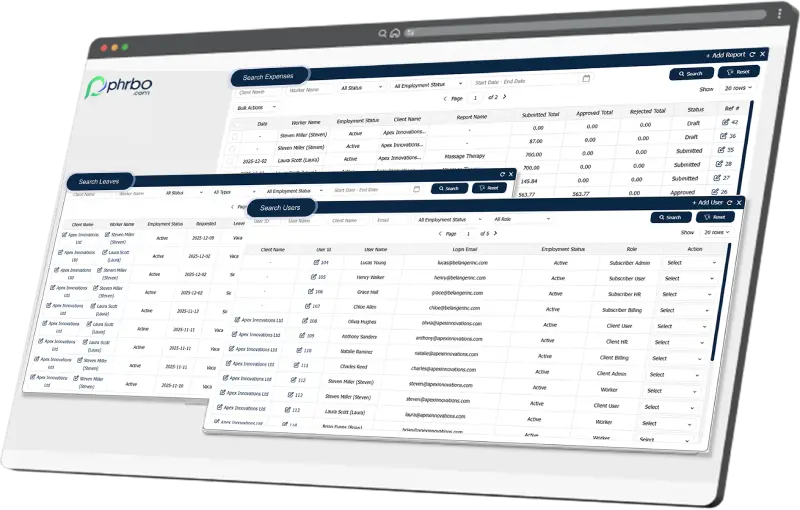
PHRBO gives EOR and COR providers the HR, payroll, and back-office technology to manage and monitor every contractor and employee from a single system.
Can You Convert a Contractor to a Full Employee?
Yes, and it happens often. A contractor’s scope expands, the engagement turns ongoing, or the company decides it needs tighter control over the work. Each of those is a trigger to convert from contractor status to employee status.
Running COR and EOR on one platform simplifies that switch. The worker’s records, tax history, and payment data carry over instead of starting from zero with a new provider mid-conversion, which is where most delays and errors happen.
Without that continuity, converting a contractor usually means re-collecting documentation, re-running onboarding, and risking a payment gap during the handoff between two separate providers who don’t share a system.
FAQ
What is a Contractor of Record and how does it work?
A Contractor of Record hires and pays your independent contractors on your behalf, handling classification checks, contracts, tax documentation, and payment, while your company keeps direction over the day-to-day work.
What’s the difference between Contractor of Record and Employer of Record?
A COR keeps the worker as an independent contractor. An EOR makes them a legal employee and administers the benefits and statutory obligations that the COR model doesn’t cover.
Is Contractor of Record the same as Agent of Record?
The terms overlap, and some providers use them interchangeably, but AOR more often traces back to staffing contexts. Check what a specific provider’s agreement covers rather than assuming from the label alone.
How much does a Contractor of Record service cost?
Pricing runs as a flat monthly fee per contractor or a percentage of contractor invoices, with volume discounts at scale and higher costs for jurisdictions carrying heavier compliance requirements.
What happens if I misclassify an international contractor?
Exposure varies by country but typically includes back taxes, interest, and penalties from tax and labor authorities, plus potential liability for the benefits the worker should have received as an employee.
