
Retroactive adjustments happen when a PEO corrects a prior invoice after the fact, a payroll tax true-up, an admin fee error, a late census update. They become disputes when the operator was never told why, how much, or how far back the correction reaches.
What Is a Retroactive Adjustment on a PEO Invoice?
A retroactive adjustment is a charge or credit applied to a current invoice that corrects something tied to a prior pay period. It is not a new fee. It is a fix to a number the PEO already billed once, recalculated with better information.
This differs from a rate change, which applies going forward, and from a billing error, which is a mistake requiring correction regardless of timing. Retroactive adjustments PEO billing conversations usually start here.
Operators tend to assume any prior-period line item is an error before confirming which category it actually falls into. That assumption alone is what turns a routine correction into a dispute nine times out of ten.
A common example: April payroll runs, taxes get calculated on preliminary wage data, and a jurisdiction updates its rate table in early May. The May invoice carries an adjustment line correcting April’s liability. Nothing was wrong with April’s invoice at the time.
Why PEO Invoices Carry Prior-Period Charges in the First Place
PEOs bill after payroll processes, not before, which creates a structural lag between when wages are earned and when every associated cost is fully known. Tax rates, benefit eligibility, and workers’ comp classifications can all shift after the fact.
This is what drives PEO payroll accrual adjustments. Your PEO isn’t holding back information at invoice time, it’s billing on the best data available, then reconciling once agencies or your own headcount changes catch up.
Most of the time, that lag is routine, not a red flag. Set up the contrast now, because the next section covers what actually is a red flag: an error masquerading as a routine true-up.
The Five Most Common Triggers Behind Retroactive Billing Corrections
Most retroactive lines trace back to one of five recurring causes:
- Payroll tax true-ups after a state or federal filing correction changes a prior liability.
- Admin fee basis errors, where the fee was calculated on gross wages instead of the adjusted wage base that your contract specifies.
- Mid-year census or benefit enrollment updates that change premium allocations retroactively.
- Workers’ comp premium true-ups, tied to actual payroll volume once a policy period closes.
- Late-arriving regulatory or tax rate changes issued by an agency after the original invoice went out.
PEO admin fee billing errors are the one category that isn’t inherently normal. It’s worth flagging separately from the other four, since it points to a calculation problem rather than a timing one.
True-Up Billing vs. Billing Error, Why the Difference Matters for Disputes
A true-up is a scheduled reconciliation mechanic built into how PEO billing works. A billing error is a mistake, the wrong rate applied, the wrong wage base used, a fee calculated incorrectly.
Both show up as unexpected charges on the same invoice. Only one requires a correction beyond what your contract already anticipates as normal, scheduled reconciliation.
Operators conflate the two because both arrive unannounced. That conflation is exactly what escalates a routine PEO true-up billing cycle into a dispute, the operator assumes error before either side explains itself.
How Far Back Can a PEO Retroactively Adjust Your Bill?
There’s no single, universal lookback window that applies across every PEO relationship. The governing language sits in your client service agreement (CSA), not in a general industry rule, and CSAs vary meaningfully between providers.
Some contracts cap retroactive adjustments to a defined number of billing cycles. Others tie the window to when the underlying error was itself discovered by the taxing authority or carrier, which can extend further back than operators expect.
Payroll tax corrections specifically follow IRS timing rules once a Form 941 amendment is involved, separate from whatever your CSA states on its own adjustment clause.
State wage-and-hour rules can also affect what’s collectible retroactively. That variation is reason enough to read your CSA’s adjustment clause directly, rather than assume a standard number applies to your contract.
How to Reconcile a PEO Invoice When an Adjustment Shows Up
Reconciliation gets faster once it’s a routine, not a scramble. Five steps cover most retroactive lines:
- Pull the master invoice and isolate the adjustment line from current-period charges.
- Request the supporting calculation, the specific pay period, rate, and wage base used.
- Compare the corrected figure against your CSA’s stated rate terms and fee basis.
- Confirm whether the correction is a true-up, a rate change, or an error.
- Log the variance in your reconciliation file, even if it checks out, so the pattern is visible next quarter.
This is the same disciplined approach that finance teams already apply to benefit premium reconciliation, matching payroll records against carrier invoices to catch overcollection before it compounds into what the industry calls benefit leakage.
How to Dispute a Retroactive Adjustment You Don’t Agree With
If the calculation doesn’t hold up against your CSA terms, put the dispute in writing before escalating verbally. A paper trail protects both sides and forces specificity from whoever responds to it.
Ask for the exact rate, wage base, and pay period behind the adjustment. Set an internal escalation timeline tied to your normal invoice-approval window, not an open-ended one.
If the initial documentation request goes unanswered, escalate to your account manager, then to a broker if one’s involved. Persistent disputes over admin fee basis or contract interpretation are when a PEO-experienced attorney earns their fee.
Retroactive charges shouldn’t be a surprise.
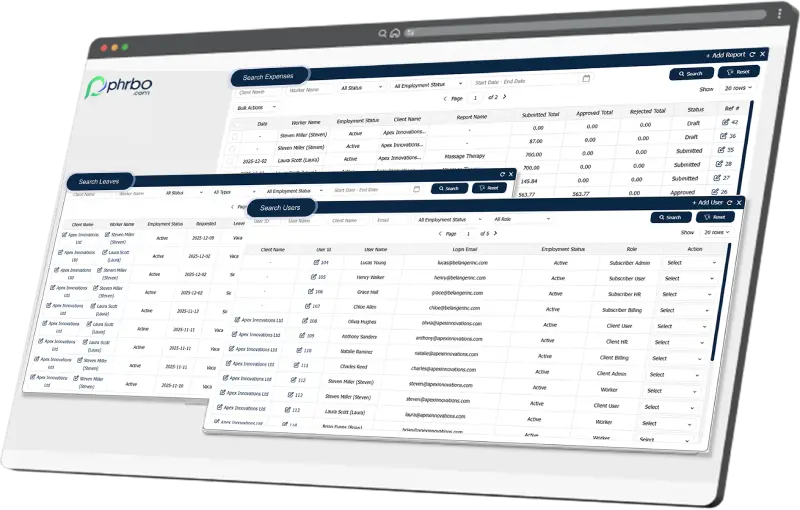
PHRBO’s client portal shows every adjustment as it happens, no more digging through invoices to find out why your bill changed.
How to Prevent Retroactive Adjustment Disputes Before They Start
The operators who see the fewest disputes run a monthly reconciliation cadence instead of reviewing invoices only when something looks off. A fixed schedule catches drift before three months of adjustments stack into one confusing bill.
Push for an adjustment-notice clause in your CSA at renewal. That’s language requiring the PEO to flag and explain retroactive lines before or alongside the invoice, not after you’ve already asked.
Request itemized true-up backup proactively each cycle, rather than waiting for a discrepancy to force the conversation. It costs nothing to ask for upfront, and it saves real time later.
FAQs
Is it legal for a PEO to backbill for a billing error?
Yes. Correcting a billing error is standard practice and generally permitted, provided the correction reflects an actual miscalculation rather than a retroactive rate increase your CSA doesn’t authorize.
The dispute is usually over the amount or timing of the correction, not whether correcting it is allowed in the first place.
What causes billing disputes between employers and PEOs?
Most disputes trace back to a lack of upfront explanation, an operator sees an unexplained prior-period charge and assumes error before confirming whether it’s a true-up, a rate change, or an actual mistake.
PEO charged me extra after payroll already ran, is that normal?
Often, yes. PEOs bill after processing payroll, so tax rate updates and workers’ comp true-ups regularly land later. It’s abnormal only when the PEO can’t produce the calculation behind it.
