
White-label PEO software lets a PEO run its business on someone else’s technology while every client sees only your name, your login screen, and your domain. The vendor owns the backend. You own the relationship, the payslip, the portal, and the brand your clients trust.
This guide walks through what white-label PEO software includes, who uses it, and what separates a shallow rebrand from a platform that carries your identity everywhere a client looks. Use it to benchmark any vendor before you sign a multi-year technology contract.
What White-Label PEO Software Actually Means
Understand the Vendor-Builds, You-Brand Model
A white-label PEO platform separates who builds the technology from who owns the client relationship. A specialist vendor develops and maintains the payroll, HR, and benefits engine behind the scenes, while your PEO controls every screen, document, and interaction the client sees and touches daily.
This co-employment structure is well established in the PEO industry, which today serves more than 200,000 businesses through roughly 500 providers nationwide, according to NAPEO. White-labeling simply changes who sits at the technology layer, not who legally shares employment responsibility with your client.
That distinction matters operationally too. Your support team fields client questions, your sales team demos the platform, and your account managers own renewal conversations, even though the vendor’s engineers handle uptime, security patches, and feature releases behind the interface clients never access.
Know What “Branding” Covers in Practice
Branding on a white-label platform means the pieces clients interact with carry your company’s identity, not a full disappearance of the underlying technology. Expect control over portal styling, document formatting, and outbound communications, with some technical layers still tied to the provider.
- Client and employee portals display your logo, color palette, and a custom subdomain, so daily logins read as yours rather than the vendor’s.
- Payslips, tax documents, and compliance notices carry your company name and letterhead, even though the generation engine sits with the technology partner behind the scenes.
- Mobile access reflects your branding within the app experience itself, though the app store listing typically stays under the platform provider’s developer account.
- Automated system emails and client notifications send from your domain, replacing the generic vendor address employees used to see in their inbox.
Who Uses White-Label PEO Software
White-label PEO software attracts two distinct buyer types, and both share the same underlying motivation: they want technology credibility without the multi-year build cycle a proprietary platform demands. The specifics of why they need it differ by starting point and existing client base.
Scale Without Hiring a Development Team
Growing PEOs reach a point where spreadsheet workflows and generic vendor software stop scaling. White-label platforms let you add enterprise-grade payroll and HR technology immediately, without recruiting engineers or spending eighteen months building a platform your clients will never fully trust as yours.
Expand Into HR Services From Insurance or Staffing
Insurance brokers and staffing agencies also lean on white-label PEO software when they extend into HR services. Instead of referring clients to a co-employment provider and losing the relationship, they deliver payroll and benefits under their own name, keeping the client loyalty they already earned.
What’s Included in a Typical White-Label PEO Platform
Feature checklists vary by vendor, but a genuinely complete white-label PEO platform covers three layers: the administrative engine, the interfaces clients and employees touch daily, and the connective tissue that ties the platform into your existing sales and reporting stack.
Cover Payroll, HRIS, and Benefits Administration
The core stack behind most white-label PEO platforms handles multi-state payroll processing, an HRIS for employee records and compliance, and benefits administration for enrollment, carrier connections, and open enrollment cycles. These modules run on the vendor’s infrastructure but display entirely under your brand.
- Multi-state payroll processing, tax filing, and wage garnishment handling
- HRIS functionality for employee records, org structure, and compliance documentation
- Benefits administration covering enrollment, carrier connections, and open enrollment support
Give Clients and Employees Self-Service Portals
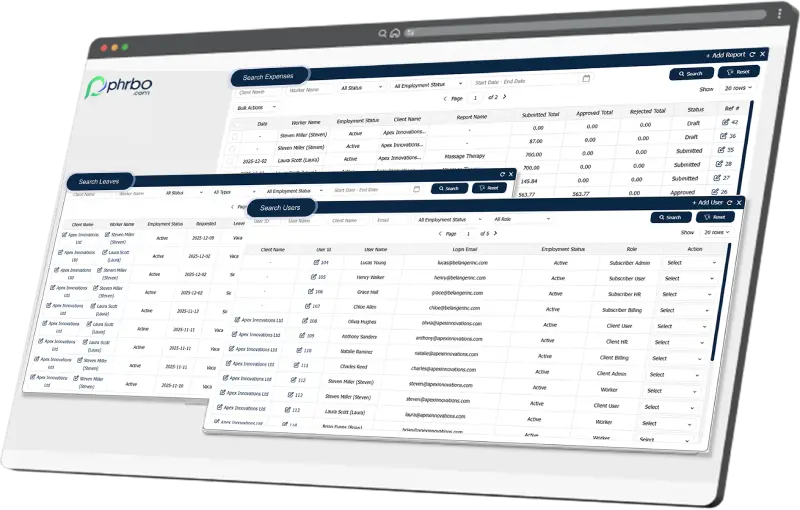
Client administrators and worksite employees both need self-service access, and white-label platforms typically ship separate branded portals for each. Employees check pay stubs and benefits; client admins run reports and manage HR tasks, all inside an interface that carries only your company’s identity.
Connect Through Mobile Apps and APIs
Most platforms extend branding to mobile, offering a white-labeled app clients download under your company name rather than the vendor’s. API access matters too, since it lets you connect payroll and HR data to your CRM or reporting tools without manual exports.
Why Brand Control Matters for a PEO’s Growth
Feature parity between white-label vendors is increasingly common, which means brand control has become the real differentiator for PEOs competing on trust rather than price. The platform behind the scenes matters less to clients than the name in front of them.
Anchor Client Relationships to Your Name
Every client interaction under a vendor’s branding is a missed opportunity to strengthen your own reputation. When clients log in, receive payslips, and open the mobile app under your name, they associate every positive experience with you, not the technology company they never see.
Build Trust Through Consistency at Every Touchpoint
PEO clients that grow with a provider tend to stay, and NAPEO’s own client research links strong client relationships to lower turnover and faster growth for the businesses they serve. Consistent, unbroken branding across every touchpoint reinforces the trust that keeps those clients renewing.
What to Evaluate Before Choosing a White-Label PEO Platform
Not every white-label vendor offers the same depth of customization, so a structured evaluation protects you from signing a contract that looks branded in the demo but reverts to generic vendor styling the moment you need something customized later.
Check the Depth of White-Labeling
Ask vendors exactly how deep their white-labeling goes before signing. Some only rebrand the login screen, while others extend your identity to the custom domain, payslips, notifications, and mobile app. Depth of branding determines how consistently your name shows up to clients daily.
Confirm Data Ownership and Portability
Confirm who owns client and employee data before you commit, and how easily you can export it if you switch platforms later. Vendor lock-in on data is a common risk in white-label arrangements, so get portability terms in writing during the evaluation stage.
Ask About Implementation Timeline
Implementation timelines vary widely across white-label vendors, from a few weeks for a lightweight rebrand to several months for deep customization. Get a realistic go-live date in writing, and ask what happens to your existing client data during the migration window.
Quick Evaluation Checklist
- Depth of white-labeling across domain, login, payslips, and notifications
- Data ownership and export terms in writing before you sign
- A realistic implementation and go-live timeline
FAQ
What is white label PEO software and how does it work?
A specialist vendor builds and maintains the payroll, HR, and benefits technology, while your PEO puts its own name, logo, and domain on every client-facing screen and document. Clients interact only with your brand and never see the underlying technology provider behind the platform.
What’s the difference between white label and private label PEO software?
White-label software is a shared, one-to-many platform that many PEOs rebrand under their own name. Private-label software is built or customized exclusively for a single PEO. The two differ significantly in depth of customization, implementation cost, and long-term technical control.
Is white label PEO software worth it for a growing PEO?
It’s typically worth it once client volume turns vendor-branded software into a credibility or retention risk, and building proprietary technology isn’t realistic in the near term. At that stage, white-labeling protects your brand equity while you continue scaling the client base you’ve built.
See What Deep White-Labeling Looks Like
Ready to see what deep white-labeling looks like in practice? Explore PHRBO’s PEO software platform, built for operators who want vendor-grade technology without ever putting a vendor’s name in front of their clients.
