
For years, EOR providers treated the client portal as a convenience layer, something IT bolted on after the contract closed, or skipped altogether. That assumption no longer holds.
In conversations with more than 100 EOR operators this year, the same pattern keeps coming up: portals are surfacing inside request of proposals (RFPs) and vendor shortlists before a single demo call gets booked.
That lines up with the broader data. TrustRadius’s 2026 B2B Buying Disconnect report found product demos and free trials now rank among the most influential resources for technology buyers, cited by 73% and 77% of buyers respectively.
The market has also been rotating back toward specialized EOR services after years dominated by large, venture-backed platforms bundling PEO and EOR under one dashboard. Prospects who cut their teeth on those platforms cannot unlearn that interface.
That expectation now travels with the buyer, regardless of which type of provider they eventually sign with. A client portal has stopped being a support nicety. It has become a signal buyers read as proof of operational competence before trusting a vendor with EOR services.
Put plainly: a client portal is no longer a support feature for EOR providers. It’s a competitive requirement, and the providers who treat it that way are the ones closing deals faster. Here’s what that requirement looks like in practice.
What Is a Client Portal in an Employer of Record Platform?
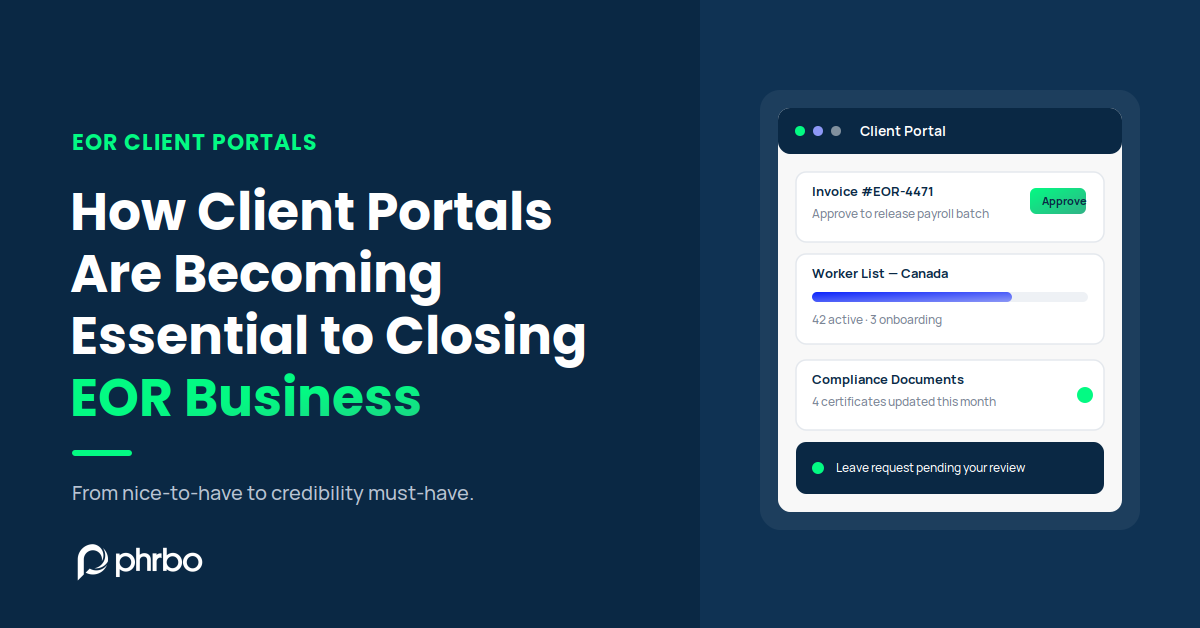
A client portal is the secure, permission-based system through which an EOR customer views/ manages its workforce data without routing every request through an account manager. It centralizes payroll visibility, compliance documentation, and employee lifecycle activity, and invoicing, behind a single login.
Inside a working portal, HR and finance teams can view payroll runs by country, pull compliance certificates for audits, track hires and terminations, and access onboarding documentation and service records, restricted by role-based permissions.
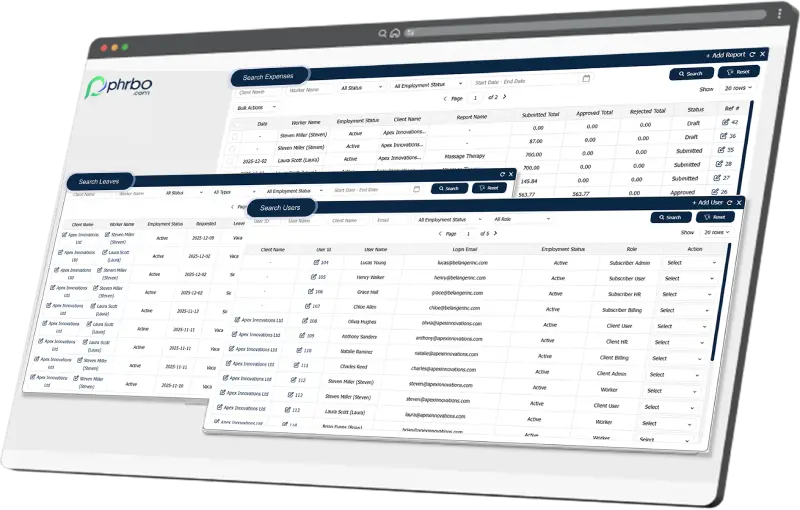
A strong portal usually combines both: clear reporting alongside real functionality clients can act on. PHRBO’s own portal, for example, pairs payroll and invoicing visibility with workflows clients use directly, like approving onboarding steps or pulling compliance documents.
Why the Portal Went From Nice-to-Have to Credibility Must-Have
If you were lucky enough to have a portal built into your infrastructure, it was probably something clients discovered after signing, not before. More likely, it was something your buyers and your own sales team never thought to ask about.
That has reversed. Buyers now request portal walkthroughs mid-evaluation, treating access as a proxy for how mature the provider’s operations actually are.
Recent Gartner sales research found most B2B buyers now prefer evaluating vendors with minimal sales rep involvement, a habit EOR buyers bring into vendor selection.
This ties to what buyers want visibility into: a global workforce management dashboard showing operational reality, not a sales deck describing it. Services and price still matter, but it stopped being the only lens buyers use to compare vendors.
How Client Portals Improve the EOR Sales Process
A portal can shorten sales cycles because it answers common compliance and operational questions upfront. Instead of a security questionnaire bouncing between legal teams, the buyer can open the portal and look for themselves.
That gives buyers something they trust: a direct look at the system, not just a description of it. Seeing how things actually work tends to move a decision along faster than a verbal assurance alone.
Some providers now offer sandbox access during evaluation, letting prospects explore the portal before signing. It’s a small shift, but one that gives buyers more confidence in what they’re about to commit to.
Why Companies Choose an EOR Provider With a Self-Service Portal
Buyers choose self-service portals because they solve a specific frustration: too many EOR relationships still run on email threads and account manager availability. A portal removes that dependency and gives buyers real-time answers on their own schedule.
A handful of distinct roles log into the same portal, and each one is looking for something different. HR and people ops check worker lists and lifecycle status. Finance reviews and approves invoices. Operations and compliance leads want status updates, not raw data.
A portal that only serves one of those roles tends to get flagged during evaluation, since more than one of these teams usually reviews it before a deal moves forward.
Do EOR Clients Need Real-Time Visibility Into Payroll and Compliance?
Not exactly, and the word real-time overstates it. What buyers actually want is information on their own terms, without emailing someone and waiting for a reply to a simple question.
That shows up as dashboard notifications: a flag when an invoice needs approval, a leave request is pending, or an expense report needs a signature, handled quickly instead of stalling.
The real risk isn’t a stale monthly report. It’s an approval or a compliance update getting buried in an inbox and missed entirely, which is why buyers now expect the portal to surface what needs attention.
What Features Should an EOR Client Portal Have?
A portal that survives serious buyer scrutiny during evaluation generally includes the following, in some form:
- Invoicing clients can review and approve on their own
- Worker lists by country, without requesting a report from support
- A payroll checklist confirming who was paid on schedule, without exposing individual pay amounts
- A compliance document repository, including certificates and statutory filings
- Onboarding and offboarding workflows that skip the email back-and-forth
- Multi-country employee data views, filterable by entity and jurisdiction
- Reporting exports covering headcount, invoicing summaries, and compliance status
Buyers increasingly check this list against a demo before moving forward, treating missing items as evidence the provider’s back office isn’t as mature as the sales pitch suggests.
Can a Client Portal Reduce EOR Onboarding Time?
Yes. Self-service portals cut onboarding time by removing the manual data collection cycle that traditionally stretched a straightforward hire into a multi-week exercise involving spreadsheets, email attachments, and repeated status check-ins.
When a client can enter employee data, upload documents, and track onboarding status themselves, providers avoid the back-and-forth that used to add days to every hire, especially roles crossing time zones and approval chains.
Time saved compounds as a client grows, since fast onboarding for hire one becomes the expectation for hire fifty, and a provider whose portal can’t keep pace becomes a bottleneck the client notices.
What Buyers Look for When Evaluating an EOR Provider’s Technology
HR and corporate buyers aren’t shopping for EOR technology on its own. They’re evaluating a provider as a whole, and technology is one piece of that decision, alongside country coverage, compliance track record, and pricing.
Within that piece, buyers look for a few specific things: direct portal access instead of routing through an account manager, coverage of the countries they’re hiring in, and a fit with the HR systems already in place.
That checklist mindset extends past the sale. Buyers increasingly ask what happens a year in, not just during onboarding, because a portal that looked solid in a demo sometimes stops improving once the contract is signed.
That question about longevity leads directly into retention, since a portal buyers trusted enough to sign with either keeps earning that trust after go-live or starts quietly eroding it.
How Self-Service Technology Impacts EOR Client Retention
Portals that work reduce support ticket volume, because clients resolve routine questions themselves instead of opening a ticket and waiting on a response. That alone changes how a client experiences the relationship day to day.
Fewer routine tickets also lowers perceived vendor risk heading into renewal conversations, since clients who rarely need to escalate tend to assume operations are running cleanly behind the scenes, even when they aren’t watching closely.
What started as a sales argument becomes a retention argument. The same portal that helped close the deal is now the reason a client renews without much hesitation, or the reason they start quietly evaluating alternatives.
See PHRBO’s client portal in action.
Payroll visibility, invoice approvals, worker lists by country, and compliance documents, all in one login.
How PHRBO Approaches Its Own Client Portal
The checklist above isn’t hypothetical for us. It’s close to the list we use internally when we look at our own portal and decide where it still needs work.
That means invoicing clients can actually follow, worker lists by country, a payroll checklist that doesn’t expose individual pay amounts, and onboarding steps that skip the email back-and-forth.
No provider gets this fully right on the first attempt, including us. What matters more is treating the portal as something that keeps improving, not something that shipped once and got left alone.
Frequently Asked Questions
What is a client portal in an EOR platform?
It’s the secure, permission-based system an EOR client uses to manage payroll visibility, compliance documents, and employee lifecycle data directly, without routing every request through an account manager.
What features should an EOR client portal have?
At minimum: payroll and invoicing transparency, a compliance document repository, onboarding and offboarding workflows, multi-country employee data views, and exportable audit trails.
Does a client portal reduce onboarding time?
Yes. It removes the manual data collection cycle that typically stretches onboarding across weeks of email attachments and status check-ins between client and provider.
How is an EOR portal different from a PEO portal?
An EOR portal reflects full compliance liability sitting with the provider, since it’s the legal employer. A PEO portal reflects a shared, co-employment arrangement instead.
Why do buyers now expect a portal before signing an EOR contract?
Because portal access has become a proxy for operational maturity. Buyers use it to evaluate trustworthiness during evaluation, not as a feature discovered after the contract is signed.
