
It’s a Friday afternoon. Your payroll ops lead has already logged off. The week closed clean — at least, you thought it did. Then a Slack message comes in from one of your account managers: the CFO of a 90-person client just called, livid. Their Q3 statutory deduction was filed at the wrong rate. Three employees are short on their net pay. Two of them are senior engineers who already had weekend plans tied to those deposits.
You spend the next two hours in remediation mode: tracing the error, issuing an off-cycle correction, drafting a client-facing explanation that threads the needle between transparency and defensibility. By Sunday evening, the fix is confirmed. Monday morning, you send the client a note. They respond with a single line: ‘Thanks for sorting it. We’ll want to revisit SLAs at our next QBR.’
That phrase — revisit SLAs — is not routine calendar management. It’s early-stage churn signaling. And it likely won’t appear in your CRM notes, your error log, or your monthly ops report.
Most EOR operators track error rates. Almost none track what those errors cost in client lifetime value, churn probability, and lost referral revenue. Those are the numbers that actually matter.
The acquisition cost reality:
Industry research consistently shows that acquiring a new B2B client costs 5–7× more than retaining an existing one. For EOR providers operating on thin margin structures — often 3–8% of client payroll — one client lost to a payroll failure isn’t just a revenue event. It’s a compounding liability that touches ARR, team capacity, and pipeline velocity simultaneously.
The Scope of the Problem — What the Data Shows
Before getting into mechanism, let’s establish scale. Payroll error rates in EOR and PEO environments don’t exist in a vacuum — they sit inside a broader industry pattern that has been documented consistently across multiple research bodies.
Error frequency is higher than operators assume
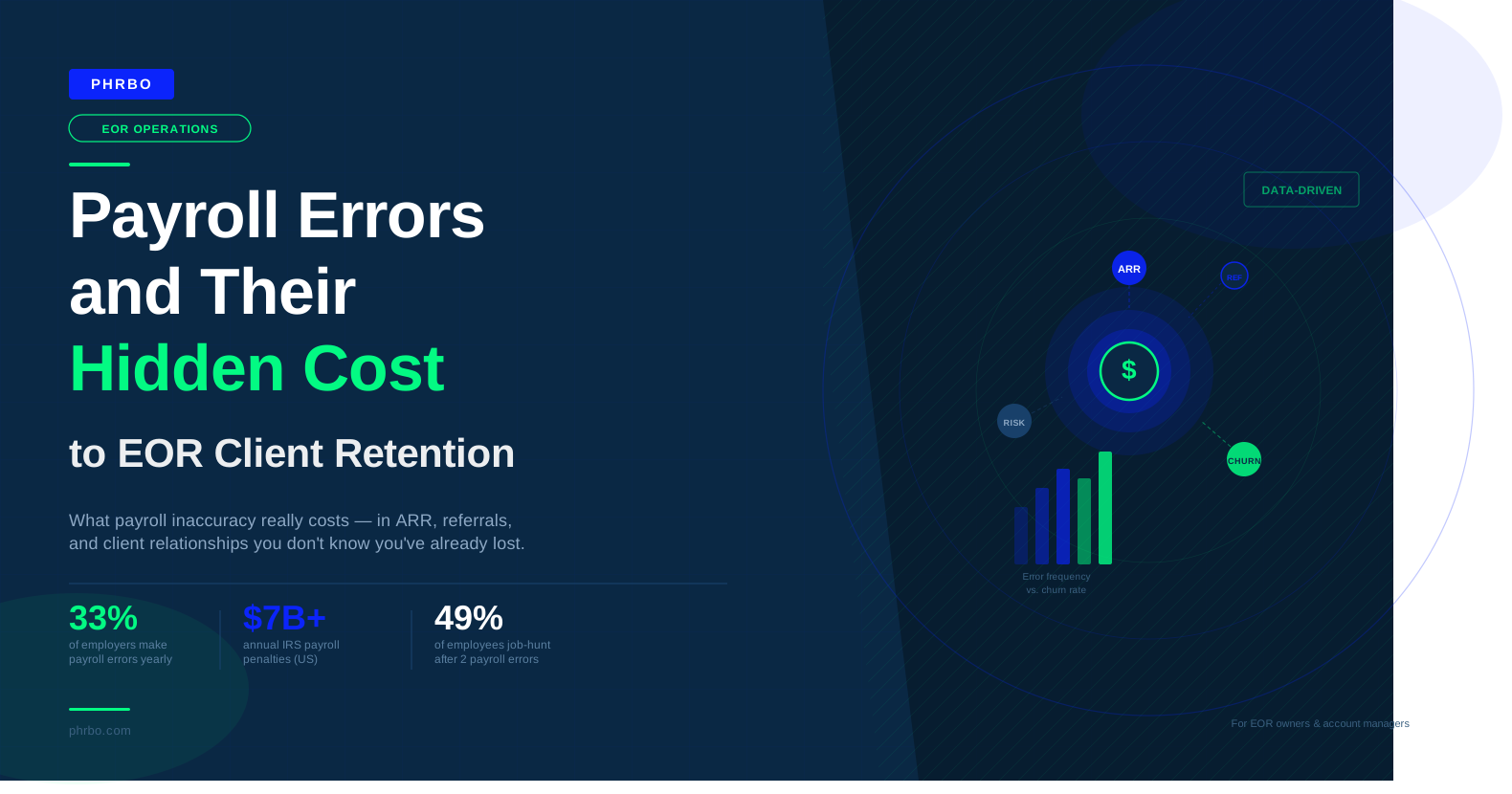
The American Payroll Association reports that approximately 33% of employers make payroll errors in a given year. That figure, on its own, sounds manageable. But EOR providers aren’t running payroll for a single employer — they’re running it across dozens of client entities simultaneously, often across multiple jurisdictions, employment classifications, and benefit structures. The cumulative error exposure is multiplicative, not additive.
A 33% annual error rate across 20 active client accounts translates to roughly 6–7 clients experiencing at least one payroll error in any given year. For a mid-size EOR operation, that’s not an edge case — it’s a structural risk embedded in the operating model.
The financial penalty layer
The IRS estimates that U.S. businesses pay over $7 billion annually in payroll penalties. Within EOR arrangements, the financial exposure is particularly sharp: clients who experience tax filing errors often absorb downstream penalties indirectly — through billing disputes, remediation costs, and the administrative burden of correcting filings across state and federal levels. The payroll error doesn’t just cost the EOR provider time. It generates a financial liability that lands, at least partially, on the client’s books.
The downstream workforce impact
The statistic that most EOR account managers underweight comes from Ernst & Young: 49% of employees say they will start actively job hunting after experiencing just two payroll errors. This matters for EOR providers because your client is not just buying payroll processing — they’re buying workforce stability. When a payroll error reaches their employees, it doesn’t stay contained to a billing conversation with their HR director. It filters into employee experience, trust in the employer, and in some cases, attrition.
Your error becomes their retention problem. That dynamic is rarely captured in a post-incident debrief.
What this looks like in practice:
For an account manager handling 15–20 active client accounts, a conservative 10% annual error rate across payroll runs produces dozens of trust-eroding moments per quarter. Most of those don’t generate a support ticket. They generate a silence that compounds.
The Visible Cost vs. The Hidden Cost
When a payroll error occurs, EOR operators tend to focus on the mechanics of resolution. That’s the right operational instinct. But it misses the commercial picture entirely.
The visible costs — what gets tracked
These are the costs that show up in your ops reporting and finance reconciliation:
- Credit notes and payroll reversals that hit your billing cycle
- Payroll team overtime during the remediation window
- Statutory penalty payments where the EOR bears liability
- Client-facing service credits issued to preserve the relationship
These are real costs. They’re also the ones most likely to be quantified, reported upward, and used to justify process improvements. The problem is that they represent, in most cases, the smaller share of total commercial damage.
The hidden costs — what drives churn
The more consequential costs live below the surface of your ops dashboard. They show up 6–12 months later in a renewal conversation that goes sideways, or in a referral that never materializes.
| Hidden Cost Category | How It Operates | Commercial Impact |
|---|---|---|
| Client churn acceleration | Repeat errors trigger early contract review and increased competitive evaluation | $80K–$200K ARR lost per mid-market client departure |
| Reduced expansion revenue | Clients who distrust payroll accuracy don’t add headcount or new jurisdictions | 20–40% of EOR growth comes from existing client expansion |
| Referral pipeline loss | EOR is a high-referral category; a dissatisfied client departure actively damages pipeline | Each lost referral = 1–3 potential new client relationships |
| Account manager capacity drain | Significant error incidents consume 4–8 hours of AM time that should be directed at growth | Opportunity cost across the entire book of business |
| Compliance audit exposure | Repeated errors elevate client audit risk, creating conversations about liability and indemnification | Variable, but reputationally severe and contractually complex |
A practitioner observation on timing:
In over a decade of EOR payroll operations, I’ve rarely seen a client terminate over a first error. Clients understand that multi-jurisdiction payroll is operationally complex. The inflection point is almost always the second error on the same issue — or the first error that touches a senior employee at the client organisation. That’s when the relationship shifts from partner to vendor. And once that shift happens, it rarely reverses before renewal.
How Payroll Errors Specifically Damage EOR Client Retention
Understanding that errors are costly is one thing. Understanding the precise mechanism by which they erode retention — and at what pace — is what separates reactive EOR operators from those who consistently renew and expand client relationships.
A. Trust is the product — not payroll processing
This is the point that most EOR sales decks get right and most EOR ops teams forget. Payroll software processes payroll. EOR providers sell something different: expertise, accountability, and the assurance that compliance complexity won’t land on the client’s desk.
When a payroll error occurs — regardless of its financial magnitude — it challenges the core value proposition. It reframes the EOR provider in the client’s mind from ‘strategic partner who absorbs complexity’ to ‘vendor I need to supervise.’ That reframing is subtle. It rarely produces an immediate complaint. But it changes how the client approaches every subsequent interaction, including their renewal decision.
B. The error-to-escalation pipeline
When an error surfaces, there’s a predictable sequence that most EOR operators run through — and within that sequence, there’s a specific window where trust erosion is highest:
- Error is detected — typically by an employee, the client’s HR contact, or an internal audit
- Client contacts the account manager, often with urgency
- AM escalates to payroll ops; a remediation timeline is communicated (usually 24–72 hours)
- The remediation window begins — this is the highest-risk period for trust erosion
- Error is resolved; client receives confirmation and, ideally, an explanation
- Post-resolution: the client evaluates the experience holistically, not just the outcome
Step 6 is where most EOR operators lose ground. The fix is completed, the incident is closed internally — but the client is still processing what the error signals about the provider’s systems, controls, and attention to their account. A clean resolution doesn’t automatically restore confidence. It depends entirely on how the remediation was handled during the window.
C. The renewal proximity effect
One of the most underappreciated dynamics in EOR client retention is the timing of errors relative to contract renewal. Client satisfaction surveys consistently show that payroll accuracy ranks as the primary factor in EOR contract renewal decisions — ahead of pricing, responsiveness, and even compliance support.
An error that occurs 8–10 months before renewal often gets absorbed. The relationship has enough goodwill to carry it. The same error occurring within 90 days of renewal creates disproportionate churn risk — it becomes the most recent data point the client holds when making their decision, and recency bias is a powerful force in B2B contract evaluation.
D. The iceberg escalation pattern
The most dangerous dynamic in EOR client retention is one that doesn’t announce itself. Most clients do not escalate every payroll error they experience. Research into B2B service dissatisfaction consistently shows that clients absorb multiple negative experiences silently before taking action — typically 2–3 incidents before they raise a formal complaint or begin competitive evaluation.
For account managers, this creates a dangerous false signal. A client who hasn’t complained in six months may not be satisfied — they may be quietly building a case for switching at renewal. The silence gets misread as a healthy relationship. The first visible signal often arrives at the QBR, or in a renewal conversation where the client’s posture has already hardened.
The Error Types That Carry the Highest Retention Risk
Not all payroll errors carry the same retention weight. Financial magnitude and retention risk are related — but they’re not the same variable. Some errors are expensive to fix but easy to explain. Others are inexpensive to correct but impossible to recover from relationally. The ranking below is based on impact to client trust, not dollar value of the mistake.
| Rank | Error Type | Why the Retention Risk Is Highest |
|---|---|---|
| 1 | Incorrect statutory deductions — tax, social security, benefits contributions | Creates immediate compliance liability for the client. Difficult to explain without implying a systems failure. Clients begin asking whether historical filings are accurate. |
| 2 | Late payroll runs | Directly visible to the client’s entire workforce. There is no version of a late payroll that doesn’t reach employees. The EOR’s operational failure becomes the client’s employee relations problem. |
| 3 | Misclassification errors — exempt vs. non-exempt, contractor vs. employee | Opens a legal exposure conversation. The client’s in-house counsel often gets involved. This shifts the relationship into a risk-management frame rather than a service frame. |
| 4 | Benefit enrolment and deduction mismatches | Employees notice benefit discrepancies faster than almost any other payroll issue. It triggers direct complaints to the client’s HR team, who then lose confidence in the EOR’s administration. |
| 5 | Multi-jurisdiction filing errors | Signals an operational capability gap. The EOR sold multi-jurisdiction competence as a core differentiator. Filing errors in that space challenge the entire value proposition. |
On off-cycle corrections:
Clients tend to view off-cycle payroll corrections differently from how EOR ops teams do. Internally, an off-cycle run is a standard remediation tool — part of the process. From the client’s perspective, particularly if it’s the second or third time they’ve seen one, it reads as evidence of a systemic process gap rather than a one-off fix. That perception gap is worth closing proactively in your client communication, not leaving to interpretation.
What High-Retention EOR Providers Do Differently
The operational gap between EOR providers with strong renewal rates and those with persistent churn isn’t usually a technology gap. It’s a process discipline gap — specifically around how payroll accuracy is managed before errors occur, and how trust is managed after they do.
Pre-payroll audits as standard operating procedure
High-retention providers don’t treat quality control as an exception-handling function. Pre-payroll audits — systematic checks of each run before it processes — are built into the operating rhythm as a standard step, not a response to a previous error. The difference in outcomes is measurable: EOR providers that implement structured pre-payroll QA processes consistently report 40–60% reductions in client-visible error rates within two quarters of implementation.
The specific audit checkpoints vary by provider, but the most effective frameworks typically include: headcount reconciliation against the prior period, deduction rate verification against current jurisdiction schedules, benefit contribution cross-referencing against enrolment records, and flag-and-hold protocols for any employee with a recent classification change.
Proactive communication before the employee does
One of the clearest differentiators between high-retention and average-retention EOR providers is who communicates first when something is off. High-retention providers have communication protocols that trigger before the error reaches the client’s employees — a brief, factual note to the account contact acknowledging the irregularity, the expected correction timeline, and the impact scope.
This sounds simple. In practice, it requires both a technical trigger mechanism (something that flags anomalies during pre-processing) and an organisational norm that treats proactive disclosure as the default, not the exception. Providers who wait to communicate until the client calls them are, by definition, already behind.
Root-cause documentation as a client-facing asset
When errors do occur, the highest-retention providers turn the post-incident process into a transparency signal rather than a damage-control exercise. A root-cause summary — one page, plain language, explaining what happened, why the existing controls didn’t catch it, and what specific process change addresses it — is shared with the client within a defined window after resolution.
Most EOR operators do some version of internal root-cause analysis. Very few share any form of it with the client. The providers who do create a meaningful relational advantage: they convert a failure moment into a demonstration of operational maturity. Clients who receive root-cause documentation after an incident are substantially more likely to renew than those who receive only the correction confirmation.
SLA-backed resolution commitments
The difference between ‘we’ll get this fixed as soon as possible’ and ‘our error resolution SLA is 24 hours for Tier 1 payroll issues and 48 hours for multi-jurisdiction corrections’ is not just semantics. It’s the difference between a verbal reassurance and a contractual commitment. High-retention providers formalise their resolution timelines, make those timelines visible to clients, and report against them.
Account manager payroll literacy
An account manager who doesn’t understand the mechanics of payroll is limited to being a message relay between the client and the ops team. An account manager who understands deduction waterfall logic, jurisdiction-specific statutory requirements, and the common failure modes in off-cycle processing can de-escalate a client conversation from a crisis to a managed issue — without waiting for ops to brief them.
Building AM payroll literacy isn’t a training cost. It’s a retention investment. The accounts managed by payroll-literate AMs consistently outperform on renewal rates and expansion revenue, because the client experiences a qualitatively different kind of support when something goes wrong.
The Retention Math — What This Actually Costs You
At some point, the discussion of payroll errors and retention risk needs to make contact with a P&L. Here’s a straightforward model for any EOR owner or VP of Client Success to run against their own numbers.
The calculation
- Average client ARR for your business: $X
- Your current annual client churn rate: Y%
- Estimated share of that churn linked to payroll friction: Z% (industry benchmark range: 20–35%)
- Preventable revenue loss from payroll-driven churn: X × Y × Z
Applied example:
Average client ARR: $120,000. Annual churn rate: 15% across 30 clients = 4–5 departures per year. If 25% of those departures are linked to payroll friction, that’s 1–2 clients per year. Revenue impact: $120K–$240K in direct ARR loss — before accounting for lost expansion revenue from those clients (typically an additional 15–30% of base ARR) and the referral pipeline those clients would have generated.
That figure — $120K–$240K in preventable annual revenue loss — is not exceptional. It’s a conservative estimate for a mid-size EOR operation running a fairly average churn rate. For operators in the $5M–$15M ARR range, the number scales quickly.
The more uncomfortable calculation is the opportunity cost: what was the expansion revenue on those accounts that never materialised? What new logos didn’t come through the referral channel those clients represented? Payroll-driven churn doesn’t just remove existing revenue. It closes a door on future revenue that is difficult to quantify but real.
Want to benchmark your EOR operation’s payroll accuracy and retention correlation?
PHRBO works with EOR providers on revenue operations, client retention frameworks, and billing infrastructure. Connect with us at phrbo.com.
The Question Most EOR Operators Can’t Answer
There’s a question I ask when working with EOR operators on retention strategy: what is your current error-to-churn correlation?
Most operators can tell you their error rate. Fewer can tell you their churn rate with confidence. Almost none can tell me what percentage of their churn is attributable, in whole or in part, to payroll accuracy issues — because they’ve never formally tracked the relationship between the two.
That tracking gap is the operational risk. Not the errors themselves — errors are inevitable in any multi-jurisdiction payroll environment. The risk is running an EOR business without a reliable signal on the commercial cost of those errors, which means you’re perpetually managing the symptom and never quite addressing the disease.
Payroll accuracy is not an ops metric. It’s a revenue metric. The EOR providers who treat it that way — who build the tracking, the pre-run controls, the communication protocols, and the AM literacy — are the ones whose clients renew because they want to, not because switching feels like too much work.
The next step is straightforward: audit the relationship between your error incidents and your client satisfaction data over the last 12 months. If you don’t have the data to run that audit, that’s the finding. And it’s worth acting on before your next renewal cycle starts.
