
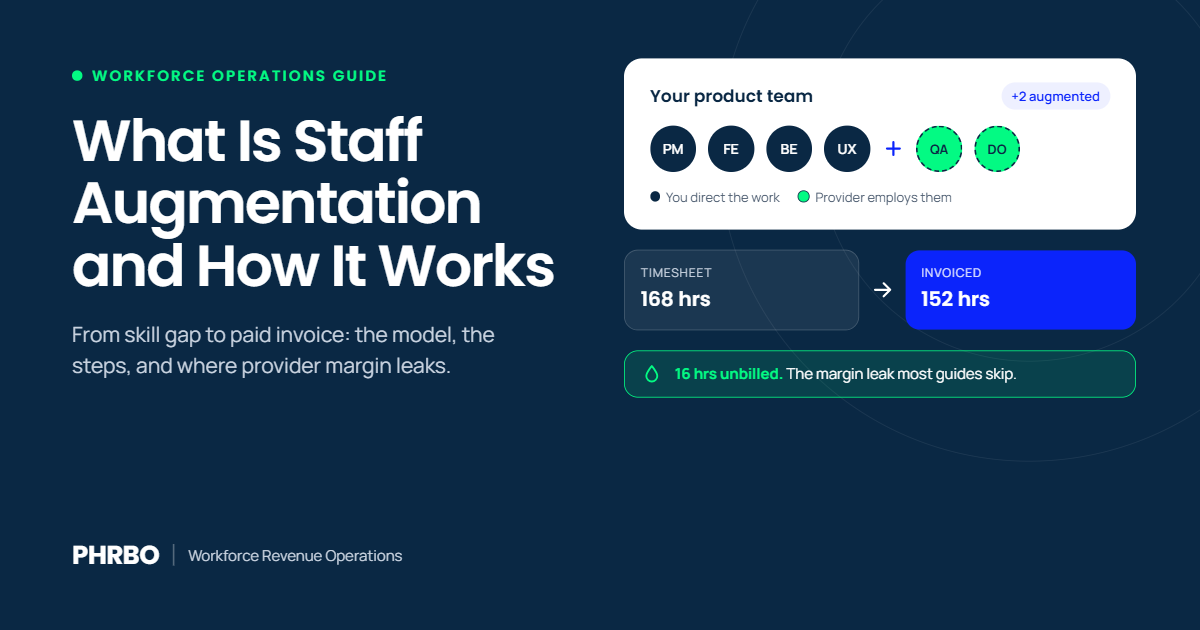
Staff augmentation lets a company add outside specialists to its own team without hiring them. The client assigns and reviews the work. A provider employs the worker, runs payroll, and bills the client for approved hours at an agreed rate. Our guide serves two readers. Buyers get a clear view of how the model works, what it costs, and when it fits.
What Is Staff Augmentation?
Staff augmentation is a hiring model where a company adds external professionals to its in-house team for a fixed period, directing their work while a provider employs and pays them.
Staff augmentation definition in plain terms
Think of it as renting capacity by the person rather than buying an outcome. You tell the provider which skills you need, at what seniority, and for how long. The provider finds the person, and you slot them into your existing team.
Your delivery model stays the same. Sprint rituals, code review rules, and reporting lines remain intact. The augmented engineer/worker joins your stand-ups, works in your tools, and ships against your definition of done, exactly as a direct hire would.
The defining trait: the client manages the work, the provider employs the worker
Every staff augmentation deal separates two things that normally sit together: control of the work and the employment relationship. The client decides what gets built and how. The provider signs the employment contract, pays wages, and withholds taxes with worker.
That split shapes every contract clause, risk, and invoice line in the staff augmentation model. When buyers blur it by setting pay, promising benefits, or handling discipline directly, they start behaving like the employer, and regulators can treat them as one.
Other names for staff augmentation
The workforce market uses several labels for the same staffing solution. Staff extension and team augmentation are common in software and web development circles. Contract staffing is the older term in US agency work. Outstaffing overlaps heavily but carries its own nuance, covered later in this guide. When the team member is in another country on a contract, the term Contractor of Record (COR) or on longer term employment the service could be called Employer of Record (EOR).
Common staff augmentation roles
IT Technology or Software Engineers roles account for most requests I have encountered. The profiles clients ask for most are software developers, QA and test engineers, DevOps and cloud engineers, data analysts and data engineers, and project managers who can run a workstream from week one.
The model also works outside tech: finance controllers during audit season, clinical research associates for a trial phase, or engineers for plant commissioning. The mechanics stay identical. Only the rate card and the compliance checklist change.
How Staff Augmentation Works: Step by Step
A typical staff engagement moves through eight stages, from spotting the talent gap to closing the assignment. Most delays happen at Steps 3 and 4, where interview loops stall and contract redlines bounce between two legal teams.
Step 1: Identify the skill or capacity gap
Start with the gap, not the job title. Write down the missing skill, the expected hours per week, the start date, and how long the need will last. A four-month data migration project calls for a different profile than an open-ended backlog engagement.
Step 2: Brief the provider and agree on a rate card
Share a short brief covering skills, seniority, time zone overlap, location limits, and any security clearance. Agree on the rate card before sourcing begins. A rate card lists bill rates by role and level, plus overtime, holiday, and travel rules.
Step 3: Sourcing, vetting, and client interviews
The provider screens its bench and network, runs technical assessments, and checks references. You receive a shortlist and interview the finalists yourself. Insist on a live technical round, because résumé screens alone let too many weak candidates through.
Step 4: Contracting (MSA, SOW or work order, and NDA/IP terms)
Paperwork comes in three layers. The master services agreement (MSA) sets liability, payment terms, and non-solicitation rules. A statement of work or work order covers each placement. An NDA and IP assignment clause confirm that everything the worker produces belongs to you.
Step 5: Onboarding into client tools and processes
Provision accounts, devices or virtual desktop access, and repository permissions before day one. Assign a technical buddy and share coding standards and escalation paths. An augmented engineer waiting a week for VPN access is a week you still pay for.
Step 6: Day-to-day management by the client
Your team leads assign tasks, run reviews, and give feedback. The provider stays out of daily delivery but should check in monthly on fit, workload, and retention risk. Performance problems go back to the provider, who handles corrective action as employer.
Step 7: Timesheets, approvals, and invoicing
The worker logs hours weekly or bi-weekly. Your manager approves them, the provider pays the worker, and then invoices you at the bill rate. This handoff is where most revenue problems begin, as the timesheet-to-invoice leakage revenue which you can fix by acquiring modern invoicing automation tool or workforce management system like PHRBO.
Step 8: Extension, conversion to hire, or offboarding
Near the end date, you have three choices: extend the work order, convert the worker to a direct hire under the agreed conversion fee, or offboard. Offboarding should cover access removal, a written knowledge handover, and return of company equipment.
Types of Staff Augmentation
Short-term vs long-term augmentation
Short-term augmentation covers a spike: a release crunch, parental leave cover, or a regulatory deadline. These terms often run under six months. Long-term augmentation fills a standing gap for a year or more, where the client prefers flexibility over new headcount approval.
Long engagements carry more legal weight. The longer a worker sits inside your team, the more they resemble your employee in the eyes of a tax authority or court. Set review points and cap tenure where local rules require it.
Commodity, skill-based, and highly skilled augmentation
Commodity augmentation fills roles with a wide talent pool, such as data entry or first-line support, where speed matters more than depth. Skill-based augmentation targets defined competencies, like a React developer or a certified payroll specialist.
Highly skilled augmentation brings in niche expertise few candidates hold: an SAP S/4HANA migration lead, a machine learning engineer with production experience, or a security architect. Expect a longer time-to-fill, thinner shortlists, and little room to negotiate rates.
Onshore, nearshore, and offshore models
Onshore talent lives in your country and works your hours. Nearshore talent works from a nearby country with a small time difference, such as Latin America for US buyers. Offshore talent sits farther away, often in India or Southeast Asia..
Choose based on how much real-time collaboration the work needs. Pair programming and incident response need several hours of daily overlap. Well-specified backlog work, testing, and documentation tolerate larger time gaps without slowing delivery.
IT staff augmentation services: why tech drives most demand
Software skills change faster than hiring cycles. A team can need Kubernetes, then data engineering, then an AI integration within eighteen months. Permanent hiring cannot turn that quickly, so IT staff augmentation services fill the gap between roadmap and headcount.
The labor market adds pressure. The US Bureau of Labor Statistics forecasts employment of software developers, QA analysts, and testers to grow 10 percent from 2025 to 2035, much faster than average. Buyers competing for that talent use augmentation to start work while permanent searches run.
Staff Augmentation vs Outsourcing vs Managed Services vs Full-Time Hiring
The core difference is who owns the result. In staff augmentation, you manage the people and own the outcome. In project outsourcing and managed services, the vendor owns delivery. In full-time hiring, you own both the work and the employment.
| Factor | Staff augmentation | Project outsourcing | Managed services | Full-time hiring |
|---|---|---|---|---|
| Who manages the work | Client | Vendor | Vendor, against SLAs | Client |
| Cost structure | Hourly or monthly bill rate per person | Fixed price or milestone payments | Recurring service fee | Salary, benefits, and hiring cost |
| Commitment length | Weeks to years, adjustable | Length of the project | Multi-year terms are common | Open-ended |
| Speed to start | Days to a few weeks | Weeks, after scoping | Weeks to months, after transition | One to several months |
| IP control | Client, through IP assignment | Negotiated in the contract | Vendor often keeps its tools | Client by default |
| Best-fit scenario | Skill gap inside an existing team | Defined project with fixed scope | Ongoing function run to SLAs | Core, long-term capability |
When staff augmentation beats full-time hiring
Augmentation wins when the need is time-bound, urgent, or uncertain. A six-month project rarely justifies a permanent requisition, severance exposure, and a long search. If the role turns permanent later, a conversion clause lets you keep the person.
It also wins when you are testing a new capability. Bring in one augmented data engineer before committing to a full data team. If the work proves its value, you hire with a sharper job description and a realistic salary benchmark.
When managed services is the better call
Choose managed services when you want an outcome, not extra hands. If nobody on your side can direct the work, or the function is non-core, such as help desk or infrastructure monitoring, paying for SLAs beats managing contractors daily.
A quick test: if you cannot name the internal manager who will assign tasks to the augmented worker every morning, you are not ready for augmentation. That missing manager is exactly what a managed service provider is paid to supply.
Staff augmentation vs a dedicated development team
A dedicated team is a complete squad, often with its own lead, supplied by one vendor and assigned only to your product. Augmentation adds individuals to your squad. Pick augmentation for a few missing seats and a dedicated team for an entire unit.
A dedicated team rate includes vendor-side management. Augmentation is leaner but moves the management load onto your leads. Before choosing, count how many spare hours your team leads really have each week for onboarding and supervision.
Staff Augmentation vs Outstaffing vs Employer of Record
Staff augmentation places a provider’s worker inside your team. Outstaffing is a close variant where the provider employs a dedicated person who works only for you, usually long term. An Employer of Record legally employs a worker you found yourself.
| Factor | Staff augmentation | Outstaffing | Employer of Record |
|---|---|---|---|
| Who finds the talent | Provider | Provider | Client |
| Who employs the worker | Provider | Provider | EOR |
| Who directs daily work | Client | Client | Client |
| Typical engagement | Project or capacity gap | Long-term dedicated role | Ongoing employment in another country |
| Main value | Speed and access to skills | Stable remote capacity | Compliant hiring without a local entity |
Where the three overlap, and why buyers confuse them
All three separate legal employment from daily direction, which is why buyers mix them up. The dividing line is recruiting. Augmentation and outstaffing providers source the talent. An EOR does not recruit; it employs someone you already chose and keeps that employment compliant.
Labels also shift by region. A vendor in Eastern Europe may call a two-year dedicated placement outstaffing, while a US agency calls the same deal contract staffing. Read the contract, not the sales deck, to see who carries each obligation.
When an augmentation provider uses an EOR for cross-border talent
Providers cannot open a legal entity in every country where strong candidates live. When a client wants a developer in Poland or Brazil and the provider has no entity there, the provider contracts an EOR to employ that worker locally.
This creates a three-party chain. The client pays the provider, the provider pays the EOR, and the EOR pays the worker. Each hop adds a fee, a currency step, and a reconciliation task, which matters a great deal once invoicing starts.
Who Handles Payroll, Taxes, and Compliance in Staff Augmentation?
The provider, or its EOR partner, handles payroll, statutory taxes, and benefits because it is the legal employer. The client approves timesheets, directs the work, and controls system access. Write each responsibility into the MSA instead of assuming it.
| Responsibility | Client | Provider | EOR (cross-border) |
|---|---|---|---|
| Employment contract | Not a party | Signs for domestic placements | Signs for cross-border placements |
| Payroll | Funds through invoice payments | Runs payroll or pays the EOR | Runs local payroll |
| Statutory taxes | None for the worker | Withholds and remits domestically | Withholds and remits locally |
| Benefits | None for the worker | Provides for domestic workers | Provides as local law requires |
| Timesheet approval | Approves hours | Collects and bills hours | Receives approved hours |
| Work direction | Directs daily work | Does not direct | Does not direct |
| Equipment | Usually provides access and devices | Provides if the contract says so | Rarely involved |
Co-employment risk and how contracts manage it
Co-employment arises when both client and provider are treated as employers of the same worker. The EEOC guidance on contingent workers explains that a client can share liability for discrimination claims when it controls the worker’s conditions of employment.
The classic warning is Vizcaino v. Microsoft, where long-tenured contractors were found to be common-law employees eligible for a stock purchase plan. Microsoft reportedly settled for $97 million in 2000. Cap tenure, skip employee perks, and route discipline through the provider.
Contracts handle the rest. The MSA should name the provider as sole employer, require workers’ compensation and employment practices coverage, and include mutual indemnities. In the UK, off-payroll working rules (IR35) add status determination duties for medium and large clients.
In the European Union, the Temporary Agency Work Directive gives agency workers equal basic working and employment conditions compared with direct hires. Buyers placing staff in EU countries should confirm that the provider prices this equal treatment into its rates.
Contractor misclassification risk with freelance-based providers
Some providers place freelancers instead of employees to cut cost. If those freelancers work full time under your direction, tax authorities can reclassify them. The IRS common-law test looks at behavioral control, financial control, and the relationship of the parties.
Ask every provider one plain question: are your placed workers employees, local employees through an EOR, or independent contractors? If contractors, request the classification analysis and indemnity terms. The US Department of Labor also treats misclassification as a wage-and-hour issue.
Benefits and Risks of Staff Augmentation
Benefits
- Speed to start. A capable provider can present vetted profiles within days, while a permanent search can take months.
- Flexible scaling. You add or release seats as the roadmap shifts, within the notice periods in your work order.
- Access to specialized skills. You bring in niche expertise for the exact period you need it, without building a permanent role around it.
- Lower hiring overhead. Recruiting, payroll, benefits administration, and filings sit with the provider. You pay for them inside the bill rate instead of running them yourself.
Risks
- Integration friction. External staff arrive without context on your codebase, culture, or unwritten rules, which slows early output.
- Knowledge loss at exit. Context about systems and past decisions can walk out with the worker when the engagement ends.
- IP exposure. Weak contracts or hidden subcontracting can leave ownership of work product unclear.
- Dependence on one provider. If one vendor supplies most of your external capacity, its price changes and delivery problems become yours.
How to reduce each risk
| Risk | Mitigation |
|---|---|
| Integration friction | Prepare access, documentation, and a named buddy before day one. |
| Knowledge loss at exit | Require written handover notes and an overlap period on long engagements. |
| IP exposure | Put IP assignment in the MSA and ban subcontracting without written consent. |
| Dependence on one provider | Keep at least two approved providers and benchmark their rates every year. |
How Much Does Staff Augmentation Cost?
Staff augmentation cost equals the worker’s pay plus the provider’s markup, which covers employer taxes, benefits, overhead, and profit. Skill, geography, engagement length, and compliance load drive the final rate. Ask for a rate card by role, not one blended figure.
Pricing models: time-and-materials, markup on pay, fixed monthly rate
- Hourly time-and-materials. You pay approved hours at a fixed bill rate. It is the most common model and the most flexible.
- Markup on pay. The bill rate equals the worker’s pay rate multiplied by an agreed factor. It is transparent, but every raise lifts your bill.
- Fixed monthly rate. One monthly fee per person, regardless of small swings in hours. It suits offshore and outstaffing deals with stable schedules.
What drives the rate
Pay is the starting point. The BLS reports a median annual wage of $135,980 for US software developers in May 2025, roughly $65 per hour on a 2,080-hour year. The lowest-paid tenth earned under $82,460; the top tenth earned above $214,670.
The provider then carries employer costs. In June 2026, benefits made up 30 percent of total compensation costs for US private industry workers, according to BLS. Recruiting, bench time, insurance, and profit sit on top of that.
Geography moves base pay the most. Engagement length matters too, because short assignments spread recruiting cost over fewer billable hours. Compliance load, such as cleared roles, regulated industries, or an EOR layer abroad, adds further cost.
Here is the arithmetic with a hypothetical factor, for illustration only. A developer paid $65 per hour at a 1.5 markup bills at $97.50. At 1.6, the bill becomes $104. Always ask the provider to list what its markup covers.
Hidden costs buyers should ask about
- Conversion fees if you hire the worker permanently.
- Overtime, weekend, and holiday multipliers written into the rate card.
- Notice periods you keep paying through after deciding to offboard.
- Onboarding days, equipment, and background checks billed as separate lines.
- EOR and currency fees on cross-border placements.
- Annual rate escalators built into multi-year MSAs.
How to Choose a Staff Augmentation Company
Judge providers on evidence, not promises. Ask each one to walk you through a recent placement, from the first brief to the first invoice. Use the checklist below during that conversation and score every answer.
- Vetting process. Who runs technical assessments, and can you see a sample scorecard?
- Time to fill. What was the median time to present a shortlist for your role type over the past year?
- Replacement guarantee. How long is the free replacement window, and how fast does a replacement start?
- Compliance coverage by country. Where does the provider employ directly, and where does it rely on an EOR partner?
- Rate transparency. Is there a rate card by role and level, with the markup disclosed on markup models?
- Timesheet and invoicing process. Does every invoice line trace back to an approved timesheet and a live work order through workforce management system?
- Exit terms. What are the notice periods, conversion fees, and handover duties?
Running an augmentation, EOR, or staffing operation?
PHRBO helps EOR and COR service providers manage and monitor their workforce with HR, payroll, and back-office operations management technology, so margin problems surface before month-end close.
FAQs
What is staff augmentation in simple terms?
Staff augmentation means borrowing skilled people from a provider to work inside your team for a set period. You assign their tasks and review their work. The provider employs them, pays them, and sends you one invoice for their approved hours.
Is staff augmentation the same as outsourcing?
No. In outsourcing, the vendor commits to delivering a result, and its own managers run the work. In staff augmentation, the vendor supplies people, but you manage them and own the result. That difference decides who carries the delivery risk.
Who pays the worker in staff augmentation?
The provider pays the worker, not the client. It runs payroll, withholds taxes, and provides any benefits, then bills the client for approved hours. On cross-border placements, an Employer of Record often pays the worker locally on the provider’s behalf.
Can augmented staff be converted to full-time employees?
Yes, most contracts allow conversion. The work order usually sets a conversion fee, and some providers reduce it the longer the worker has been placed. Check the non-solicitation clause before making an offer, because skipping it can trigger penalties.
How long do staff augmentation contracts usually last?
There is no fixed standard. Short assignments run from a few weeks to six months, while long engagements can continue for years. Very long tenures raise co-employment risk, so many clients set a maximum assignment length and review placements at each renewal.
Is staff augmentation cheaper than hiring?
Per hour, augmentation usually costs more than a salaried employee, because the bill rate carries the provider’s overhead and margin. For a short or uncertain need, it often costs less overall, since you skip recruiting, severance, and idle time after the work ends.
Conclusion
Staff augmentation adds external talent to your team while a provider holds the employment. It runs on a clear chain: brief, vet, contract, onboard, direct, approve, invoice, and close. It breaks down between the timesheet and the invoice, where rates, hours, and fees drift.
