
The short answer: in 2027, the EOR market settles into three layers, and the middle layer changes fastest. Pricing pressure, tighter compliance rules, and mid-market consolidation and collaboration will decide which EOR providers keep their margins and which ones quietly lose them.
At the top sit the venture-funded global aggregator platforms. At the bottom sit regional operators running their own entities. Over the last year, dozens of acquisitions and partnerships have started building a layer between them: closed networks of mid-market providers.
Successful regional players have learned that the real constraint is customer acquisition, not delivery. Whoever owns the client relationship owns the easier growth. The challenge to this client ownership is serving clients who keep outgrowing the countries where you run your own entities.
So far, the answer to that problem has been acquisition. In 2027, a different answer emerges: regional operators working with each other in open networks, connected by operating platforms such as PHRBO rather than by ownership.
These predictions come from hundreds of conversations over the last three years with operators, sales leaders, owners, and finance and payroll teams at global EORs. As well, I’ve consulted industry research and my partners at PHRBO who also ran an EOR for 15 years. Each prediction ends with what it means for the people who run EOR businesses.
Where the EOR market stands going into 2027
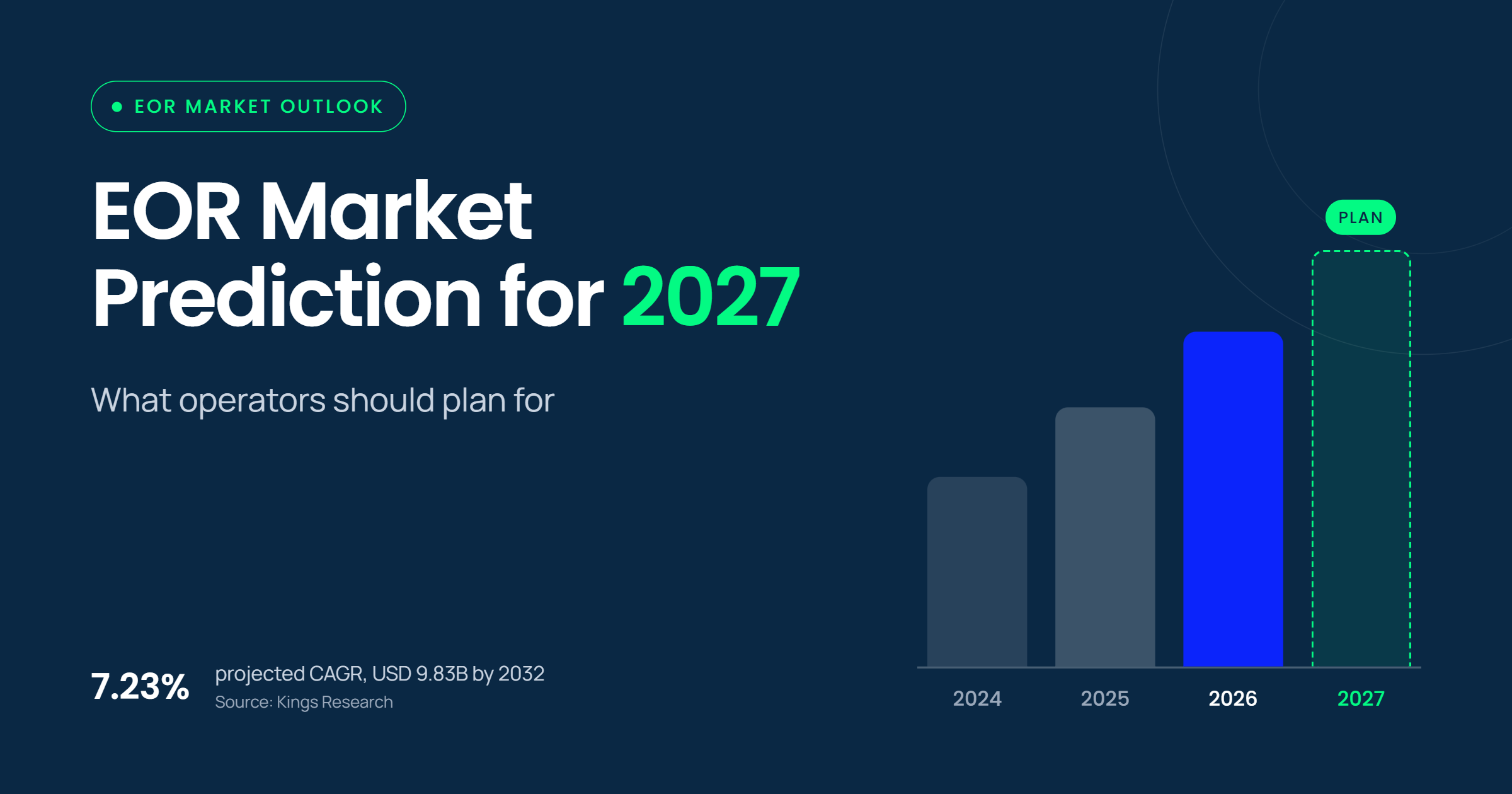
Independent analysts put the global EOR market at roughly USD 6 billion, growing between 6% and 7.5% a year. That is steady, not explosive. The high-growth narrative of 2021–2023 has settled into a mature services market.
| Analyst | Base figure | Forecast | CAGR |
|---|---|---|---|
| Kings ResearchUpdated March 2026 | USD 6.03B in 2025 | USD 9.83B by 2032 | 7.23% |
| QKS Group | — | 2026–2030 worldwide | 6.35% |
Two details in the Kings Research data matter more than the headline. Small and mid-sized businesses held 57.32% of the market in 2024. North America held 36.55%, and Asia Pacific is the fastest-growing region at a 7.96% CAGR.
For operators, single-digit growth changes the math. You can no longer grow out of operational waste. Every leaked dollar in billing, FX, or partner fees now comes straight out of margin.
Prediction 1: The headline EOR fee keeps falling, and margin moves to the invoice lines
In 2027, the per-employee monthly fee becomes a commodity number. Flat fees advertised under USD 200 a month have reset buyer expectations, and procurement teams now benchmark every quote against them.
Providers will not win the price war on the headline fee. They will protect margin through what sits around it: onboarding fees, offboarding fees, FX spreads, deposits, benefits markups, and country minimums.
That creates a new risk. Buyers are getting better at reading invoices line by line. Any fee that was never in the contract, or any FX markup nobody can explain, becomes a dispute, a credit note, or a churned client.
What operators should do: map every invoice line to a contract clause first. Then look beyond the flat fee itself. Two pricing approaches protect margin better than adding line items clients will dispute.
- Percentage markups across the board: apply a consistent markup to salary, expenses, allowances, benefits, or any cost line you choose, either alongside a flat fee or in place of it. Manual accounting setups struggle with this. Modern EOR and PEO invoicing tools such as PHRBO apply it automatically on every invoice.
- A white-glove client experience: compete on how completely you manage the client relationship. Some operators now make this experience layer the centerpiece of their offer and leave compliance and payroll delivery to in-country partners.
Prediction 2: Consolidation speeds up, and integration debt follows it
Expect more EOR roll-ups in 2027, driven by payments companies, PE-backed platforms, and regional providers merging to reach scale. The pattern is already visible.
- In August 2024, Payoneer bought Singapore-based Skuad for USD 61 million, per Kings Research.
- In April 2026, Hightekers, Eos Global Expansion, Serviap Global and Rivermate unified under one brand, reporting 38 owned entities and 3,500+ workers.
From the operator side, a merger announcement is the easy part. The hard part comes later: three payroll engines, four invoice formats, and client contracts written under different rate cards.
That is where revenue leaks. Billing rules get lost in migration, partner fees are double-counted, and nobody owns the reconciliation between old and new systems.
What operators should do: if you plan to buy or be bought, standardize your client contracts, rate cards, and invoice data now. Clean operational data raises your valuation and shortens integration.
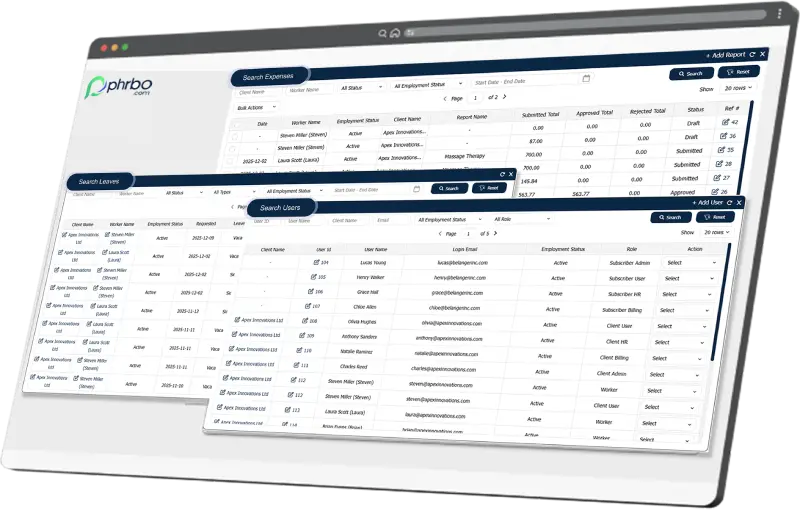
Better still, you may not need to merge to reach scale. Systemize through an open network platform such as PHRBO, which is designed for interoperability between independent EOR providers and EOR aggregator networks. Partners can then serve shared clients without merging their systems or their companies.
Prediction 3: Compliance gets heavier, and the EOR carries the liability
2027 is the year several major employment law changes land at once. As the legal employer, the EOR absorbs the operational load and the claim risk, whether or not the client fee reflects it.
| Change | Market | Timing | What it means for an EOR |
|---|---|---|---|
| Unfair dismissal qualifying period drops from 2 years to 6 months; compensation cap removed | UK | Dismissals from 1 January 2027Source: Slaughter and May | Terminations requested by clients need documented process, not a quick exit |
| Gender pay gap action plans, guaranteed hours for zero-hours workers | UK | During 2027 | More reporting duties per hosted worker |
| EU Pay Transparency Directive national laws | EU | Many countries by end-2026 or in 2027Source: L&E Global | Pay ranges in hiring, pay data on request, gender pay reporting |
On pay transparency, the 7 June 2026 deadline passed with only Italy, Lithuania, Malta and Slovakia fully transposed, per L&E Global. The Netherlands expects implementation around January 2027. France expects a parliamentary vote only around April–May 2027.
The operator problem is keeping up with the legal changes and proving compliance per worker, per country, on demand. An EOR that cannot pull salary bands, pay criteria, and termination records quickly will pay for it in disputes.
What operators should do: price compliance work into your fees instead of absorbing it. Build a per-country compliance calendar and attach evidence to each worker record.
What operators should do: treat compliance as a priced service and a data problem, not a cost you quietly absorb.
- Price it in: terminations, pay transparency requests, and time-record audits all take hours. Put them in your fee schedule.
- Build a 2027 compliance calendar: list each change per country and assign an owner and a deadline to it.
- Attach evidence to every worker record: contracts, salary bands, pay criteria, timesheets, and termination files, retrievable on demand.
- Move time and project recording into a system: spreadsheets will not meet tamper-proof requirements. A timesheet module tied to the worker record and the invoice, such as PHRBO’s Worker Timesheets Management, closes that gap.
- Get partner commitments in writing: ask each in-country partner how it will meet the new rules, and by when.
Prediction 4: “Owned entity” becomes a sales claim buyers verify, and hybrid wins
Buyers in 2027 will ask a sharper question: do you employ my worker directly, or does an in-country partner (ICP) do it for you? Due diligence teams now request entity registrations, not marketing maps.
The honest answer for most providers is hybrid. Owned entities in high-volume markets, ICPs everywhere else. That is a sound model. The risk is in how it is run, not in the structure itself.
With ICPs, your margin sits between two invoices: the partner’s bill to you and your bill to the client. Every mismatch between them is either a lost charge or an overbilling dispute waiting to happen.
Operators we speak with name the same leaks again and again: partner fee changes not passed through, statutory cost updates applied late, and FX rates locked on different dates on each side.
Hybrid also creates an experience problem. When last-mile payroll runs through different partners in different countries, clients see different invoice formats, payslip timings, and response times. They notice, and they compare.
This is where hybrid operators can win. If onboarding, documents, timesheets, invoices, and messaging all run through your own platform, the client gets one consistent experience. It no longer matters who delivers payroll locally, because the client only ever sees you.
What operators should do: stop reconciling after the fact. Invest in a system that creates the ICP invoice and the client invoice at the same time, from the same worker data, with your margin structured into every line. Reconciliation then becomes instant instead of a month-end project.
Prediction 5: AI moves from the sales page into the back office
AI in EOR has mostly lived on the buyer-facing side: chat assistants, contract generators, country guides. In 2027 the real gains come from the back office, where the work is repetitive and the errors are expensive.
Kings Research already lists AI integration in onboarding, payroll, document verification, and compliance monitoring as a defining market trend. I expect three uses to become standard.
- Payroll input validation: flagging variances against last cycle before the payroll partner runs it, not after.
- Invoice checking: comparing each client invoice line against the contract rate card and the partner cost.
- Document and expiry tracking: catching expiring visas, contracts, and right-to-work documents weeks ahead.
The catch: AI only checks what it can see. If your contracts, rate cards, and worker records live in separate tools, AI will check incomplete data quickly.
What operators should do: consolidate worker, contract, payroll, and billing data into one operating record before buying AI features. The data layer comes first.
Then be strict about what the AI can see. Payroll data is some of the most sensitive personal information a business holds, and it should never be pasted into a general-purpose LLM. Choose AI functionality that works on redacted or encrypted personal information when it runs back-office tasks.
Prediction 6: Regional and mid-market EORs win on depth, not country count
“180+ countries” stops being a differentiator in 2027. Most hiring still concentrates in a short list of markets, and buyers will pay for depth in those markets over a long list they never use.
The corridors I expect to stay busiest for operators are the US, Canada, the UK, South Africa, the Philippines, and India. Each one rewards local payroll knowledge more than global reach.
- United States and Canada: state and provincial payroll rules, benefits administration, and contractor classification audits.
- United Kingdom: the Employment Rights Act changes above, landing through 2027.
- South Africa: a strong talent pool for English-language support and finance roles, with exchange-control rules on cross-border payments.
- Philippines: shared services and customer operations demand.
- India: India’s four labour codes took effect on 21 November 2025, with central and state rules rolling out through 2026, per DLA Piper. The new wage definition affects how gratuity and provident fund are calculated.
What operators should do: pick your corridors deliberately. Publish country-level expertise, and price for the depth you actually deliver.
To compete for direct clients, a regional EOR usually needs real depth in six to ten markets. With fewer, most clients outgrow you before the relationship pays back its acquisition cost.
For operators with fewer markets, the stronger model is working as a regional partner for other EORs. There is nothing second-tier about it. It brings steady volume, avoids costly marketing spend, and open networks make it easier to join.
What operators should do: decide which business you are building: a direct-to-client EOR across six to ten markets, or a regional delivery partner for other EORs. Then publish country-level expertise and price for the depth you actually deliver.
Prediction 7: AI search squeezes paid search, and EOR marketing swings back to direct channels
AI summaries now answer many buyer questions before anyone clicks. Pew Research found Google users clicked a traditional result in 8% of visits when an AI summary appeared, versus 15% without one (Search Engine Land).
Fewer clicks make paid search harder to justify. In 2027, expect EOR operators to feel it as rising cost per lead from Google Ads and thinning traffic to generic “what is an EOR” content.
The response will be a swing back toward conventional marketing: partner referrals, events and webinars, email sequences, LinkedIn thought leadership, and direct relationships with the advisors who recommend EORs. Content still matters, but it has to be the source AI engines cite, not a page competing for a click.
What operators should do: shift budget from generic paid search to channels you own. Publish country- and problem-specific content that AI engines will cite, and build direct referral relationships. PHRBO’s EOR marketing course walks operators through this, step by step.
2027 will test your back office. Get ready now.
Shorter dismissal windows, new reporting duties and pay transparency rules all add work per hosted worker. PHRBO gives EOR and PEO operators one platform for workforce records, reporting and invoicing, so your team scales with demand without adding headcount.
FAQs: EOR market outlook for 2027
How big will the EOR market be in 2027? Independent analysts estimate the global EOR market at about USD 6 billion in 2025, growing 6% to 7.5% a year. On that path, 2027 lands roughly in the USD 6.5–7 billion range, depending on the forecast used.
Will EOR prices go down in 2027? Headline per-employee fees will stay under pressure. Total cost to clients may not fall, because providers will lean on onboarding, offboarding, FX, and country-specific charges. Clear contracts matter more than the headline rate.
Which regions will grow fastest? Asia Pacific is forecast as the fastest-growing EOR region, at a 7.96% CAGR per Kings Research. North America remains the largest market, at 36.55% share in 2024.
What compliance changes affect EOR providers in 2027? In the UK, the unfair dismissal qualifying period falls to six months from 1 January 2027. Across the EU, national pay transparency laws continue to arrive through 2026 and 2027.
Will AI replace EOR operations teams? No. AI will take over repetitive checks such as payroll variance review, invoice validation, and document expiry tracking. People still handle terminations, disputes, partner management, and client relationships.
