
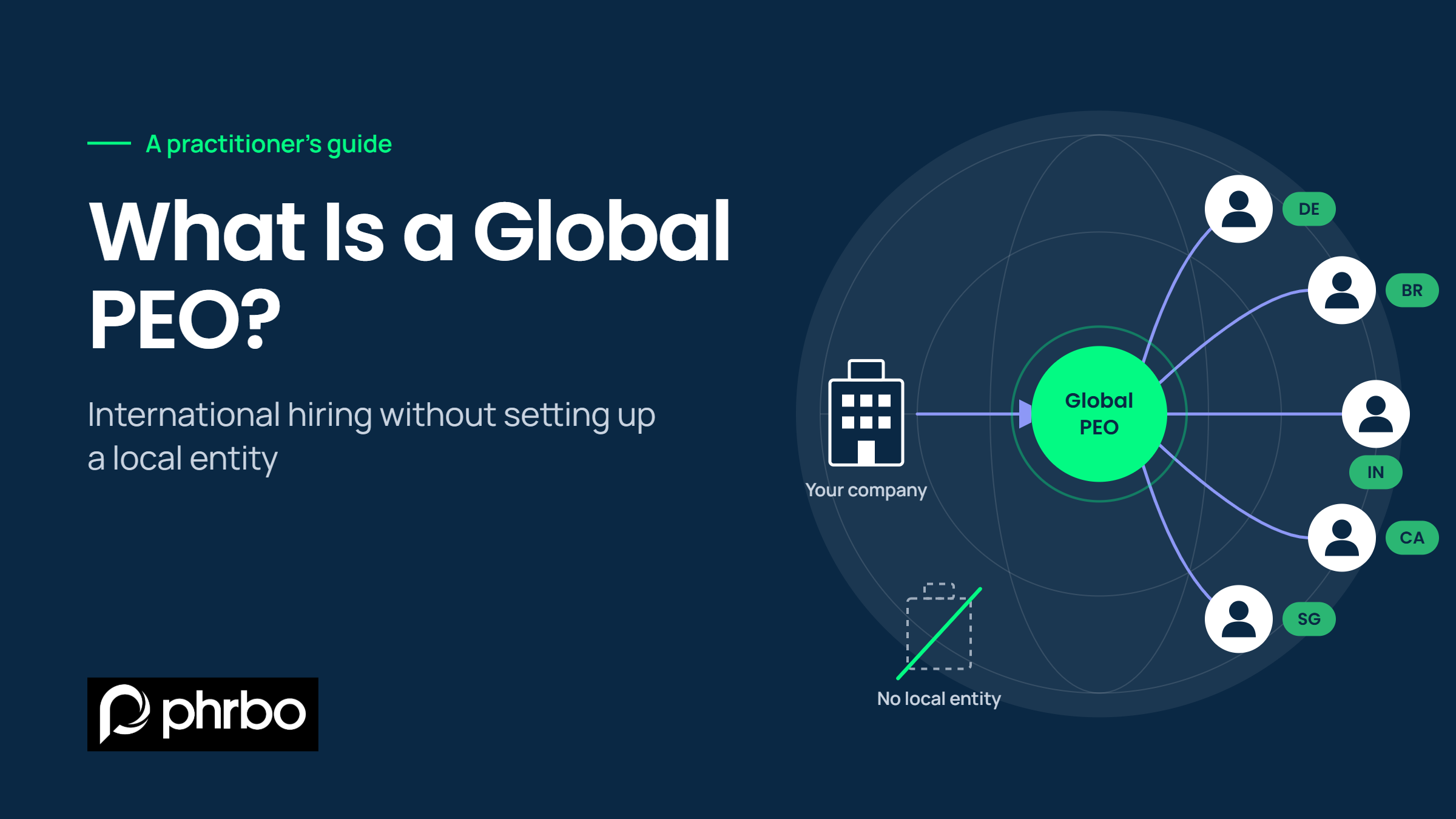
A global PEO is a provider that legally employs your workers in countries where you have no entity, running local payroll, taxes, benefits, and compliance while you manage their work.
Key Takeaways
- A global PEO becomes the legal employer in the country, while your managers keep control of daily work, goals, and performance.
- Outside the US, the legal structure is almost always an employer of record. “Global PEO” is the label buyers search for.
- Budget a flat fee of roughly USD 400 to 1,000 per employee per month, plus deposits, FX margins, and termination costs.
- The model does not remove permanent establishment risk, and countries such as Germany and Mexico restrict how it can be used.
- Most companies should price their own entity once a country reaches 20 to 40 employees or starts generating local revenue.
What Is a Global PEO?
A global PEO, also called an international PEO or global employer of record, legally employs your staff in countries where you have no entity. It issues local contracts, runs payroll, withholds taxes, and enrolls statutory benefits, while your managers direct the daily work.
Most buyers arrive here with a deadline, not a strategy. A sales lead in Poland wants to join next month. A customer in Brazil requires a local delivery team. Or the entity application you filed in March is still waiting on a bank account.
This guide explains how the model works, what it costs, where it breaks, and when to replace it with your own entity. It is written from the provider side of the table, where these arrangements are built and serviced every day.
How Does a Global PEO Work?
A global PEO works by splitting employment into two roles: the provider holds the legal employer obligations in-country, and your company directs the work. A service agreement between you and the provider ties those roles together and sets who pays for what.
The three-party relationship: your company, the global PEO, and the employee
Three contracts hold it together. The employee signs a local employment contract with the provider’s in-country entity. Your company signs a service agreement with the provider. You and the employee sign nothing employment-related with each other, though a direct NDA is sometimes added.
Your manager sets goals, approves leave requests, and runs performance reviews. The provider issues payslips, files returns with the tax office, registers the employee with social security, and answers to the labor inspector if something goes wrong. Each side should know where that line sits.
What happens from offer letter to first payslip
- Scope the role. You share the job title, salary, start date, and duties. The provider checks local minimum wage, mandatory allowances, probation limits, and whether a work permit is needed.
- Quote and sign. The provider prices employer contributions, its service fee, and any deposit. You sign the service agreement and, where personal data crosses borders, a data processing addendum.
- Issue the local contract. The provider drafts a contract in the local format and language, then sends it to the candidate for signature.
- Register and onboard. The provider registers the employee with tax and social security authorities, collects bank and ID details, and enrolls statutory benefits.
- Run the first payroll. Your team approves hours, bonuses, and expenses before the cutoff. The provider calculates gross-to-net pay, pays the employee, and remits taxes.
- Invoice and reconcile. The provider invoices you for salary, employer costs, and its fee. Check each invoice against the payroll register every month, not only at quarter end.
Why the term “global PEO” exists when the legal structure is usually EOR
In the US, a PEO is a co-employer. The client has its own US entity, and the PEO shares specific employer duties. The IRS runs a voluntary certification program for PEOs that treats a certified PEO as the employer for the wages it pays.
Co-employment needs the client to have a local entity to share duties with. Abroad, your company usually has none, so the provider must be the sole legal employer. That is an employer of record structure. Vendors kept the PEO label because US buyers already understood it.
Is a Global PEO the Same as an Employer of Record?
Mostly, yes. In nearly every country, what is sold as a global PEO operates legally as an employer of record: the provider is the only employer on paper, and your company is a client buying a service.
The difference is mainly vocabulary. US buyers search for “PEO” because they used one at home. European and APAC buyers tend to search for “employer of record.” Contracts, payroll mechanics, and liabilities stay the same whichever label appears on the proposal.
The distinction matters in three places: when a country regulates the arrangement as employee leasing, when a provider claims co-employment abroad without an entity to back it, and when your finance team needs to know whose tax ID appears on filings. Ask the provider directly.
PEO vs. Global PEO vs. EOR: Key Differences
| Factor | PEO (US domestic) | Global PEO | Employer of Record (EOR) |
|---|---|---|---|
| Geographic scope | One country, usually the US | Multiple countries, marketed to cross-border buyers | One or many countries |
| Legal employer | Shared by client and PEO under co-employment | Provider or its in-country partner | Provider or its in-country partner |
| Entity requirement | Client must have its own entity | No client entity needed | No client entity needed |
| Liability allocation | Split by the client service agreement | Provider holds statutory employer liability; client keeps management liability | Same as global PEO |
| Typical buyer | US small and mid-sized businesses seeking benefits buying power | Companies making first hires abroad | Same, plus companies with occasional single hires |
| Benefits model | Pooled master plans across PEO clients | Statutory benefits plus provider-selected supplemental plans per country | Same as global PEO |
| Pricing basis | Percentage of payroll or per-employee fee | Flat fee per employee per month, sometimes percentage | Flat fee per employee per month, sometimes percentage |
Read the table from the entity row. If you own an entity in the country, you need a PEO or a local payroll provider. If you do not, the global PEO and EOR columns describe the same purchase under two names.
Can You Hire Employees Abroad Without a Legal Entity?
Yes. A global PEO lets you hire full-time employees abroad without registering a company, because the provider’s local entity signs the contract and holds the employer registrations. You still need to watch tax presence and country limits on these arrangements.
How a global PEO replaces entity setup
Setting up a subsidiary means company registration, a local bank account, tax and social security registrations, a registered address, and often a resident director. A global PEO has already done all of that. You use its registrations instead of building your own.
What you do not get is a market strategy. The provider will not tell you whether the country deserves long-term investment. It will make the first hire legal, on time, and correctly paid.
Entity setup vs. global PEO: time-to-hire and cost comparison
| Factor | Own entity | Global PEO |
|---|---|---|
| Time to first hire | 2 to 6 months; longer where banking or director rules slow approval | 1 to 3 weeks after the offer is accepted |
| Upfront cost | Legal, registration, and accounting fees, often five figures (USD) in year one | Onboarding fee plus a refundable deposit |
| Ongoing cost | Local accountant, payroll provider, annual filings, audit where required | Monthly service fee per employee |
| Exit cost | Liquidation or dormancy, often months of work | Termination costs and contract notice period |
These ranges are indicative and vary sharply by country. Treat them as a starting point for your own quotes.
Where a global PEO is not enough
A global PEO solves the employment question, not the corporate tax question. If an employee negotiates and signs contracts on your behalf, tax authorities can treat your company as having a permanent establishment. The OECD tightened this dependent-agent test under BEPS Action 7.
Some countries also restrict the model itself. Germany treats many EOR setups as employee leasing, which needs a license and caps assignments to one client at 18 months under the AÜG. Mexico banned personnel subcontracting in 2021, with heavy fines.
Sales roles carry the highest risk on both fronts. If your first hire in a country will close deals, get tax advice on permanent establishment before the offer goes out, not after the first customer invoice.
What Services Does a Global PEO Provide?
A global PEO provides in-country payroll, benefits, compliant contracts, onboarding and termination handling, and, depending on the provider, visa support and contractor management. Coverage depth varies by country and by whether the provider owns its local entity.
Global payroll and tax withholding
The provider calculates gross-to-net pay under local rules, withholds income tax and employee social contributions, pays employer contributions, and files the monthly or quarterly returns. Payslips must follow local format rules, which differ more than most buyers expect.
From the provider side, most payroll errors start with late inputs: a bonus approved after cutoff, a leave day not recorded, a salary change sent by email. Agree on one input channel and a fixed monthly cutoff from day one.
Statutory and supplemental benefits administration
Statutory benefits are non-negotiable: pension, health, unemployment, and accident insurance, in whatever form each country mandates. The provider registers the employee for these schemes and pays the contributions through payroll.
Supplemental benefits, such as private health cover, meal vouchers, or extra pension contributions, are where providers differ. Some offer a fixed menu per country. Others let you match your home package at extra cost. Ask which before promising anything in the offer.
Locally compliant employment contracts
A US offer letter will not hold up under French, Brazilian, or Indian labor law. Local contracts must cover probation limits, notice periods, working hours, statutory leave, and, in many countries, a specific language. The provider drafts them from templates its local counsel maintains.
Read the contract before it goes to the candidate. Check that job title, salary, and bonus terms match your offer, and that any equity promise sits in a separate agreement your company controls.
Onboarding, offboarding, and termination compliance
Onboarding covers registrations, document collection, right-to-work checks, and benefit enrollment. Offboarding covers final pay, accrued leave payout, equipment return, and deregistration. Both carry country-specific deadlines that the provider should track, not you.
Termination is where the real exposure sits. Many countries require a documented reason, consultation, or notice far longer than US at-will norms. Severance can run to months of salary. A good provider will slow you down here, and that friction is worth paying for.
Immigration and visa support (provider-dependent)
Some providers sponsor work permits through their local entity. Others only refer you to an immigration firm, and some will not sponsor at all in certain countries. This is the service where sales pages and actual capability drift furthest apart.
Ask for the countries where the provider sponsored a visa in the last 12 months, the average processing time, and who pays government and legal fees if an application fails.
Contractor management and misclassification protection
Many providers also pay independent contractors abroad, collecting invoices and paying in local currency. That service is useful but does not change the worker’s legal status. A contract label carries little weight once a regulator looks at how the work is actually done.
The US Department of Labor has treated misclassification as a priority enforcement area, and most countries apply similar control tests. If a contractor works fixed hours, under your direction, on core work, converting them to an employee through the global PEO is usually safer.
Who Is the Legal Employer When You Use a Global PEO?
The global PEO, or its in-country partner, is the legal employer. Its entity appears on the contract, the payslip, and the tax filings. Your company keeps managerial control: you assign work, set targets, and decide on raises and promotions.
What liability shifts to the provider and what stays with you
The provider carries statutory employer liability: correct payroll, tax remittance, social security, mandatory benefits, and local labor law compliance in contracts and terminations. If a filing is missed, the authority looks to the provider as the registered employer.
You keep liability for how the employee is managed. Discrimination, harassment, unsafe working conditions, and wrongful instructions remain your exposure. Most service agreements include an indemnity making you cover costs caused by your own decisions, including a termination pushed through against advice.
IP ownership and confidentiality clauses to check in the contract
Because the provider is the employer, work product often vests in the provider first under local law. Your service agreement must assign that IP to your company, and the employment contract needs an invention assignment the provider then passes on to you.
Check these four items before the first employee starts:
- An IP assignment from employee to provider, and from provider to you, with no gap in the chain.
- Moral rights waivers where local law allows them.
- Confidentiality terms that name your company as a beneficiary.
- A data processing agreement that meets GDPR Article 28 when EU personal data is involved.
How Much Does a Global PEO Cost?
Most global PEOs charge a flat fee of roughly USD 400 to 1,000 per employee per month. Salary and employer contributions sit on top, so all-in cost often runs 20% to over 50% above gross salary, depending on the country.
Flat fee per employee per month vs. percentage-of-payroll pricing
A flat fee is predictable and favors higher salaries: the same USD 600 is a smaller share of a senior engineer’s pay than a support agent’s. Most providers price full-time employees this way.
Percentage pricing scales with salary and variable pay. It can suit low-salary markets but grows expensive fast for senior roles. Always ask whether the percentage applies to bonuses, commissions, and equity-related payments, because that clause decides your real cost.
Typical cost ranges by region
| Region | Typical fee per employee per month (USD) | What drives total cost |
|---|---|---|
| Western Europe | 500 to 900 | High employer contributions; France and Belgium sit near the top |
| Central and Eastern Europe | 400 to 700 | Moderate contributions; Romania shifts most of them to the employee |
| Latin America | 400 to 800 | Mandatory year-end pay, such as Brazil’s 13th salary and Mexico’s aguinaldo |
| Asia-Pacific | 400 to 900 | Wide spread; Australia and Singapore sit at the upper end |
| Middle East and Africa | 500 to 1,000 | Fewer owned entities, more partner-network delivery |
| Canada | 400 to 700 | Provincial rules change payroll setup and statutory holidays |
These are indicative planning ranges, not a price list. Confirm them with written quotes for your specific countries and roles.
Hidden costs: setup fees, deposits, FX margins, and termination fees
- Setup fees: charged once per employee or per country, sometimes waived on annual contracts.
- Security deposits: often one to three months of total employment cost, held against severance and unpaid invoices. Ask when and how it is refunded.
- Termination fees: severance is a pass-through, but some providers add an offboarding fee on top.
- Change fees: charges for salary amendments, contract rewrites, or off-cycle payroll runs.
Worked example: one employee in Germany
| Line item | Annual amount (EUR) |
|---|---|
| Gross salary | 70,000 |
| Employer social contributions (about 20%, illustrative) | 14,000 |
| Provider fee (EUR 600 × 12) | 7,200 |
| Annual cost | 91,200 |
| Security deposit (one month of total cost, refundable) | 7,600 held, not spent |
This example is illustrative only. German contribution rates and income ceilings change every January, and some contributions stop above those ceilings, so the employer share for higher salaries can fall below 20%.
Risks and Disadvantages of Using a Global PEO
The main risks are limited benefits control, reliance on in-country partners, higher cost at scale, and exposure to the provider’s data handling and payroll accuracy. None is a reason to avoid the model, but each needs a contract term or process to contain it.
| Risk | What it looks like | Mitigation |
|---|---|---|
| Less control over benefits design | You cannot copy your home-country package in every country | Agree a per-country benefits menu in writing before the first offer |
| Dependency on in-country partners | Service quality and escalation speed vary by local partner | Ask which countries run on owned entities and get partner SLAs flowed down |
| Cost at scale | Fees overtake entity running costs as headcount grows | Compare fees with entity costs for each country every year after passing 20-worker threshold |
| Data handling and payroll accuracy | Payroll errors, late payments, or a breach in a partner’s system | Require error-rate reporting, correction deadlines, and a signed data processing agreement |
Partner-network risk deserves extra attention. When a provider does not own the entity, your employee’s payroll passes through two companies, and errors take longer to trace. Ask for the partner’s legal name, not just the country it covers.
How to Choose the Right Global PEO Provider
Choose a provider by asking questions that expose its operations, not its sales deck. These ten cover the failure points that show up most often when clients move between providers.
- Do you own the entity in this country, or use a partner? If a partner, which company?
- What was your payroll error rate last year, and how fast are errors corrected?
- What service-level commitment applies to payroll timing, and what happens when you miss it?
- What does termination support include, and who reviews risk before notice is given?
- How is the security deposit calculated, held, and refunded?
- Which exchange rate do you use, and what margin do you add?
- Can you sponsor work visas in this country, and when did you last do it?
- Which supplemental benefits can you offer here, and at what cost?
- How do IP assignment and confidentiality flow through the contract chain to us?
- Where is employee data stored, and who are your sub-processors?
When Should You Switch From a Global PEO to Your Own Entity?
Switch when a country’s headcount, revenue, and permanence make an entity cheaper and safer than ongoing fees. For many companies, that point arrives between 20 and 40 employees in one country, sooner if those employees generate local revenue.
| Signal | If | Then |
|---|---|---|
| Headcount per country | 20 or more employees, still growing | Price an entity against the next 12 months of fees |
| Revenue in market | Local customers need local contracts or invoices | An entity is likely needed for contracting and tax |
| Long-term commitment | Office lease, local leadership hire, or a three-year plan | Start entity setup and keep the global PEO during transition |
| Permanent establishment exposure | Staff negotiate or sign deals | Get tax advice now; an entity may be the cleaner route |
| Regulatory caps | Germany’s 18-month leasing limit is approaching | Plan the transfer to your own entity before the cap |
Keep the global PEO running during setup. Moving employees to a new entity takes contract transfers, re-registrations, and often a parallel payroll month. Ask your provider for its transfer process before you sign, because exit terms vary widely. It is also worth noting that getting an accurate entity operational price requires local expertise and other non-monetary costs. Many businesses never establish entities because they value the complete “hands-off” employment experience.
Frequently Asked Questions
What is an international PEO?
An international PEO is another name for a global PEO: a provider that employs staff in countries where you have no entity. It handles local contracts, payroll, taxes, and statutory benefits. Legally, it usually operates as an employer of record rather than a co-employer.
What is a GEO (global employment organization)?
A GEO, or global employment organization, is a company that employs workers abroad for a client, typically through its own or partner entities. The term overlaps heavily with global PEO and employer of record. Some providers use GEO to describe expatriate and assignee payroll specifically.
How long does it take to onboard an employee through a global PEO?
Most onboardings take one to three weeks from signed offer to start date. Countries with pre-employment medicals, background checks, or long notice periods at the candidate’s current job take longer. Work permits add weeks or months, depending on the country and visa category.
Can a global PEO hire contractors as well as employees?
Many can. Providers often run a separate contractor service that collects invoices and pays contractors in local currency. That service does not employ the contractor or protect you from misclassification. If the person works like an employee, hire them as one through the provider.
Does a global PEO handle employee benefits in every country?
It handles statutory benefits in every country it covers, because payroll cannot run legally without them. Supplemental benefits, such as private health insurance or enhanced pensions, depend on the provider’s local arrangements and may be unavailable or priced separately in some countries.
Is a global PEO compliant with local labor laws?
A reputable provider builds contracts, payroll, and terminations around local labor law, and that compliance is the core of what you pay for. Compliance still depends on accurate inputs from you and on the arrangement being legal in that country, which is not universal.
The Decision in Brief
A global PEO is the fastest legal route to employing people in a country where you have no entity. It suits first hires, market tests, and small teams. It does not remove tax presence risk, and past a certain headcount, your own entity costs less.
Judge providers on operations: entity ownership, payroll accuracy, termination handling, and exit terms. Then review each country once a year against the cost of going direct.
