
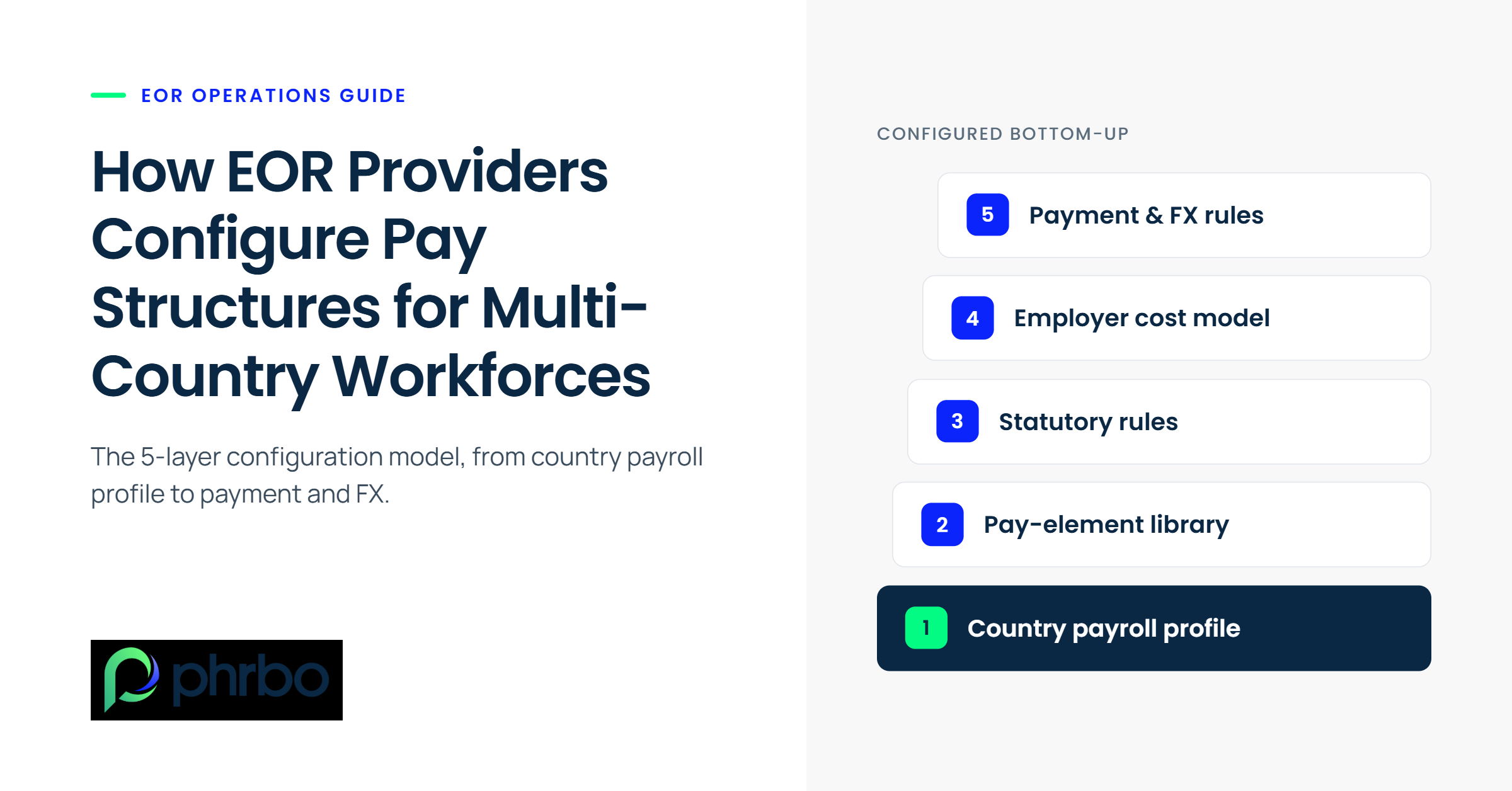
EOR providers configure pay structures in five layers: a country payroll profile, a pay-element library, statutory rules, an employer cost model, and payment and FX rules. Each layer depends on the one beneath it, so the order of setup matters.
Every new country adds its own pay elements, contribution rates, bonus rules, and pay cycles. Operators who set up each country from scratch pay for it twice: once in onboarding hours, and again in margin lost to errors that surface after the first payroll run.
This guide walks through each layer in setup order, using the US, Canada, the UK, and South Africa as the main examples, with the Philippines and India where their rules differ sharply. Use it as a repeatable sequence for your next country launch.
What “Pay Structure Configuration” Means for an EOR Provider
Pay structure configuration is the setup of every earning, deduction, contribution, and payment rule an EOR applies to a worker in one country. It is built once per country, then reused for every hire there, with only the employee’s contract values changing.
Think of it as the country’s payroll rulebook. A new hire in Toronto or Johannesburg should not trigger fresh configuration work. It should pick up a structure that already knows the local pay cycle, mandatory bonuses, and contribution rates.
Pay structure vs. compensation package
The client decides the compensation package: base salary, bonus targets, allowances, and benefits it wants to offer. The EOR then translates that package into a pay structure that local law, tax authorities, and social security agencies will accept.
That translation is rarely one-to-one. A “13th cheque” promised in a South African offer letter becomes a contractual payment the payroll must accrue. A UK “car allowance” is taxable pay, while a company car is a benefit in kind reported separately.
Why configuration is an EOR-side responsibility
As the legal employer, the EOR files the returns, pays the contributions, and answers to the labor inspector. If a contribution rate is wrong, the penalty notice arrives with the EOR’s name on it, not the client’s.
That is why configuration cannot be handed to the client or left entirely to an in-country partner. The partner may run the calculation, but the EOR owns the rules, signs off on them, and carries the cost when they fail.
The 3-Layer Model EOR Providers Use to Configure Multi-Country Pay
Every multi-country pay structure breaks down into 3 layers. Configure them in order: each layer reads values from the one before it, so an error in the country profile flows into every calculation that follows.
- Country payroll profile. Currency, pay frequency, tax year, and filing calendar. This layer sets when payroll runs and which deadlines it must meet.
- Pay-element library. Earnings codes, deduction codes, and allowances. These are the building blocks every payslip in the country is assembled from.
- Statutory rules. Mandatory bonuses, leave pay, and minimum wage floors. These are the amounts local law requires, whatever the employment contract says.
- Employer cost model. Employer social contributions, insurance, and the EOR fee. This layer turns gross pay into the full cost the client is invoiced for.
- Payment and FX rules. Disbursement method, conversion timing, and rate source. These rules decide how money moves from the client’s currency into the worker’s bank account.
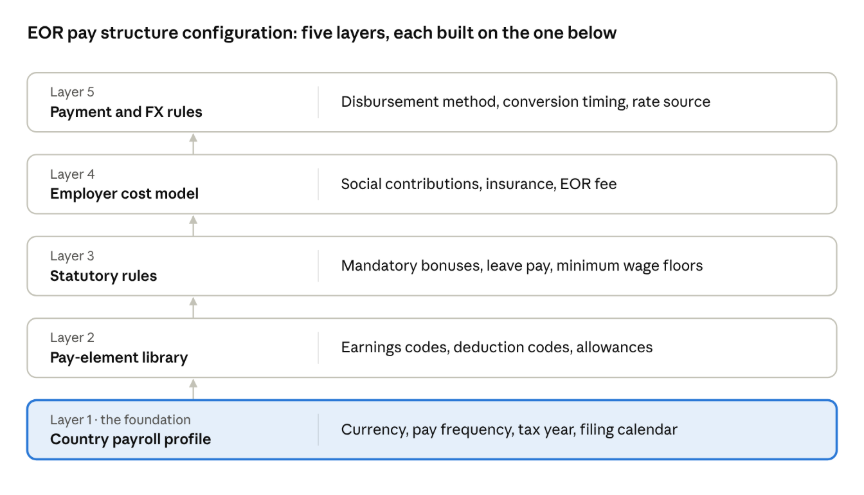
EOR pay structure configuration · the 5-layer model
Suggested alt text: EOR pay structure configuration 5-layer model for multi-country payroll, from country payroll profile to payment and FX rules.
The next five sections cover each layer in depth, with the setup decisions involved and the mistakes that tend to surface in the first quarter after a country goes live.
Layer 1: Setting Up the Country Payroll Profile
The country payroll profile defines the calendar and currency every other layer runs on: payroll currency, pay frequency, tax year, and statutory filing deadlines. Get this layer wrong and correct calculations still land on the wrong date.
Pay frequency and pay cycles by country
Pay frequency is partly a legal question. US states set minimum pay frequencies, Canadian provinces regulate how often wages are paid, and the Philippines requires pay at least twice monthly. Bi-weekly is common in North America; monthly in the UK, South Africa, and India.
Frequency changes the math, not just the calendar. Contribution ceilings, tax withholding tables, and overtime periods are often set per pay period. A structure built for monthly pay will under- or over-withhold if a client later asks to move staff to semi-monthly runs.
Federal and state or provincial sub-profiles
In the US and Canada, one country payroll profile is not enough. A US employee’s withholding depends on federal rules plus the state, and sometimes the city or county, where they work. Each state is effectively its own sub-profile.
Canada works the same way at provincial level. Income tax rates, statutory holidays, vacation entitlements, and employer health taxes vary by province, and Quebec runs its own pension plan, parental insurance plan, and provincial tax filings. Build a federal profile with provincial sub-profiles beneath it.
Building a global payroll calendar
A global payroll calendar lists every country’s input cutoff, client approval window, funding deadline, and pay date in one view. Without it, payroll ops teams track deadlines in separate spreadsheets and discover clashes only when a client’s funding arrives late.
Work backward from the pay date. If salaries must land on the 25th and bank transfers take two days, funding is due on the 23rd. Approvals close before funding, and timesheet and expense cutoffs close before approvals.
Some countries tie filing to the pay run itself. In the UK, an RTI Full Payment Submission goes to HMRC on or before each pay date, so a late approval delays the filing as well as the salary.
Tax year and statutory filing deadlines
Tax years do not line up across these markets. The UK tax year starts on 6 April, South Africa’s on 1 March, and India’s financial year on 1 April, while the US, Canada, and the Philippines follow the calendar year.
Employee year-end documents follow the same split: W-2s in the US, T4s in Canada, P60s in the UK, and IRP5s in South Africa each run on their own country’s calendar.
Store monthly, quarterly, and annual filing deadlines in the profile itself, not in someone’s inbox. When a deadline moves, as they sometimes do after a budget announcement, one update should change the calendar for every client in that country.
How the starting point varies by country
The six markets below show how different the profile can look before a single salary is entered.
| Country | Common pay frequency | Mandatory 13th-month or bonus | Key employer contributions | Payroll currency |
|---|---|---|---|---|
| USA | Bi-weekly (minimum frequency set by state law) | None | Social Security and Medicare (FICA), federal and state unemployment taxes (FUTA, SUTA), workers’ compensation | USD |
| Canada | Bi-weekly or semi-monthly | None | CPP (QPP in Quebec), EI premiums, provincial employer health taxes where applicable, workers’ compensation | CAD |
| UK | Monthly | None | Employer National Insurance, auto-enrolment pension, Apprenticeship Levy for larger employers | GBP |
| South Africa | Monthly (weekly common for hourly staff) | Not statutory; a 13th cheque is common by contract | UIF, Skills Development Levy, Compensation Fund (COIDA) | ZAR |
| Philippines | Semi-monthly | 13th-month pay mandatory, due by 24 December | SSS, PhilHealth, Pag-IBIG | PHP |
| India | Monthly | Statutory bonus for eligible employees under the Code on Wages, 2019 | EPF, ESI where applicable | INR |
Rates, thresholds, and eligibility rules change every year. Confirm each item with the relevant government source or your in-country partner before you configure a live payroll.
Layer 2: Building a Pay-Element Library Across Countries
The pay-element library is the set of earnings and deduction codes a payroll can use in a country. Every line on a payslip maps to one code, and every code carries its own tax treatment, contribution treatment, and reporting category.
Earnings codes
Earnings codes cover base salary, overtime, shift differentials, commissions, and allowances such as housing, meals, transport, or remote work. Each code needs answers to three questions: is it taxable, does it attract social contributions, and does it count toward statutory bonus or severance calculations?
That third question catches most teams out. Under India’s Code on Wages, allowances excluded from wages are capped at 50 percent of total pay, and any excess counts as wages for provident fund, gratuity, and bonus. An allowance-heavy structure can raise costs without anyone noticing.
Deduction codes
Deduction codes cover income tax withholding, employee social contributions, mandatory pension, and voluntary items such as extra pension contributions, union dues, or salary advances. Statutory deductions should be locked to the rules engine. Voluntary deductions need a consent record for each employee.
Order matters too. Many countries calculate income tax after deducting employee social contributions, so the deduction sequence in the configuration must match the statutory calculation order. If it does not, every payslip is off by a small amount that grows across the year.
In the US, a 401(k) deferral reduces federal income tax but not Social Security or Medicare, while most cafeteria-plan health premiums reduce both. Each deduction code needs a flag for exactly which taxes it reduces.
Global vs. local pay elements
Some elements exist in every country: base salary, overtime, bonus, income tax, employee social contributions. Define these once as global codes. Then add local codes per country, such as Canada’s CPP, South Africa’s UIF, or the Philippines’ 13th-month accrual.
This split lets finance compare base pay or total overtime across 15 countries in one report, while local payroll teams still see the codes their tax authority expects.
Naming conventions
Use a fixed pattern for every code, such as type, category, and country: ERN-BASE-GLB for global base salary, DED-PEN-UK for UK workplace pension. A predictable name lets anyone read a payslip export and know what each line is without opening the configuration.
Mismatched names are a reporting problem before they are a payroll problem. When “Housing” in one country and “Accommodation Allowance” in another are the same benefit, client cost reports split one line into two and nobody trusts the totals.
Practitioner tip: Keep one master pay-element library with country-level overrides, not a separate library per country. Separate libraries drift apart within a year, and every new global report then needs a manual mapping exercise before anyone can use it.
Layer 3: Configuring Statutory Allowances, Mandatory Benefits, and 13th-Month Pay
Statutory rules are the payments local law requires regardless of contract: mandatory bonuses, leave pay, sick pay, parental leave, and minimum wage. They sit above the pay-element library because they reference its codes to decide what counts toward each calculation.
Mandatory bonuses and the 13th cheque
Among these six markets, only the Philippines and India mandate an annual bonus. Philippine 13th-month pay equals at least one-twelfth of basic salary earned in the year, paid on or before 24 December.
India’s statutory bonus now sits under the Code on Wages, 2019, which replaced the Payment of Bonus Act. It keeps a wage ceiling for eligibility and a minimum and maximum rate, with payment due within a set period after the accounting year closes.
South Africa is easy to misread. The 13th cheque is not required by law, but once it appears in an employment contract it becomes a binding obligation. Configure it as a contractual element with an accrual, not as a discretionary bonus.
The US, Canada, and the UK have no statutory 13th-month payment. Year-end and retention bonuses there are contractual or discretionary, so configuration focuses on correct tax treatment, such as US supplemental wage withholding, rather than on mandatory accruals.
India shows why these values belong in configurable rules. The August 2026 notifications under the Code on Wages applied retrospectively from 21 November 2025 and changed the wage definition used for bonus. A hardcoded formula would need rework and back-calculation.
Accrual vs. lump-sum configuration
There are two ways to configure a mandatory bonus. Lump-sum configuration calculates and pays it once, at the statutory date. Accrual configuration books one-twelfth of the liability every month, then releases the accrued amount when the payment falls due.
The choice drives client invoicing. Accrue monthly and the client pays the bonus cost in twelve even parts across the year. Pay as a lump sum and the client receives a year-end invoice close to double a normal month’s salary cost.
Statutory leave pay, sick pay, and parental leave rules
Leave rules decide who pays and how much. In the UK, Statutory Sick Pay has been payable from the first day of absence since 6 April 2026, with the lower earnings limit removed. Payroll rules built before that date need updating.
Funding sources differ too. In South Africa, maternity benefits are claimed from the Unemployment Insurance Fund rather than paid as salary by default. In the Philippines, the employer advances maternity benefits and claims reimbursement from SSS.
Canada pays maternity and parental benefits through Employment Insurance, triggered by the employer’s Record of Employment. The US has no federal paid leave mandate, but many states and cities require paid sick leave or run paid family leave programs funded through payroll deductions.
Configure each leave type with its pay rate, duration, funding source, and any reimbursement claim. Reimbursements matter for EOR margin: if nobody tracks the claim, the EOR absorbs a cost the state was meant to cover.
Vacation pay has its own mechanics. Most Canadian provinces set vacation pay as a percentage of earnings, commonly starting at 4 percent, and hourly staff may receive it on every pay run. UK workers get 5.6 weeks of paid holiday, which can include bank holidays.
Minimum wage floors and annual rate updates
Minimum wage floors change regularly. The UK and South Africa update national rates each year, India’s floors vary by state and skill level, the Philippines sets regional rates, and US and Canadian floors differ by state or province. Store each floor as a dated rule.
The trap is the employee hired just above the minimum. When the floor rises on its effective date, that salary becomes non-compliant overnight. The rules engine should catch it, and the client should get notice before the first affected payroll, not after.
Client-pricing risk: Statutory bonuses that are not accrued monthly create invoicing gaps at year-end. If the client was quoted a monthly cost without the accrual, the EOR either absorbs the bonus or sends a large, unexpected invoice. Neither outcome helps at renewal.
7 Pay Structure Configuration Mistakes EOR Providers Make in New Countries
Most configuration failures come from the same seven shortcuts. Each one looks harmless during setup and becomes expensive after the first few payroll runs, when corrections involve back-pay, amended filings, and awkward client conversations.
1. Copying a pay structure from a “similar” country
Similar-looking markets can share very little in payroll. A US structure copied to Canada misses CPP, EI, provincial rules, and Quebec’s separate regime.
The UK and South Africa both call their withholding system PAYE, yet their tax years, contributions, and filings differ. Start every country from the global template and local legal sources, never from another country’s configuration.
2. Missing statutory bonus accruals
If Philippine 13th-month pay or a contractual South African 13th cheque is configured as a December-only payment, the monthly client invoice understates true cost all year. The shortfall lands in one invoice, and the client asks why it was never mentioned during the sales process.
3. Hardcoding contribution rates without a ceiling or annual update process
A rate typed into a formula works until the government changes it. Without a stored ceiling and a yearly review date, contributions drift from the legal amount, and the correction arrives months later as arrears, interest, and possibly penalties.
4. Mismatched pay-element names across countries
When the same allowance carries three names in three countries, nobody can produce a clean cost-by-category report. Finance builds manual mappings, the mappings break, and client cost reviews turn into reconciliation exercises instead of renewal conversations.
5. No FX policy documented in the client contract
If the contract does not name the lock point, rate source, and buffer treatment, every currency swing becomes a negotiation. The EOR usually ends up absorbing the loss to protect the relationship, which turns FX into a recurring margin leak.
6. Configuring payroll before the employment contract terms are final
Late changes to salary, allowances, probation terms, or start date ripple through every layer. Configure the employee record only after the contract is signed. Otherwise the first payslip reflects a draft, and the correction runs through the second payroll.
7. Skipping a parallel test run before go-live
Run at least one payroll cycle in parallel, comparing your output against the in-country partner’s or a manual calculation, line by line. Differences of a few cents point to rounding rules. Larger gaps point to a wrong rate, base, or sequence.
Run all five layers in one platform
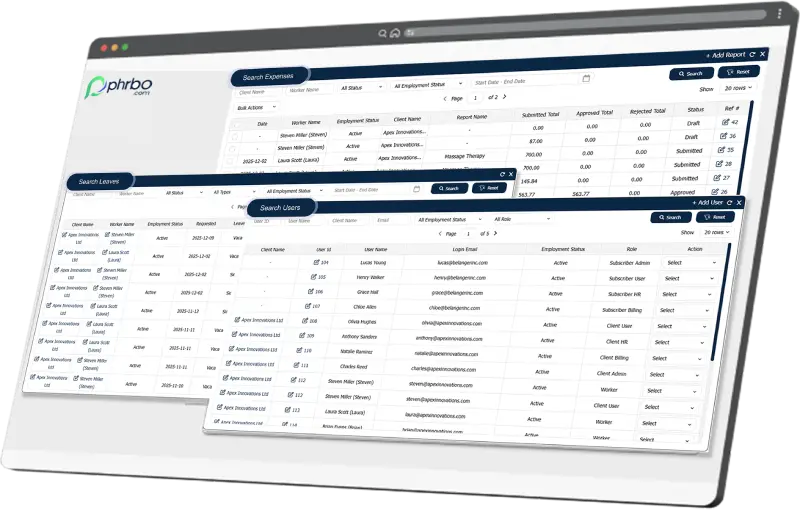
PHRBO brings country payroll rules, timesheets, leave, multi-currency payroll, and client invoicing into one workforce revenue operations platform. When a rate changes, the payslip and the client invoice update from the same numbers.
Conclusion: Build Once, Reuse in Every New Country
EOR pay structures hold up when they are built in five layers: country payroll profile, pay-element library, statutory rules, employer cost model, and payment and FX rules. Configure them in that order, with a global template and local overrides. Then test before go-live.
