
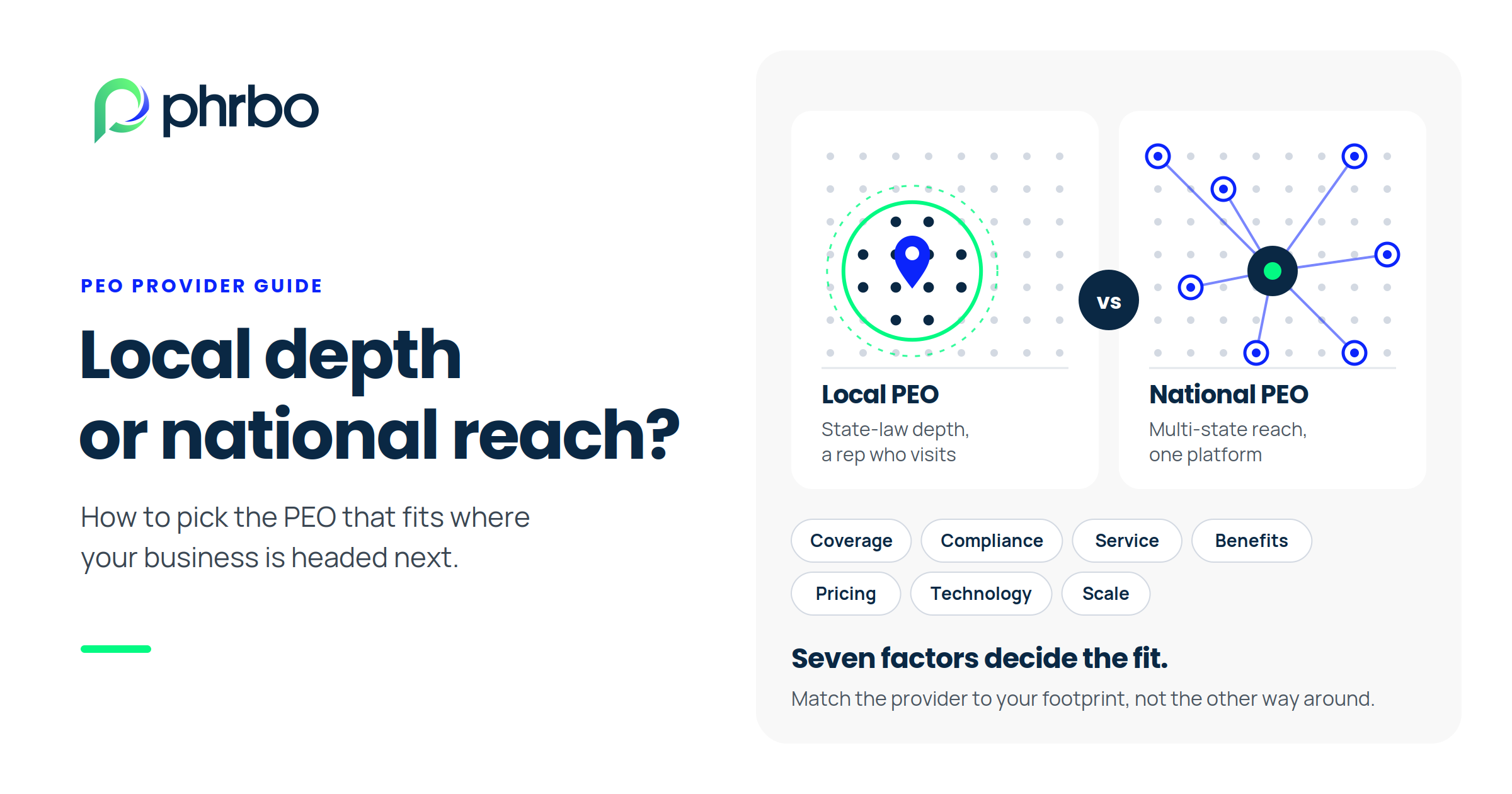
A local PEO suits employers with all staff in one state who want hands-on service. A national PEO suits multi-state or remote teams needing broader benefits and compliance coverage.
KEY TAKEAWAYS
- Your workforce footprint decides the fit. Where employees work today, and where you will hire in the next two years, matters more than the provider’s size.
- Local PEOs win on state and city law depth and in-person support. National PEOs win on multi-state coverage and large-group benefits pricing.
- Neither model is cheaper by default. The pricing model, benefits markups, and exit terms drive what you actually pay.
- Running a separate local PEO in each state splits your payroll data, doubles payment and fee transactions, and creates policy gaps between teams.
- Confirm IRS CPEO certification and ESAC accreditation yourself before you sign with any provider, local or national.
The local vs national PEO decision comes down to one trade. A local PEO gives you proximity and personal service but limited reach. A national PEO gives you multi-state coverage and benefits buying power, with less hands-on contact.
Which one fits depends on three things: where your employees sit, how fast you plan to grow, and how much support you expect from your provider. This guide is for small and mid-sized employers evaluating a first PEO or reviewing one at renewal.
Plenty of companies face this call. NAPEO’s 2025 client research counts more than 230,000 U.S. businesses working with a PEO, about 15% of all employers with 10 to 499 employees.
After a decade around PEO and EOR operations, the mistake I see most is simple: employers pick on brand recognition and only check the footprint fit after the contract is signed.
What Is the Difference Between a Local PEO and a National PEO?
A local PEO serves employers in one state or a small region, with in-person account support. A national PEO serves employers across most or all U.S. states through centralized payroll, larger benefits pools, and standard processes. Both act as co-employers.
What Is a Local (Regional) PEO?
A local or regional PEO usually operates in one state or a cluster of neighboring states. Its client roster is smaller, its account managers often live in the same metro area, and its staff can visit your office when an HR issue needs a face.
When buyers compare a regional PEO vs national PEO, this is the core distinction. The regional firm builds its expertise around one set of state agencies, one workers’ comp market, and the carriers that dominate local provider networks.
What Is a National PEO?
A national PEO is registered or licensed to operate in all or most U.S. states. Payroll, tax filing, and benefits run through central teams on a shared technology platform, with service delivered from regional hubs or a support center.
Because its client base spans many states, a national PEO negotiates with insurance carriers as one large group. The trade-off is standardization: contracts, processes, and service tiers are built to work for thousands of clients, not shaped around yours.
The Shared Foundation
Legally, both models work the same way. The PEO becomes a co-employer and takes on payroll, tax filing, benefits administration, workers’ compensation, and HR compliance support. Your company keeps control of hiring, daily work, and business decisions.
So the gap between a local and a national PEO is scope and delivery, not the core service. You are choosing how far the provider can reach and how it will serve you, not whether it can run payroll.
Local vs National PEO: Side-by-Side Comparison
The core trade-off is depth versus reach: a local PEO goes deep in one place, while a national PEO goes wide across many.
| Factor | Local PEO | National PEO |
|---|---|---|
| Geographic coverage | 1 state or region | Multi-state / nationwide |
| Compliance focus | Deep state and local law expertise | Broad multi-state coverage |
| Service model | Dedicated rep, on-site visits | Service center, digital-first |
| Benefits access | Regional carriers | Large-group national plans |
| Pricing | Flexible, negotiable terms | Standardized, sometimes lower per-employee rate |
| Technology | Varies, often partner software | Proprietary platforms |
| Scalability | Limited outside home region | Built for expansion |
Advantages of a Local PEO
Dedicated Account Team and Direct Access to Leadership
With a smaller client base, a local PEO can assign one account manager who knows your company, your payroll calendar, and your recurring HR issues. When something escalates, you can often reach the owner or operations head the same day.
Deep Knowledge of State and Municipal Employment Law
A PEO that works in one state lives with its rules every day. It tracks state labor department updates, city ordinances, and local workers’ comp classifications, because every client on its roster faces the same requirements you do.
That depth pays off where cities write their own rules. The U.S. Department of Labor notes that some local governments set minimum wages above the state rate, and employers must pay whichever rate is highest.
On-Site Support for Training, Open Enrollment, and HR Issues
Local providers can show up in person. That means on-site open enrollment meetings, supervisor training, and help with a sensitive termination or workplace investigation. For a PEO with local presence, on-site HR support is part of the service, not a paid add-on.
Flexible Contract Terms and Pricing
Smaller PEOs have more room to negotiate. You may be able to shorten the first term, shape the fee structure around seasonal headcount, or waive setup charges, because the person who approves the deal is usually in the meeting.
What Are the Disadvantages of Using a Local PEO?
A local PEO’s strengths come from its narrow footprint, and so do its weak spots. These are the gaps that surface most often once a client starts to grow:
- Limited out-of-state coverage: if you hire in a state the PEO does not support, you may need a second provider or a separate arrangement for that one employee.
- Smaller benefits pool: fewer covered lives can mean less negotiating power with carriers at renewal and a shorter list of plan options.
- Lighter technology stack: many local PEOs license third-party payroll and HR software, so self-service features and reporting depend on that partner’s product.
- Fewer specialists: multi-state tax registration and ACA reporting for applicable large employers call for specialists that small providers may not keep on staff.
Advantages of a National PEO
Multi-State Compliance Under One Contract
A national PEO handles state tax registration, unemployment insurance accounts, new-hire reporting, and required postings in each state where you employ people. Multi-state PEO compliance under one agreement spares your team from tracking dozens of agency deadlines alone.
The rules shift from state to state. NCSL records that Connecticut became the first state to require private employers to provide paid sick leave in 2011, and more states and cities have passed their own versions since.
Access to Large-Group Health Insurance and Broader Benefits
Health coverage is often the main reason employers sign with a national PEO. Pooling thousands of worksite employees gives the PEO large-group buying power, which can open carriers, plan tiers, and extra benefits a 30-person company could not get alone.
The money involved is large. The KFF 2025 Employer Health Benefits Survey puts the average annual family premium at $26,993, up 6% from 2024. A better rate on one plan tier can outweigh a year of PEO admin fees.
Centralized Payroll and Tax Administration Across States
National providers run one payroll engine across every state. Withholding, state income tax, local taxes, and year-end forms come from a single system, so an employee moving from Texas to Colorado is a record update, not a new vendor setup.
Built-In Scalability for Growth and Remote Hiring
National PEOs are set up for growth. Opening a new office, hiring a remote engineer in another state, or absorbing an acquired team happens inside the existing contract, usually without renegotiating terms or moving employees to a new provider.
Disadvantages of a National PEO
Scale has its own costs. Employers who move from a local provider to a national one tend to raise the same three complaints:
- Less personal, ticket-based service: support often runs through a service center or ticket queue, and your named contact may change when the PEO reassigns accounts.
- Rigid contracts and add-on fees: standard agreements leave little room to negotiate, and services such as HR consulting or custom reports can carry separate charges.
- Gaps in hyper-local knowledge: a central compliance team may respond more slowly to a new city ordinance than a provider based in that city.
Local vs National PEO Pricing: Which Is Cheaper?
Neither type is cheaper by default. Cost depends on the pricing model, the benefits markup, and the fees outside the base rate. A local PEO with a flat fee can cost less than a national one, and the reverse happens just as often.
PEO Pricing Models Explained
PEOs bill in one of two ways. Percentage-of-payroll pricing charges a share of gross wages, so your fee rises with every raise and bonus. Per-employee-per-month (PEPM) pricing charges a flat amount per worker, so cost follows headcount instead.
A simple illustration: a 40-person team averaging $60,000 in salary carries $2.4 million in annual payroll. At 3% of payroll, the fee is $72,000 a year. At $125 PEPM, it is $60,000. Run your own numbers both ways.
Hidden Costs to Watch For
The quoted admin fee rarely tells the full story. Before you compare proposals, ask each provider to itemize these costs in writing:
- Setup and implementation fees charged during onboarding
- Benefits markups built into the premiums shown on your invoice
- Workers’ comp and state unemployment rates billed above your actual claims experience
- Termination clauses, early-exit penalties, and required notice periods
Why Total Cost of Employment Matters More Than the Headline Rate
Compare proposals on total cost of employment: admin fee, employer taxes, workers’ comp, and the employer share of benefits combined. A PEO with a higher fee and better benefit rates can cost less overall than the lowest quote.
Ask every finalist to price the same employee census, with the same plan choices and the same headcount. Without a matching baseline, you are comparing two different services, not two prices.
Do National PEOs Offer Better Health Insurance Benefits?
National PEOs often offer broader plan selection because of their group size. Local PEOs with strong regional carrier relationships can still compete, especially when your workforce is concentrated in one metro area.
How Pooled Purchasing Power Works
When a PEO sponsors a plan for all its worksite employees, carriers price risk across that whole pool rather than your company alone. One costly claim in a 25-person firm carries far less weight inside a pool of thousands.
That stability is the real gain for small employers. Renewal increases tend to be smaller and easier to predict, and you can offer dental, vision, life, and retirement options usually seen at much larger companies.
When Regional Plans Outperform National Ones
Bigger is not always better. If your staff all live in one metro area, a regional carrier with the main local hospital system in network may serve them better than a national plan with a thin local network.
Ask each PEO for provider directories, not just the premium sheet. Check whether your employees’ current doctors and nearest hospitals are in network before you compare prices.
Which PEO Is Better for State-Specific Compliance?
Single-state employers usually get more from a local PEO’s depth in state and city law. Multi-state employers need a PEO with confirmed coverage, and working knowledge, in every state where they employ people.
State rules are where small mistakes turn expensive. Three areas cause the most trouble for growing employers:
- Paid leave mandates: state and city sick leave and paid family leave programs differ on accrual, payroll contributions, and notice rules. NCSL’s state tracker shows how far apart they are.
- Final-pay rules: the deadline for a departing employee’s last paycheck is set by state law, and some states require payment on the termination date. The Department of Labor points employers to each state’s rules.
- Local minimum wage: employers must pay the highest of the federal, state, or local rate, and several cities set their own. The DOL state minimum wage table is a useful starting point.
What PEO Should You Use If You Have Employees in Multiple States?
Choose a national PEO, or a PEO that can confirm active coverage in every state where you employ people today. Get the list of supported states in writing before you sign.
The Risk of Running Multiple Local PEOs
Some employers try to stitch together one local PEO per state. In practice, that setup creates three problems that grow with every new location:
- Fragmented data: payroll, benefits, and HR records sit in separate systems, so headcount and labor cost reports need manual reconciliation every month.
- Duplicate fees: each PEO charges its own admin fee, setup fee, and minimum, which wipes out any per-state savings.
- Inconsistent policies: employees in different states end up with different handbooks, benefits, and PTO rules, which leads to fairness complaints.
Remote-Hiring Considerations
One remote hire in a new state can create withholding, unemployment insurance, and new-hire reporting duties there. Ask how quickly the PEO can register you in that state, and whether it charges a per-state fee for doing so.
Can a Local PEO Scale With Your Business?
A local PEO can scale with you inside its region. The real test is what happens when your first hire lands outside it. Ask these questions before you sign:
- Which states can you support today, and in which are you already registered?
- Do you partner with another PEO for out-of-region employees, and who manages that relationship?
- What happens to our benefits plan if we add employees where your carriers have no network?
What Switching PEOs Mid-Growth Actually Involves
Switching PEOs during a growth phase is possible, but it is a project, not a form. Plan for several weeks of lead time and expect work in three areas:
- Benefits transition: new plans, new ID cards, and possibly reset deductibles if the move happens mid-plan-year.
- Tax ID changes: with a non-certified PEO, a mid-year move can restart Social Security and federal unemployment wage bases. Check the IRS CPEO program rules with your tax advisor.
- Employee communication: staff need clear notice about new pay stubs, new portals, and receiving more than one W-2 for the year.
Should a Small Business Choose a Local or National PEO?
Let your workforce footprint make the call. Match your business profile to one of the three paths below:
Choose a Local PEO If:
- 100% of your staff work in one state
- You value face-to-face HR support and a named account manager
- You have no plans to hire outside your state in the next two to three years
Choose a National PEO If:
- You already have employees in two or more states
- You are hiring remote workers wherever the talent is
- You need large-group benefits to compete for candidates
Consider a Hybrid PEO If:
- You want a local service team but need multi-state capability today or soon
The Hybrid Option: Local Service With National Resources
A hybrid PEO pairs a local service team with national-scale infrastructure. Your account manager sits in your region, while payroll, multi-state tax filing, and benefits run on systems built to handle employees in any state.
In practice, this is often a regional PEO that has registered in additional states, joined a larger benefits pool, and upgraded its back office, while keeping the same local rep you meet in person.
How to Verify the “Local” Claim
Some providers call themselves local because they keep a sales office nearby. Test the claim with three direct questions:
- Where does my account manager work, and how many clients does that person handle?
- Is payroll processed by a local team or by a central service center?
- Who comes on-site for open enrollment or an HR incident, and how fast?
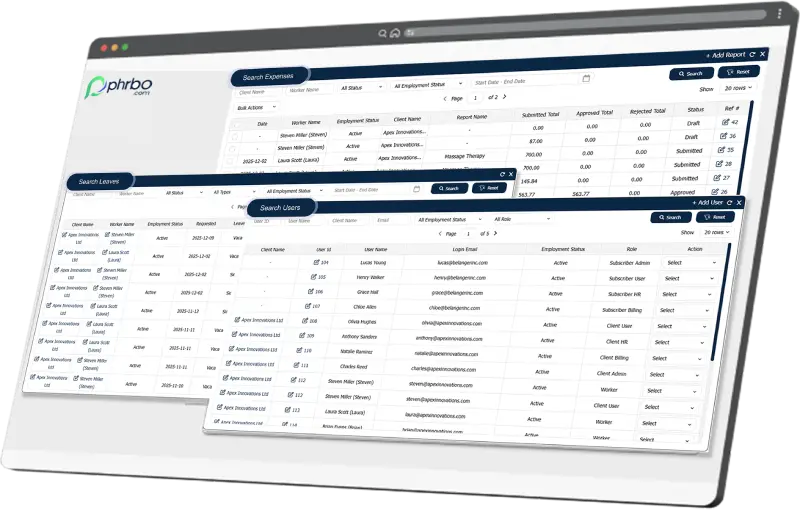
Behind the scenes, more regional PEOs now run on workforce operations platforms such as PHRBO, which handle payroll and back-office operations so the local team can spend its time with clients.
How to Choose a PEO Provider: 8 Questions to Ask
Use these questions in every discovery call. The answers will separate a strong fit from a polished sales pitch quickly.
- Which states do you actively support today? Ask for current client counts by state, not a list of states where you could be registered later.
- Will I have a dedicated account manager? Find out how many clients that person handles and how escalations work.
- What benefits carriers and plan tiers can you offer? Request provider directories for the zip codes where your employees live.
- How is pricing structured, and what fees sit outside the base rate? Get setup, benefits markup, and exit costs itemized in writing.
- Are you IRS-certified (CPEO) and ESAC-accredited? Check the IRS CPEO public listings and the ESAC accreditation lookup yourself.
- What does your technology platform include? Ask for a live demo of employee self-service, reporting, and the client admin view.
- What are the contract length and exit terms? Look for notice periods, early-exit penalties, and data handover terms.
- Can you share references from clients my size and in my industry? Call at least two, and ask what they would change.
Run a local PEO with national-grade operations
Accurate payroll, on-time benefits enrollment, and fast answers decide whether clients renew. PHRBO is the workforce operations platform PEOs use to run HR, payroll, and back-office work from one system.
Frequently Asked Questions
Is a local PEO better than a national PEO?
Neither is better across the board. A local PEO is usually the stronger choice for single-state employers that want personal service and state-law depth. A national PEO fits employers with staff in several states, remote hiring plans, or large-group benefit needs.
What does “regional PEO” mean?
A regional PEO is a professional employer organization that serves clients in one state or a small group of neighboring states. It offers the same co-employment services as a national provider, including payroll, benefits, and HR support, with a narrower footprint.
Are national PEOs more expensive than local PEOs?
Not necessarily. National PEOs often use standardized pricing and can offer lower per-employee rates at scale, while local PEOs may negotiate more freely. Total cost depends on the pricing model, benefits markups, and extra fees, so compare complete proposals side by side.
Can I switch from a local PEO to a national PEO?
Yes. Most employers switch at the end of a contract term or benefits plan year to avoid penalties and deductible resets. Review your exit clause, give the required notice, and plan benefits enrollment, payroll setup, and employee communication well before the switch.
What is a certified PEO (CPEO), and does it matter?
A CPEO is a PEO the IRS has certified after it meets tax compliance, bonding, financial reporting, and background requirements. Certification changes how federal employment tax liability is shared with clients. You can confirm status on the IRS public listings.
Conclusion: Match the PEO Model to Your Workforce, Not the Brand
Pick the PEO model that matches where your people work, not the biggest brand. Single-state teams that value face time usually do best locally; multi-state and remote teams need national or hybrid coverage. Then compare every finalist on total cost, not the headline rate.
