
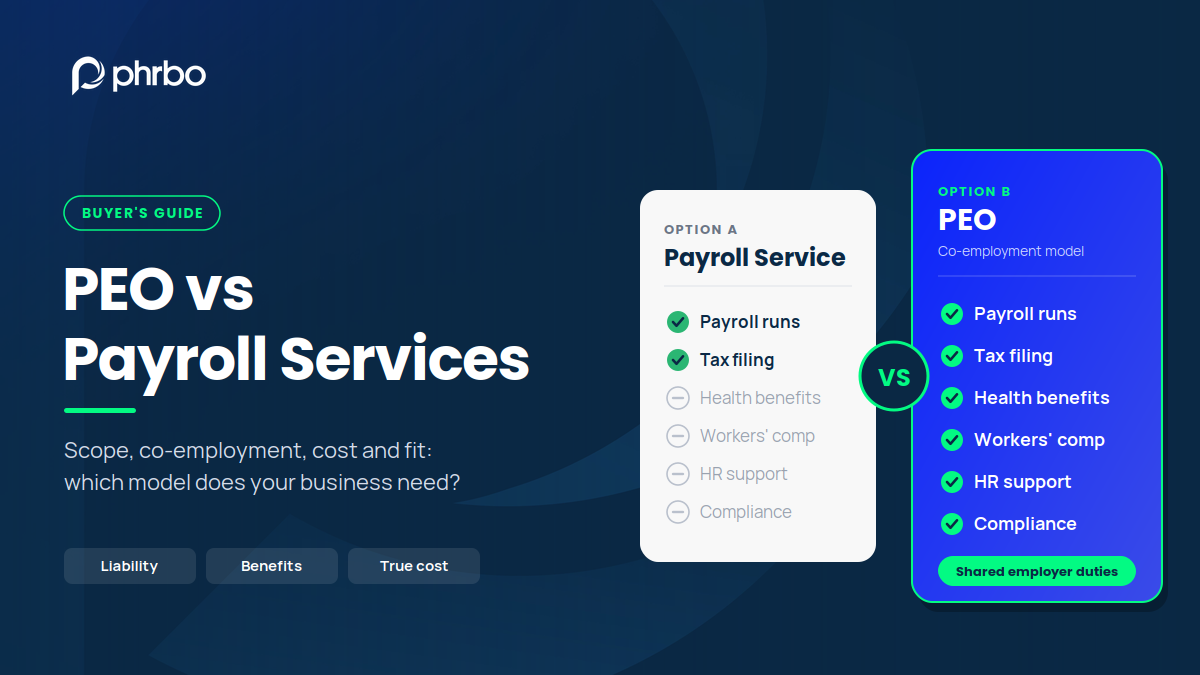
A payroll service runs pay and files payroll taxes for you. A PEO does that too, then shares employer duties for benefits, HR compliance, and workers’ compensation through co-employment.
KEY TAKEAWAYS
- Scope: A payroll service handles pay runs and tax filings; a PEO adds benefits, HR support, compliance, and workers’ compensation.
- Liability: Only a PEO shares employer responsibility through co-employment, and an IRS-certified PEO (CPEO) takes on federal employment tax liability for the wages it pays.
- Cost: Payroll services charge a base fee plus a per-employee fee; PEOs charge a percentage of payroll or a flat per-employee monthly fee.
- Fit: Payroll services suit companies with in-house HR. PEOs suit US companies with roughly 10 to 150 employees that need competitive health benefits and have no HR department.
Choosing between a PEO and a payroll service comes down to how much employer responsibility you want to hand off. A payroll provider calculates wages, withholds taxes, and files returns under your company’s name. Everything else about being an employer, including liability for payroll and HR errors, stays on your desk.
A PEO runs payroll too, then becomes a co-employer. It sponsors health plans, carries workers’ compensation, and shares liability for HR compliance. The decision of which solution best suits you, usually turns on two questions: does someone own HR internally, and can you offer competitive health coverage on your own?
What Is a Payroll Service Provider (PSP)?
A payroll service provider (PSP) is a vendor that calculates employee pay, withholds and remits payroll taxes, and files the required returns for your business. You remain the sole legal employer, and the provider acts as your processing agent.
Most PSPs file under your Employer Identification Number (EIN). If a deposit is late or a return is wrong, the IRS looks to your business first. That detail matters more than most buyers realize when they compare quotes.
What Payroll Services Typically Include
A standard payroll package covers the mechanics of paying people correctly and on time:
- Pay runs on your chosen schedule, with gross-to-net calculations
- Federal, state, and local tax withholding and deposits, following the rules in IRS Publication 15
- Quarterly and annual filings, including Form 941, Form 940, W-2s, and 1099s
- Direct deposit, digital pay stubs, and employee self-service access
- Payroll reports for your accountant, general ledger, and audits
What Payroll Services Usually Do Not Include
A payroll provider stops at the paycheck. Group health plans, retirement plan sponsorship, workers’ compensation coverage, employee handbooks, and wage-and-hour compliance advice usually sit outside the contract. Some providers sell these as add-ons, but you still own every employer obligation and its risk.
What Is a PEO (Professional Employer Organization)?
A professional employer organization (PEO) is a company that enters a co-employment agreement with your business. It takes over payroll, benefits, workers’ compensation, and HR compliance for your employees, while you keep control of hiring, daily work, and business decisions.
The model is larger than many owners expect. According to NAPEO’s industry research, about 500 PEOs serve roughly 233,000 client businesses in the United States, and the industry generates $446 billion in revenue.
Core PEO Services
- Payroll processing and payroll tax filing
- Benefits administration for group health, dental, vision, life, and retirement plans
- Workers’ compensation coverage and claims management
- HR support for handbooks, onboarding, terminations, and policy questions
- Compliance help with federal, state, and local employment rules
- Risk management, including safety programs and, in many plans, employment practices liability coverage
How a PEO Acts as Your Outsourced HR and Payroll Department
For a company without an HR team, a PEO fills the role an HR manager, a benefits broker, and a payroll clerk would otherwise share. Owners call one team for a pay question, an enrollment change, or an employee dispute, rather than three vendors.
How the Co-Employment Relationship Works in a PEO
Co-employment splits employer duties between two parties under a written client service agreement. Your company directs the work: who gets hired, what they do, how they perform, and what they earn. The PEO takes on administrative duties tied to payroll taxes, benefits, and insurance.
The PEO typically becomes the employer of record for tax and benefits purposes. Employees receive W-2s showing the PEO’s name, enroll in the PEO’s benefit plans, and fall under its workers’ compensation coverage, yet they report to your managers every day.
Who Is Liable for Employees Under Co-Employment?
Liability is shared, not transferred. The PEO accepts responsibility for the duties it performs under contract, such as remitting payroll taxes and administering benefits. Your business stays responsible for workplace decisions, including discrimination claims, wage-and-hour practices you control, and on-site safety.
Federal tax liability depends on certification. Under the IRS Certified PEO program, a CPEO is generally treated as the employer for federal employment taxes on wages it pays. With a non-certified PEO, your business can still be held liable if the PEO fails to remit.
What Responsibilities Stay With You as the Client Company
- Hiring, firing, promotions, and pay decisions
- Daily supervision, scheduling, and performance management
- Workplace safety at your own locations
- Fair treatment of employees under anti-discrimination law in how your managers make decisions
- Accurate, timely reporting of hours, new hires, and pay changes to the PEO
Why Location Changes What a PEO Means
The term PEO carries a specific meaning in the United States. Co-employment is a recognized legal structure here, built on federal tax law and state statutes. Elsewhere, many countries recognize only one legal employer per worker, so the shared-employer arrangement often has no direct equivalent.
That is why providers abroad often use PEO and employer of record (EOR) as interchangeable labels. A foreign “PEO” usually becomes the sole legal employer, the way an EOR does. Buyers comparing global quotes should confirm which structure the contract actually creates before signing. It is worth noting that true EOR services exist in the USA, providing full employment for workers providing labour to entities outside the country. (See the PHRBO EOR Directory)
US PEOs also center their value on primary health coverage. Most working-age Americans get health insurance through an employer, so access to less expensive, large-group medical plans is the main reason small firms sign. In countries with public health systems, employer plans only supplement state-provided care.
Within the US, co-employment is regulated mostly at the state level. More than 40 states regulate PEOs through licensing or registration, as NAPEO’s state policy tracking shows. Rules on unemployment tax reporting and workers’ compensation also differ from one state to the next.
A payroll provider never enters co-employment. It works as your vendor, so every employer obligation, from tax deposits to benefits compliance, legally stays with your business in the eyes of the IRS and state agencies, even when the provider made the error.
PEO vs Payroll Services: Side-by-Side Comparison
The table below compares both models across the factors buyers raise most often during evaluations.
| Factor | Payroll Service (PSP) | PEO |
|---|---|---|
| Scope of services | Payroll, tax filing, reporting | Payroll, benefits, HR, compliance, workers’ comp |
| Employment relationship | You are the sole employer | Co-employment with the PEO |
| Liability sharing | None; all liability stays with you | Shared under the client service agreement |
| Payroll tax filing (EIN) | Filed under your EIN | Usually filed under the PEO’s EIN |
| Primary health benefits | Not provided; you buy a plan separately | Access to the PEO’s large-group medical plans |
| Secondary benefits | Rare; some sell add-ons | Dental, vision, life, disability, 401(k) |
| Workers’ comp | You buy your own policy | Often under the PEO’s master policy, per state rules |
| HR and compliance support | Limited or paid add-on | Included, with HR advisors |
| Pricing model | Base fee + per-employee fee | % of payroll or flat PEPM fee |
| Contract terms | Month-to-month or annual | Usually annual, with exit notice periods |
| Control over HR decisions | Full control | Full control of people decisions; plans limited to PEO menu |
| Best for | Firms with in-house HR | Firms of about 10–150 employees with no HR team |
PEO Cost vs Payroll Service Cost
Comparing the two on sticker price alone gives a misleading answer. A payroll service will almost always cost less per employee because it does less. The fair comparison adds up everything you would pay separately to match what a PEO bundles.
How Payroll Services Charge
Payroll providers usually bill a monthly base fee plus a charge for each employee paid. Extras such as year-end W-2 processing, multi-state filing, new-hire reporting, or time tracking can carry separate fees, so ask for the full annual cost in writing.
How PEOs Charge
PEOs use one of two models. Percentage-of-payroll pricing ties the fee to gross wages, so it rises with every raise and bonus. Per-employee-per-month (PEPM) pricing charges a flat amount per head, which makes budgeting easier as payroll grows.
Many PEOs also bundle workers’ compensation premiums and benefits costs into one invoice. A bundled number is hard to compare, so ask the PEO to separate its administrative fee from pass-through costs like insurance premiums and taxes.
Hidden Costs to Compare
- Setup or implementation fees for onboarding your employees
- Benefits markups added on top of carrier premiums
- Workers’ compensation premiums priced above your own class-code rates
- State unemployment tax charged at a rate different from your own experience rate
- Termination fees or long notice periods for leaving mid-contract
- Charges for off-cycle payrolls, corrections, or new states
How to Calculate the True Cost
Start with what you would spend to cover the same work without a PEO. That list usually includes HR staff time or an outside consultant, a benefits broker or administration tool, employment practices insurance, handbook and compliance reviews, and the payroll service itself.
Then compare that total with the PEO’s administrative fee, not its full invoice. Benefits pricing matters too: employer-sponsored family coverage averaged $26,993 a year in 2025, according to the KFF Employer Health Benefits Survey. Small rate differences add up quickly.
Worked Example: A 25-Employee Company (Illustrative)
The figures below are placeholder estimates that show the method; they are not market quotes. Assume 25 employees, an average salary of $60,000, and $1.5 million in annual gross payroll. Replace each line with numbers from your own quotes.
| Annual cost line (illustrative) | Payroll service + vendors | PEO |
|---|---|---|
| Payroll processing | $3,000 | Included |
| Part-time HR consultant | $18,000 | Included |
| Benefits administration and broker support | $2,400 | Included |
| Employment practices liability insurance | $4,500 | Often included |
| Handbook and compliance reviews | $2,500 | Included |
| PEO administrative fee ($140 PEPM) | — | $42,000 |
| Estimated annual total | $30,400 | $42,000 |
In this scenario, the PEO costs about $11,600 more per year. The gap closes if its group health rates save roughly $465 per employee annually, about 5% of the 2025 average single premium, or if the alternative is a full-time HR hire.
Do PEOs Handle Payroll Taxes Differently?
Yes. With a payroll service, returns go out under your EIN and your business is the taxpayer of record. Most PEOs report wages and file federal payroll returns, such as Form 941, under the PEO’s own EIN, combining your employees with those of other clients.
State Unemployment Tax (SUTA) Implications
State unemployment tax is where location matters most. Depending on the state, a PEO reports your wages either under its own account and rate or under your company’s account. The Department of Labor’s UI tax overview explains how experience rates work.
If the PEO uses its own rate, your cost reflects the PEO’s claims history rather than yours. A company with low turnover may pay more inside a PEO, while a high-turnover employer may pay less. Ask which method applies in each of your states.
Year-End Reporting and Tax History When You Leave a PEO
Under a PEO, employees receive W-2s that list the PEO as employer. If you join or leave mid-year, Social Security and FUTA wage bases can restart in some arrangements, creating extra employer tax. Certified PEOs are treated as successor employers, which generally prevents that restart.
Before you sign, ask how the PEO hands back tax history, payroll records, and state account details at exit. A clean exit file saves weeks of back-and-forth with state agencies and your next provider.
Benefits Administration and Workers’ Compensation: Where PEOs Pull Ahead
Benefits are the main reason small US companies sign with a PEO. The Benefits made up 30% of private-industry compensation costs in June 2026, according to the Bureau of Labor Statistics, yet small employers rarely get the pricing or plan choice large groups receive.
How Pooled Purchasing Opens Access to Larger-Group Plans
A PEO sponsors benefit plans for all of its worksite employees combined. A 20-person firm joins a pool of thousands, which gives the PEO more negotiating power with carriers and steadier renewals. Employees often gain plan options their employer could not offer alone.
The gap shows up in retirement coverage as well. NAPEO’s research finds that 52% of PEO clients with 10 to 49 employees offer a retirement plan, compared with 23% of similar businesses that do not use a PEO.
How PEOs Manage Workers’ Comp Policies, Claims, and Premiums
PEOs often cover clients under a master workers’ compensation policy and bill premiums with each payroll, based on actual wages. This pay-as-you-go approach removes large upfront deposits and year-end audit surprises. The PEO also manages claims, return-to-work plans, and safety guidance.
Because workers’ compensation is regulated by each state, confirm that the PEO holds valid coverage in every state where you have employees. Some states require a separate policy in the client’s name rather than coverage under a master policy.
What a Payroll Provider Can (and Can’t) Offer Here
Many payroll providers connect to a workers’ compensation carrier for pay-as-you-go premiums and refer you to benefits brokers. What they cannot do is place your employees in a large-group plan, because you remain the plan sponsor and your group is rated on its own.
You also carry Affordable Care Act duties alone. Once you reach 50 full-time employees, including equivalents, the IRS employer shared responsibility rules apply to your business directly, with no PEO to share the reporting work.
Disadvantages of a PEO Compared to a Payroll Service
A PEO is the wrong fit for some businesses. These are the trade-offs worth weighing before you sign:
- Less control over benefits. You choose from the PEO’s plan menu. If your team wants a specific carrier or provider network, the PEO may not offer it.
- Higher total cost for payroll-only needs. If you already have HR staff and a benefits broker, you pay for services you will not use.
- Contract commitments and exit work. Annual terms, notice periods, and tax account transfers make leaving slower than switching payroll vendors.
- Employee confusion. Another company’s name on W-2s and benefits cards raises questions. Without clear communication from leadership, employees may wonder who actually employs them.
When to Choose a Payroll Service vs a PEO
A Payroll Service Is the Better Fit When…
- You have an HR manager or HR team in-house
- Your headcount is very small, such as under 10 employees, and benefits are not yet a priority
- You already have a benefits broker and a group plan your team likes
- You want full control over vendors, plans, and tax accounts
A PEO Is the Better Fit When…
- You have roughly 10 to 150 employees and no dedicated HR person
- You need competitive health benefits to hire and keep people
- You employ staff in several states and lack the bandwidth to track each state’s rules
- Leadership spends hours each week on HR paperwork instead of running the business
The upside can be measurable. NAPEO, the industry’s trade association, reports that businesses using a PEO grow twice as fast, have 12% lower employee turnover, and are 50% less likely to go out of business.
Signs It’s Time to Switch From a Payroll Service to a PEO
The trigger is rarely one event. It is usually a pattern: a missed state registration, a candidate who declines over weak benefits, a renewal with a double-digit premium increase, or a founder answering HR questions at night. Two or more signals justify a quote.
PEO vs Payroll Service vs EOR: Which Model Fits Out-of-State or International Hiring?
Location decides which model works. Payroll services and PEOs both handle US multi-state hiring, but neither can legally employ people in a country where you have no entity. That job belongs to an employer of record (EOR).
| Hiring scenario | Payroll service | PEO | EOR |
|---|---|---|---|
| Hiring in a new US state | Yes, after you register for state taxes | Yes, PEO handles most registrations | Possible, usually at higher cost |
| International hiring without an entity | No | No, US co-employment only | Yes, EOR is the legal employer |
| Payroll-only needs | Best fit | More than you need | More than you need |
An EOR is full employment, not co-employment. The EOR becomes the sole legal employer in the worker’s country, runs local payroll, provides statutory benefits, and holds the employment contract while you direct the work. Companies use one to hire abroad without opening an entity.
Questions to Ask Before Choosing a PEO or Payroll Provider
Use these questions in every evaluation call, and ask for the answers in writing:
- What is the full annual cost, with administrative fees separated from premiums and taxes?
- Are you an IRS-certified PEO? (You can verify status through the IRS CPEO program page.)
- Which states are you licensed or registered in, and do you cover every state where we have employees?
- Which medical, dental, vision, and retirement plans can our employees choose from?
- How are state unemployment and workers’ compensation rates calculated for our account?
- What are the contract term, notice period, and termination fees?
- What do you deliver at exit, including tax records, payroll history, and state account details?
- What response times do you commit to for payroll errors and HR questions?
- What can employees and employer do in the self-service portal, and does it work on mobile?
- Who is our named contact, and how many client accounts does that person manage?
Running a PEO? Stop Losing Revenue Between Payroll and Invoicing
Every client you onboard adds payroll runs, benefits deductions, and invoices that must reconcile to the cent. PHRBO gives PEO operators one workforce revenue operations platform for automated invoicing, HR, payroll, and back-office management, so billing matches every pay run.
Frequently Asked Questions
What is the main difference between a PEO and a payroll service?
A payroll service processes pay and files payroll taxes while you remain the sole employer. A PEO handles payroll too, then shares employer responsibilities through co-employment, adding group benefits, workers’ compensation, and HR compliance support under one agreement for your employees.
Is a PEO worth it for a small business?
A PEO is often worth it for US businesses with 10 to 150 employees and no HR staff, especially when competitive health benefits matter for hiring. Very small teams with simple needs, or firms with in-house HR, usually get better value from payroll services.
How much does a PEO cost compared to a payroll company?
Payroll companies charge a monthly base fee plus a per-employee fee, so they cost less upfront. PEOs charge a percentage of payroll or a flat per-employee monthly fee that covers HR, benefits administration, and compliance. Compare against what you would pay separately.
Who is the legal employer in a PEO arrangement?
Both companies are employers under co-employment. Your business directs daily work and makes hiring and firing decisions. The PEO acts as employer of record for payroll taxes, benefits, and workers’ compensation, and its name appears on employee W-2 forms.
Can I switch from a payroll service to a PEO mid-year?
Yes, but timing affects taxes. Moving to a non-certified PEO mid-year can restart Social Security and FUTA wage bases, raising employer tax on higher earners. Certified PEOs are treated as successor employers, which generally avoids that. Many companies switch on January 1.
Does a PEO replace my HR department?
A PEO can replace HR administration for many small businesses, covering payroll, benefits, compliance, and policy guidance. It does not replace leadership on culture, hiring strategy, or daily management. Larger companies often keep an internal HR lead who works alongside the PEO.
The Bottom Line
The decision rule is simple: choose a payroll service when you already own HR and benefits, and choose a PEO when you need someone to share those duties. Everything else in this guide helps you test that rule against real quotes.
Run the true-cost comparison, ask the certification and exit questions, and check how each of your states treats unemployment tax and workers’ compensation. The right answer for a 15-person firm in one state rarely matches a 120-person firm in six.
