
If your EOR invoices clients or pays workers in currencies other than your own, every payment arrives at a different rate. Recording each conversion in your system of record is what lets you match payments to invoices and payables without a spreadsheet hunt.
Start with a simple question: how is your team tracking currency conversions today? Most EOR finance teams handle them in two places, and neither is usually connected to the invoice the money belongs to.
This article walks through where conversion tracking breaks down, two practical ways to book exchange rates on client invoices, and what to record so payments line up with invoices and payables no matter when they land. Figures are illustrative.
How Are You Tracking Currency Conversions Today?
An EOR meets currency conversion twice: when a client pays an invoice in a currency other than your base currency, and when you deliver payroll in a worker’s local currency. Each needs a recorded rate, or the books stop reconciling.
Take a Toronto-based EOR whose base currency is CAD. It invoices a US client, then pays workers in the UK, South Africa, the Philippines, and India. Money comes in as USD and goes out as GBP, ZAR, PHP, and INR.
In many operations, the rate for each of those conversions lives somewhere different. The receipt sits in a bank portal, the invoice sits in billing, and the payroll funding sits with treasury. Ask your team four questions:
- Where is the exchange rate for each client payment recorded, and who records it?
- Can you trace a payroll conversion back to the client invoice that funded it?
- When a payment arrives short or over, how long does it take to explain why?
- How many hours at month-end go into matching foreign-currency payments by hand?
If the answers involve exported statements, a shared spreadsheet, and one person who “knows how it works,” your conversion tracking depends on memory rather than records.
Why Matching Payments to Invoices Takes So Long
Exchange rates change every day, and payments rarely arrive on the day an invoice is issued. That gap means the amount you receive almost never equals the amount you billed once both are expressed in your base currency.
A client invoiced on the 14th may pay on the 23rd. In those nine days the rate moves, their bank may deduct a transfer fee, and the payment may arrive in two parts. Each change turns a clean match into an investigation.
The payables side works the same way. You fund a ZAR payroll from CAD, but the real cost is only known once the conversion executes. If that rate is not stored against the payroll run, nobody can tie the cost back to the client invoice.
Multiply this across several currencies and dozens of clients, and reconciliation becomes a standing task rather than a month-end check. Small differences pile up in a suspense account, and nobody is sure which are fees, rate movement, or real errors.
Two Ways to Book Exchange Rates on Client Invoices
You can invoice in your base currency and book the rate when the client pays, or invoice in the client’s currency at one set rate for every invoice in that currency. The first puts rate movement on the client; the second gives a consistent number.
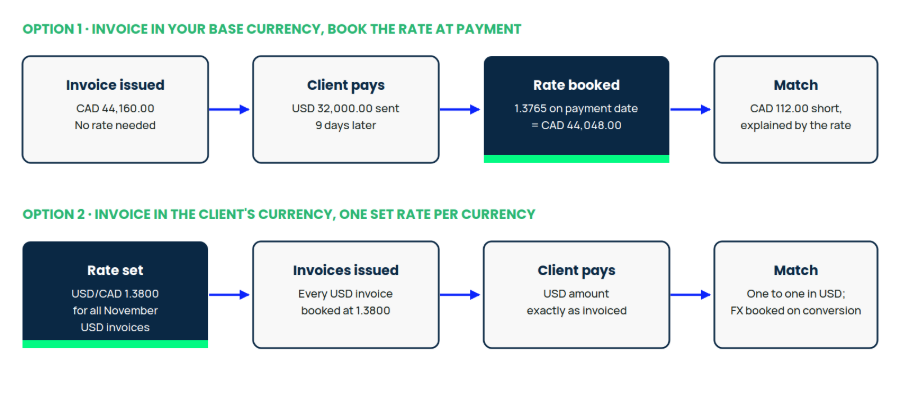
Figure 1. Where the exchange rate is recorded under each option. Figures are illustrative.
Option 1: Invoice in your base currency, book the rate at payment
Here the invoice is in your currency. The Toronto EOR bills its US client CAD 44,160.00. The client chooses to pay from a USD account and sends USD 32,000.00 nine days later, expecting it to cover the invoice.
On the payment date the rate is 1.3765, so the receipt converts to CAD 44,048.00, leaving CAD 112.00 short. The shortfall is easy to explain, but only if the payment-date rate, its source, and the amounts in both currencies are recorded against that invoice.
This option keeps your invoice values fixed and puts rate movement on the client. The cost is that every payment carries its own rate. You need a short-payment rule, such as invoicing the difference next cycle, and a rate record for every single receipt.
Option 2: Invoice in the client’s currency, at one set rate per currency
Here the invoice is in the client’s currency, and you set one rate for all invoices in that currency for a fixed period. The Toronto EOR sets USD/CAD at 1.3800 for November, and every USD invoice that month is booked at that rate.
Matching becomes one to one. A USD 32,000.00 invoice is paid with USD 32,000.00, so the receipt clears the invoice without any rate calculation. Clients also see the same rate on every invoice, which removes most “why did this change?” questions.
The rate difference moves to one place. Say three November USD invoices total USD 59,700.00, and treasury converts them on the 20th at 1.3760. The CAD 238.80 difference is booked once as an FX result for the period, not spread across three invoices.
You carry that movement, so set a rule for when the rate resets: monthly, per payroll cycle, or early if the market moves beyond an agreed band. Write the rule into the client agreement so the set rate is never a surprise.
| Factor | Option 1Base-currency invoice, rate at payment | Option 2Client-currency invoice, set rate |
|---|---|---|
| When the rate is recorded | On each payment date | Once per currency, per period |
| Who carries rate movement | The client | The EOR, between the set rate and conversion |
| Matching effort | Rate lookup and difference on every receipt | One to one in the invoice currency |
| Where differences show up | Short or over payments on individual invoices | One FX result per currency per period |
| Client experience | Final cost unknown until they pay | Same rate on every invoice in the period |
| Best fit | Clients with their own treasury desk | Clients who want one predictable number |
Table 1. The two rate-booking options compared.
The Same Discipline Applies to Payroll Payables
Payroll delivered in a worker’s local currency is a payable with its own exchange rate. Record the executed rate against the payroll run, and link that run to the client invoice that funded it.
When treasury converts CAD into ZAR for a South African payroll, the record should hold the executed rate, the time, the amounts in both currencies, the deal reference, and the payroll run and invoice it relates to.
With that link in place, the question “did we bill enough to cover this payroll?” takes seconds to answer. Without it, someone rebuilds the answer from three exports, usually when a client has already raised it.
Why Every Exchange Belongs in Your System of Record
When every currency exchange is stored in the same system as your invoices and payables, payments align with what they belong to, regardless of when they were transacted or at what rate.
A spreadsheet can hold rates, but it cannot hold the relationships between them. The value comes from the link: this receipt, at this rate, cleared this invoice; this conversion, at this rate, funded this payroll run.
| Record | What to store |
|---|---|
| Rate | Currency pair, rate, source, and date and time taken |
| Amounts | The amount in the transaction currency and in your base currency |
| Links | The invoice, payment, payroll run, or payable the exchange belongs to |
| Differences | Fees, short or over payments, and FX results, each with its cause |
Table 2. The minimum conversion record for receivables and payables.
Whichever booking option you choose, this record is what turns month-end matching into a review rather than a rebuild. It also gives your account managers a clear answer when a client asks how a figure was reached.
How PHRBO Records Currency Exchanges
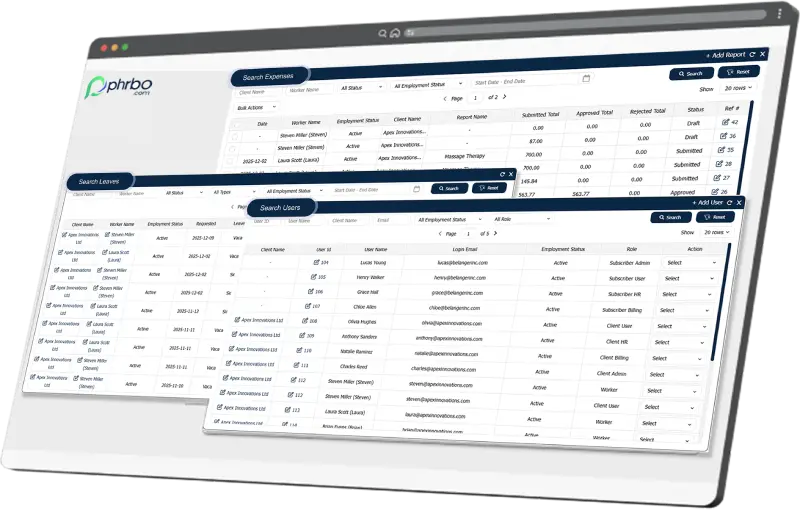
PHRBO’s Invoicing Automation with Multi-currency Support keeps exchange rates inside the same system as your invoices and payables, so payments can be matched without stitching spreadsheets together.
PHRBO is built for EOR, PEO, staffing, and payroll operators, so currency handling sits inside the invoicing and payables workflow rather than in a separate payments tool.
Invoicing Automation with Multi-currency Support. Issues invoices in the billing currency is set as a defalut for each client and records the rate used, so the same rate applies consistently across invoices in that currency.
Reporting and Analytics. Gives finance a per-currency view of invoices, payments, and rate differences, so unexplained balances show up before month-end.
ClientDesk. PHRBO’s client self-service portal lets clients view their invoices and rate detail on their own schedule, which cuts the rate questions landing with account managers.
Billing clients in more than one currency?
See how EOR operators use PHRBO to invoice, collect and reconcile across currencies from one platform.
Frequently Asked Questions
Should an EOR invoice clients in its own currency or the client’s?
It depends on who should carry rate movement. Invoicing in your base currency puts it on the client but means a different rate on every payment. This has the advantage of getting the client to absorb fx fees and eliminates a manual step. However, having a system that embeds the rate to each payment and invoice is really a game changer for this approach. Invoicing in the client’s currency at a set rate makes matching simpler while you carry the currency exchange forward to a future transaction.
What does “booking the rate at payment” mean?
It means converting the client’s payment into your base currency at the exchange rate on the day, at the time it transacts, and recording that rate against the invoice. Any short or over payment is then explained by the rate rather than left unreconciled.
How often should a set invoice rate be updated?
Most operators reset it monthly or per payroll cycle. Add a rule to reset early if the market moves beyond an agreed band, and state the rule in the client agreement.
Why record exchange rates in a system of record instead of a spreadsheet?
A system of record links each rate to the invoice, payment, or payroll run it belongs to. That link is what makes matching quick, whatever date or rate the transaction used.
Conclusion
Currency conversions become hard to track when rates are recorded away from the invoices and payables they belong to. Pick one rate-booking approach per client, record every exchange in your system of record, and matching stops being a monthly investigation.
